Thank you for visiting SNEWPapers!
Sign up free
Letter to Editor
October 10, 1802
The National Intelligencer And Washington Advertiser
Washington, District Of Columbia
What is this article about?
Samuel Knox, a clergyman at Frederick Academy, publicly defends himself against calumnies accusing him of directing the anti-Federalist Hornet newspaper. He asserts his independence of opinion, condemns the Federalist Herald's lies, and cites John Witherspoon to justify clerical involvement in politics.
Clipping
OCR Quality
95%
Excellent
Full Text
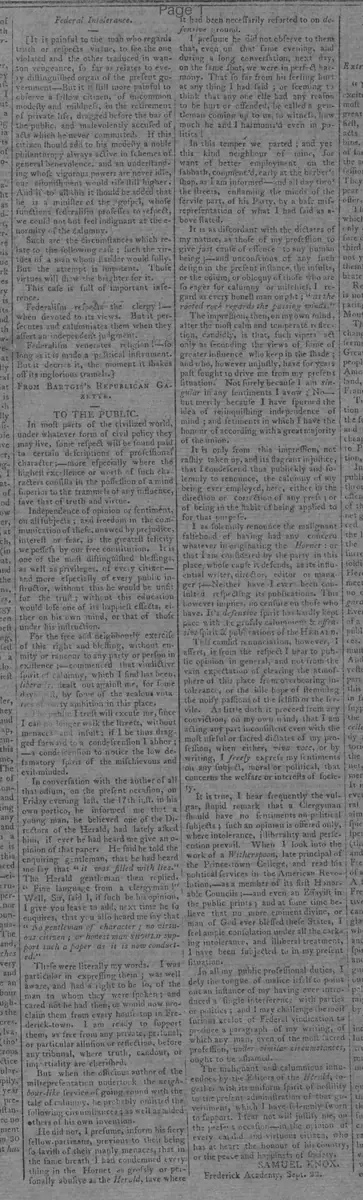
[It is painful to the man who regards truth or respects virtue, to see the one violated and the other traduced in wanton vengeance, so far as relates to every distinguished organ of the present government--But it is still more painful to observe a fellow citizen, of uncommon modesty and mildness, in the retirement of private life, dragged before the bar of the public, and malevolently accused of acts which he never committed. If this citizen should add to his modesty a noble philanthropy always active in schemes of general benevolence, and an understanding whose vigorous powers are never idle, our astonishment would rise still higher. And if to all this it should be added that he is a minister of the gospel, whose functions federalism professes to respect, we could not but feel indignant at the enormity of the calumny.
Such are the circumstances which relate to the following case: such the virtues of a man whom slander would sully. But the attempt is impotent. Those virtues will show the brighter for it.
This case is full of important inference.
Federalism respects the clergy! when devoted to its views. But it persecutes and calumniates them when they assert an independent judgment.
Federalism venerates religion! so long as it is made a political instrument. But it decries it, the moment it shakes off its inglorious trammels.]
From BALTIMORE'S REPUBLICAN GAZETTE.
TO THE PUBLIC.
In most parts of the civilized world, under whatever form of civil policy they may live, one respect will be found paid to certain descriptions of professional character; more especially where the highest excellence or worth of such characters consists in the possession of a mind superior to the trammels of any influence, save that of truth and virtue.
Independence of opinion or sentiment, on all subjects; and freedom in the communication of these, unawed by prejudice, interest or fear, is the greatest felicity we possess by our free constitution. It is one of the most distinguished blessings, as well as privileges, of every citizen and more especially of every public instructor, without this he would be unfit for the trust; without this education would lose one of its happiest effects, either on his own mind, or that of those under his instruction.
For the free and neighbourly exercise of this right and blessing, without enmity or rancour to any party or person in existence;--commenced that vindictive spirit of calumny, which I find has been, liberally, dealt out against me, for some days, by some of the zealous votaries of party ambition in this place.
The public I trust will excuse me, since I can no longer walk the streets, without menaces and insult; if I be thus dragged forward to a condescension I abhor; --a condescension to notice the low defamatory spirit of the mischievous and evil-minded.
In conversation with the author of all that odium, on the present occasion, on Friday evening last, the 17th inst. in his own portico, he informed me that a young man, he believed one of the Directors of the Herald, had lately asked him, if ever he had heard me give an opinion of that paper. He said he told the enquiring gentleman, that he had heard me say that "it was filled with lies."
The Herald gentleman then replied. "Fine language from a clergyman!"
Well, Sir, said I, if such be his opinion, I give you leave to add, next time he enquires, that you also heard me say that "No gentleman of character: no virtuous citizen: or honest man SHOULD support such a paper as it is now conducted."
These were literally my words. I was particular in expressing them; was well aware, and had a right to be so, of the man to whom they were spoken; and cared not he had them, or would now proclaim them from every house-top in Frederick-town. I am ready to support them, as free from any private, personal, or particular allusion or reference, before any tribunal, where truth, candour, or impartiality are cherished.
But when the officious author of the misrepresentation undertook the neighbour-like service of going round with the tale of calumny, he probably omitted the following circumstances; as well as added others of his own invention.
He did not, I presume, inform his very fellow-partisans, previous to their being so lavish of their manly menaces, that in the same breath I had condemned every thing in the Hornet as grossly or personally abusive as the Herald, save where it had been necessarily resorted to on defensive ground.
I presume he did not observe to them that, even on that same evening, and during a long conversation, next day, on the same subject, we were in perfect harmony. That so far from his feeling hurt at any thing I had said; or seeming to think that any one else had any reason to be hurt or offended, he called a gentleman coming up to us, to witness, how much he and I harmonised even in politics!
In this temper we parted; and yet this kind neighbour of mine, for want of better employment on the Sabbath, commenced, early at the barber's shop, as I am informed--and all day thro' the streets, enflaming the minds of the servile part, of his Party, by a base misrepresentation of what I had said as above stated.
It is as discordant with the dictates of my nature, as those of my profession to give just cause of offence to any human being; and unconscious of any such design in the present instance, the insults, or the odium, or obloquy of those who are so eager for calumny or mischief, I regard as every honest man ought; "as the rooted rock regards the passing winds."
The impression, then, on my own mind, after the most calm and temperate reflection, candidly, is that, such vipers' acts only as seconding the views of some of greater influence who keep in the shade; and who, however unjustly, have for years past ought to drive me from my present situation. Not surely because I am singular in any Sentiments I avow; No-- but merely because I have pursued the idea of relinquishing independence of mind; and sentiments in which I have the honour of according with a great majority of the union.
It is only from this impression, not rashly taken up, and its flagrant injustice, that I condescend thus publicly and solemnly to renounce, the calumny of my being ever employed, here, either in the direction or correction of any press; or of being in the habit of being applied to for that purpose.
I as solely renounce the malignant falsehood of having had any concern whatever in originating the Hornet: or that I am considered by the party in this place, whose cause it defends, as its influential writer, director, editor or manager;--Neither have I ever been consulted respecting its publications. This however implies, no censure on those who have. It's defensive spirit has hardly kept pace with the grossly calumniating & offensive spirit & publications of the Herald.
This candid renunciation, however, I assert, is from the respect I bear to public opinion in general, and not from the vain expectation of clearing the atmosphere of this place from overbearing intolerance, or the idle hope of stemming the noisy passions of the selfish or the servile. As little doth it proceed from any conviction, on my own mind, that I am acting any part inconsistent even with the most useful or sacred dictates of my profession, when either, viva voce, or by writing, I freely express my sentiments on any subject, moral or political, that concerns the welfare or interests of society.
It is true, I hear frequently the vulgar, stupid remark that a Clergyman should have no sentiments on political subjects; such an opinion is offered only, where intolerance, illiberality and persecution prevail. When I look into the work of a Witherspoon, late principal of the Prince-town College, and read his political services in the American Revolution,--as a member of its first Honourable Councils;--and even an Essayist in the public prints; and at some time believe that no more eminent divine, or man of God ever blessed these States, I feel ample consolation under all the carking intolerance, and illiberal treatment, I have been subjected to in my present situation.
In all my public professional duties, I defy the tongue of malice itself to point out an instance of my having ever introduced a single interference with parties or politics; and I may challenge the most furious zealot of Federal vindication to produce a paragraph of my writing, of which any man, even of the most sacred profession, under similar circumstances, ought to be ashamed.
The malignant and calumnious innuendoes by the Editors of the Herald, together with its uniform spirit of hostility to the present administration of that government, which I have solemnly Sworn to support, I fear not will justify me, on the present occasion--in the opinion of every candid and virtuous citizen, who has at heart the honour of his country, or the peace and happiness of society.
SAMUEL KNOX.
Frederick Academy, Sept. 22.
Such are the circumstances which relate to the following case: such the virtues of a man whom slander would sully. But the attempt is impotent. Those virtues will show the brighter for it.
This case is full of important inference.
Federalism respects the clergy! when devoted to its views. But it persecutes and calumniates them when they assert an independent judgment.
Federalism venerates religion! so long as it is made a political instrument. But it decries it, the moment it shakes off its inglorious trammels.]
From BALTIMORE'S REPUBLICAN GAZETTE.
TO THE PUBLIC.
In most parts of the civilized world, under whatever form of civil policy they may live, one respect will be found paid to certain descriptions of professional character; more especially where the highest excellence or worth of such characters consists in the possession of a mind superior to the trammels of any influence, save that of truth and virtue.
Independence of opinion or sentiment, on all subjects; and freedom in the communication of these, unawed by prejudice, interest or fear, is the greatest felicity we possess by our free constitution. It is one of the most distinguished blessings, as well as privileges, of every citizen and more especially of every public instructor, without this he would be unfit for the trust; without this education would lose one of its happiest effects, either on his own mind, or that of those under his instruction.
For the free and neighbourly exercise of this right and blessing, without enmity or rancour to any party or person in existence;--commenced that vindictive spirit of calumny, which I find has been, liberally, dealt out against me, for some days, by some of the zealous votaries of party ambition in this place.
The public I trust will excuse me, since I can no longer walk the streets, without menaces and insult; if I be thus dragged forward to a condescension I abhor; --a condescension to notice the low defamatory spirit of the mischievous and evil-minded.
In conversation with the author of all that odium, on the present occasion, on Friday evening last, the 17th inst. in his own portico, he informed me that a young man, he believed one of the Directors of the Herald, had lately asked him, if ever he had heard me give an opinion of that paper. He said he told the enquiring gentleman, that he had heard me say that "it was filled with lies."
The Herald gentleman then replied. "Fine language from a clergyman!"
Well, Sir, said I, if such be his opinion, I give you leave to add, next time he enquires, that you also heard me say that "No gentleman of character: no virtuous citizen: or honest man SHOULD support such a paper as it is now conducted."
These were literally my words. I was particular in expressing them; was well aware, and had a right to be so, of the man to whom they were spoken; and cared not he had them, or would now proclaim them from every house-top in Frederick-town. I am ready to support them, as free from any private, personal, or particular allusion or reference, before any tribunal, where truth, candour, or impartiality are cherished.
But when the officious author of the misrepresentation undertook the neighbour-like service of going round with the tale of calumny, he probably omitted the following circumstances; as well as added others of his own invention.
He did not, I presume, inform his very fellow-partisans, previous to their being so lavish of their manly menaces, that in the same breath I had condemned every thing in the Hornet as grossly or personally abusive as the Herald, save where it had been necessarily resorted to on defensive ground.
I presume he did not observe to them that, even on that same evening, and during a long conversation, next day, on the same subject, we were in perfect harmony. That so far from his feeling hurt at any thing I had said; or seeming to think that any one else had any reason to be hurt or offended, he called a gentleman coming up to us, to witness, how much he and I harmonised even in politics!
In this temper we parted; and yet this kind neighbour of mine, for want of better employment on the Sabbath, commenced, early at the barber's shop, as I am informed--and all day thro' the streets, enflaming the minds of the servile part, of his Party, by a base misrepresentation of what I had said as above stated.
It is as discordant with the dictates of my nature, as those of my profession to give just cause of offence to any human being; and unconscious of any such design in the present instance, the insults, or the odium, or obloquy of those who are so eager for calumny or mischief, I regard as every honest man ought; "as the rooted rock regards the passing winds."
The impression, then, on my own mind, after the most calm and temperate reflection, candidly, is that, such vipers' acts only as seconding the views of some of greater influence who keep in the shade; and who, however unjustly, have for years past ought to drive me from my present situation. Not surely because I am singular in any Sentiments I avow; No-- but merely because I have pursued the idea of relinquishing independence of mind; and sentiments in which I have the honour of according with a great majority of the union.
It is only from this impression, not rashly taken up, and its flagrant injustice, that I condescend thus publicly and solemnly to renounce, the calumny of my being ever employed, here, either in the direction or correction of any press; or of being in the habit of being applied to for that purpose.
I as solely renounce the malignant falsehood of having had any concern whatever in originating the Hornet: or that I am considered by the party in this place, whose cause it defends, as its influential writer, director, editor or manager;--Neither have I ever been consulted respecting its publications. This however implies, no censure on those who have. It's defensive spirit has hardly kept pace with the grossly calumniating & offensive spirit & publications of the Herald.
This candid renunciation, however, I assert, is from the respect I bear to public opinion in general, and not from the vain expectation of clearing the atmosphere of this place from overbearing intolerance, or the idle hope of stemming the noisy passions of the selfish or the servile. As little doth it proceed from any conviction, on my own mind, that I am acting any part inconsistent even with the most useful or sacred dictates of my profession, when either, viva voce, or by writing, I freely express my sentiments on any subject, moral or political, that concerns the welfare or interests of society.
It is true, I hear frequently the vulgar, stupid remark that a Clergyman should have no sentiments on political subjects; such an opinion is offered only, where intolerance, illiberality and persecution prevail. When I look into the work of a Witherspoon, late principal of the Prince-town College, and read his political services in the American Revolution,--as a member of its first Honourable Councils;--and even an Essayist in the public prints; and at some time believe that no more eminent divine, or man of God ever blessed these States, I feel ample consolation under all the carking intolerance, and illiberal treatment, I have been subjected to in my present situation.
In all my public professional duties, I defy the tongue of malice itself to point out an instance of my having ever introduced a single interference with parties or politics; and I may challenge the most furious zealot of Federal vindication to produce a paragraph of my writing, of which any man, even of the most sacred profession, under similar circumstances, ought to be ashamed.
The malignant and calumnious innuendoes by the Editors of the Herald, together with its uniform spirit of hostility to the present administration of that government, which I have solemnly Sworn to support, I fear not will justify me, on the present occasion--in the opinion of every candid and virtuous citizen, who has at heart the honour of his country, or the peace and happiness of society.
SAMUEL KNOX.
Frederick Academy, Sept. 22.
What sub-type of article is it?
Persuasive
Political
Ethical Moral
What themes does it cover?
Politics
Press Freedom
Religion
What keywords are associated?
Calumny
Clergyman Politics
Federalist Herald
Hornet Newspaper
Press Freedom
Independent Opinion
Witherspoon
Frederick Academy
What entities or persons were involved?
Samuel Knox
To The Public
Letter to Editor Details
Author
Samuel Knox
Recipient
To The Public
Main Argument
samuel knox denies involvement in directing or writing for the hornet newspaper and defends his right as a clergyman to express independent political opinions critical of the federalist herald, citing historical precedent like witherspoon.
Notable Details
Conversation On Friday Evening Last, The 17th Inst.
Condemns Herald As Filled With Lies
References John Witherspoon's Political Involvement
Renounces Any Role In The Hornet