Thank you for visiting SNEWPapers!
Sign up free
Literary
May 26, 1864
Southern Christian Advocate
Charleston, Charleston County, South Carolina
What is this article about?
In a diligence traveling from Amsterdam, the narrator and Mr. Sybrand discuss an inheritance in Deventer. Sybrand teases a talkative merchant from Amersfort by repeatedly interrupting him with the topic, highlighting how only the heir (the narrator) finds it engaging. The merchant laments hard times in business.
Clipping
OCR Quality
95%
Excellent
Full Text
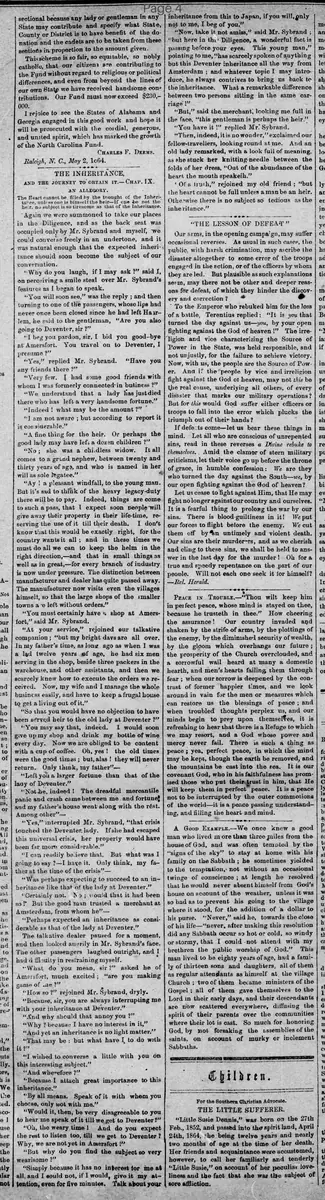
THE INHERITANCE,
AND THE JOURNEY TO OBTAIN IT.-CHAP.IX.
AN ALLEGORY.
The Heart cannot be filled by the thought of the Inheritance, unless one is himself the heir-If one be not the heir, no subject is so tiresome as that of the Inheritance.
'Again we were summoned to take our places in the Diligence, and as the back seat was occupied only by Mr. Sybrand and myself, we could converse freely in an undertone, and it was natural enough that the expected inheritance should soon become the subject of our conversation.
Why do you laugh, if I may ask ?" said I, on perceiving a smile steal over Mr. Sybrand's features as I began to speak.
"You will soon see," was the reply ; and then turning to one of the passengers, whose lips had never once been closed since he had left Haarlem, he said to the gentleman, "Are you also going to Deventer, sir ?"
I beg you pardon, sir, I bid you good-bye at Amersfort. You travel on to Deventer, I presume ?"
"Yes." replied Mr. Sybrand. "Have you any friends there ?"
"Very few. I had some good friends with whom I was formerly connected in business ?"
"We understand that a lady has just died there who has left a very handsome fortune."
"Indeed ! what may be the amount ?"
"I am not aware ; but according to report it is considerable."
"A fine thing for the heir. Or perhaps the good lady may have left a dozen children ?"
"No; she was a childless widow. It all comes to a grand nephew, between twenty and thirty years of age, and who is named in her will as sole legatee."
"Ay ! a pleasant windfall, to the young man. But it's sad to think of the heavy legacy-duty there will be to pay. Indeed, things are come to such a pass, that I expect soon people will give away their property in their life-time, reserving the use of it till their death. I don't know that this would be exactly right, for the country wants it all; and in these times we must do all we can to keep the helm in the right direction,-and that in small things as well as in great,-for every branch of industry is now under pressure. The distinction between manufacturer and dealer has quite passed away.
The manufacturer now visits even the villages himself, so that the large shops of the smaller towns are left without orders."
"You must certainly have shop at Amersfort." said Mr. Sybrand.
"At your service," rejoined our talkative companion; "but my bright days are all over. In my father's time, as long ago as when I was a lad twelve years of age, he had six men serving in the shop, beside three packers in the warehouse, and other assistants, and then we scarcely knew how to execute the orders we received. Now, my wife and I manage the whole business easily, and have to keep a frugal house to get a living out of it."
"So that you would have no objection to have been served heir to the old lady at Deventer ?"
"You may say that, indeed. I would soon give up my shop and drink my bottle of wine every day. Now we are obliged to be content with a cup of coffee. Oh, yes ! the old times were the good times; but, alas ! they will never return.. Only think, my father"-
"Left you a larger fortune than that of the lady of Deventer."
"Not so. indeed I The dreadful mercantile panic and crash came between me and fortune! and my father's house went along with the rest.
Among other"-
"Yes," interrupted Mr. Sybrand, "that crisis touched the Deventer. lady. If she had escaped this universal crisis, her property would have been far more considerable."
"I can readily believe that. But what was I going to say ?-I have it. Only think, my father at the time of the crisis"-
"Was perhaps expecting to succeed to an inheritance like that of the lady at Deventer."
Certainly not. No ; would that it had been so! But the good man trusted a merchant at Amsterdam, from whom he"-
"Perhaps expected an inheritance as considerable as that of the lady at Deventer."
The talkative dealer paused for a moment. and then looked angrily in Mr. Sybrand's face.
The other passengers laughed outright, and I had difficulty in restraining myself.
What do you mean, sir?" asked he of Amersfort, much excited; "are you making game of me ?"
"How so ?" rejoined Mr. Sybrand, dryly.
"Because, sir, you are always interrupting me with your inheritance at Deventer."
"And why should that annoy you ?"
"Why ? because I have no interest in it,"
"And yet an inheritance is no light matter."
"That may be : but what have I to do with it?"
"I wished to converse a little with you on this interesting subject."
"And wherefore ?"
"Because I attach great importance to this inheritance."
"By all means. Speak of it with whom you choose, only not with me."
"Would it, then, be very disagreeable to you to hear me speak of it till we get to Deventer?"
"Oh, the weary time I And do you expect the rest to listen too, till we get to Deventer ?
Why, we are not yet in Amersfort !"
"But why do you find the subject so very wearisome?"
"Simply because it has no interest for me at all, and I could not, if I would, give it my attention, even for five minutes. Talk about your inheritance from this to Japan, if you will, only not to me, I beg of you."
"Now, take it not amiss," said Mr. Sybrand; "but here in this Diligence, a wonderful fact is passing before your eyes. This young man," pointing to me, "has scarcely spoken of anything but this Deventer inheritance all the way from Amsterdam ; and whatever topic I may introduce, he always contrives to bring us back to the inheritance. What a remarkable difference between two persons sitting in the same carriage !"
"But," said the merchant, looking me full in the face, "this gentleman is perhaps the heir."
"You have it !" replied Mr. Sybrand.
"Then, indeed, it is no wonder." exclaimed our fellow-travellers, looking round at me. And an old lady remarked, with a look full of meaning as she stuck her knitting-needle between the folds of her dress, "Out of the abundance of the heart the mouth speaketh."
'Of a truth," rejoined my old friend; "but the heart cannot be full unless a man be an heir. Otherwise there is no subject so tedious as the inheritance."
AND THE JOURNEY TO OBTAIN IT.-CHAP.IX.
AN ALLEGORY.
The Heart cannot be filled by the thought of the Inheritance, unless one is himself the heir-If one be not the heir, no subject is so tiresome as that of the Inheritance.
'Again we were summoned to take our places in the Diligence, and as the back seat was occupied only by Mr. Sybrand and myself, we could converse freely in an undertone, and it was natural enough that the expected inheritance should soon become the subject of our conversation.
Why do you laugh, if I may ask ?" said I, on perceiving a smile steal over Mr. Sybrand's features as I began to speak.
"You will soon see," was the reply ; and then turning to one of the passengers, whose lips had never once been closed since he had left Haarlem, he said to the gentleman, "Are you also going to Deventer, sir ?"
I beg you pardon, sir, I bid you good-bye at Amersfort. You travel on to Deventer, I presume ?"
"Yes." replied Mr. Sybrand. "Have you any friends there ?"
"Very few. I had some good friends with whom I was formerly connected in business ?"
"We understand that a lady has just died there who has left a very handsome fortune."
"Indeed ! what may be the amount ?"
"I am not aware ; but according to report it is considerable."
"A fine thing for the heir. Or perhaps the good lady may have left a dozen children ?"
"No; she was a childless widow. It all comes to a grand nephew, between twenty and thirty years of age, and who is named in her will as sole legatee."
"Ay ! a pleasant windfall, to the young man. But it's sad to think of the heavy legacy-duty there will be to pay. Indeed, things are come to such a pass, that I expect soon people will give away their property in their life-time, reserving the use of it till their death. I don't know that this would be exactly right, for the country wants it all; and in these times we must do all we can to keep the helm in the right direction,-and that in small things as well as in great,-for every branch of industry is now under pressure. The distinction between manufacturer and dealer has quite passed away.
The manufacturer now visits even the villages himself, so that the large shops of the smaller towns are left without orders."
"You must certainly have shop at Amersfort." said Mr. Sybrand.
"At your service," rejoined our talkative companion; "but my bright days are all over. In my father's time, as long ago as when I was a lad twelve years of age, he had six men serving in the shop, beside three packers in the warehouse, and other assistants, and then we scarcely knew how to execute the orders we received. Now, my wife and I manage the whole business easily, and have to keep a frugal house to get a living out of it."
"So that you would have no objection to have been served heir to the old lady at Deventer ?"
"You may say that, indeed. I would soon give up my shop and drink my bottle of wine every day. Now we are obliged to be content with a cup of coffee. Oh, yes ! the old times were the good times; but, alas ! they will never return.. Only think, my father"-
"Left you a larger fortune than that of the lady of Deventer."
"Not so. indeed I The dreadful mercantile panic and crash came between me and fortune! and my father's house went along with the rest.
Among other"-
"Yes," interrupted Mr. Sybrand, "that crisis touched the Deventer. lady. If she had escaped this universal crisis, her property would have been far more considerable."
"I can readily believe that. But what was I going to say ?-I have it. Only think, my father at the time of the crisis"-
"Was perhaps expecting to succeed to an inheritance like that of the lady at Deventer."
Certainly not. No ; would that it had been so! But the good man trusted a merchant at Amsterdam, from whom he"-
"Perhaps expected an inheritance as considerable as that of the lady at Deventer."
The talkative dealer paused for a moment. and then looked angrily in Mr. Sybrand's face.
The other passengers laughed outright, and I had difficulty in restraining myself.
What do you mean, sir?" asked he of Amersfort, much excited; "are you making game of me ?"
"How so ?" rejoined Mr. Sybrand, dryly.
"Because, sir, you are always interrupting me with your inheritance at Deventer."
"And why should that annoy you ?"
"Why ? because I have no interest in it,"
"And yet an inheritance is no light matter."
"That may be : but what have I to do with it?"
"I wished to converse a little with you on this interesting subject."
"And wherefore ?"
"Because I attach great importance to this inheritance."
"By all means. Speak of it with whom you choose, only not with me."
"Would it, then, be very disagreeable to you to hear me speak of it till we get to Deventer?"
"Oh, the weary time I And do you expect the rest to listen too, till we get to Deventer ?
Why, we are not yet in Amersfort !"
"But why do you find the subject so very wearisome?"
"Simply because it has no interest for me at all, and I could not, if I would, give it my attention, even for five minutes. Talk about your inheritance from this to Japan, if you will, only not to me, I beg of you."
"Now, take it not amiss," said Mr. Sybrand; "but here in this Diligence, a wonderful fact is passing before your eyes. This young man," pointing to me, "has scarcely spoken of anything but this Deventer inheritance all the way from Amsterdam ; and whatever topic I may introduce, he always contrives to bring us back to the inheritance. What a remarkable difference between two persons sitting in the same carriage !"
"But," said the merchant, looking me full in the face, "this gentleman is perhaps the heir."
"You have it !" replied Mr. Sybrand.
"Then, indeed, it is no wonder." exclaimed our fellow-travellers, looking round at me. And an old lady remarked, with a look full of meaning as she stuck her knitting-needle between the folds of her dress, "Out of the abundance of the heart the mouth speaketh."
'Of a truth," rejoined my old friend; "but the heart cannot be full unless a man be an heir. Otherwise there is no subject so tedious as the inheritance."
What sub-type of article is it?
Allegory
Prose Fiction
What themes does it cover?
Commerce Trade
Moral Virtue
Taxation Oppression
What keywords are associated?
Inheritance
Heir
Diligence
Deventer
Business Crisis
Legacy Duty
Moral Lesson
Literary Details
Title
The Inheritance, And The Journey To Obtain It. Chap.Ix. An Allegory.
Key Lines
The Heart Cannot Be Filled By The Thought Of The Inheritance, Unless One Is Himself The Heir If One Be Not The Heir, No Subject Is So Tiresome As That Of The Inheritance.
Out Of The Abundance Of The Heart The Mouth Speaketh.
But The Heart Cannot Be Full Unless A Man Be An Heir. Otherwise There Is No Subject So Tedious As The Inheritance.