Thank you for visiting SNEWPapers!
Sign up free
Litchfield Enquirer
Litchfield, Litchfield County, Connecticut
What is this article about?
On May 6, a meeting in London chaired by Earl Fitzwilliam raised funds for a statue to Duke of Wellington commemorating the Catholic Relief Bill. Poet Moore delivered a speech praising Wellington's role in Irish pacification, leading to a resolution for the statue with inscriptions of Catholic advocates.
Clipping
OCR Quality
Full Text
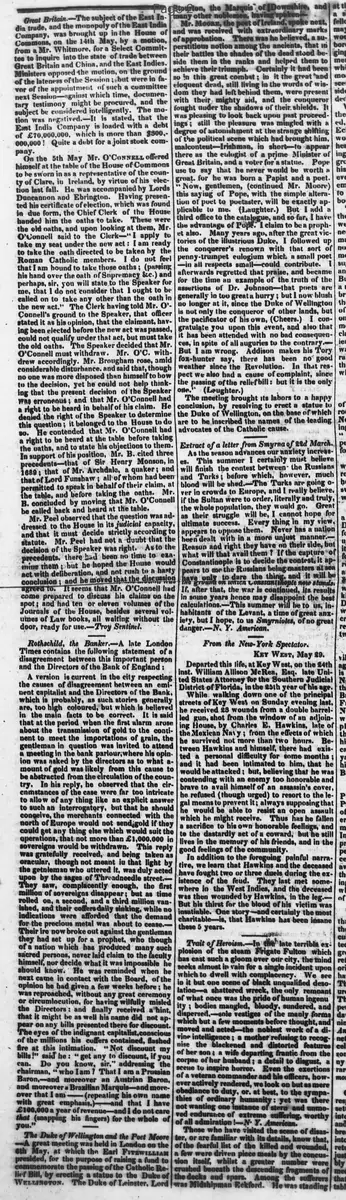
A great meeting was held in London on the 6th May, at which the Earl Fitzwilliam presided, for the purpose of raising a fund to commemorate the passing of the Catholic Relief Bill, by erecting a statue to the Duke of Wellington. The Duke of Leinster, Lord many other noblemen, having spoken Mr. Moore, the poet of Ireland, spoke next, and was received with extraordinary marks of approbation. There was he believed, a superstitious notion among the ancients, that in their battles the shades of the dead stood beside them in the ranks and helped them to achieve their triumph. Certainly it had been so in this great combat; in it the great and eloquent dead, still living in the words of wisdom they had left behind them, were present with their mighty aid, and the conqueror fought under the shadows of their shields. It was pleasing to look back upon past proceedings; still the pleasure was mingled with a degree of astonishment at the strange shifting of the political scene which had brought him, malcontent-Irishman, in short to appear there as the eulogist of a prime Minister of Great Britain, and a voter for a statue. Pope use to say that he never would be worth a groat, for he was born a Papist and a poet. "Now, gentlemen, (continued Mr. Moore) this saying of Pope, with the simple alteration of poet to poetaster, will be exactly applicable to me. (Laughter.) But I add a third office to the catalogue, and so far I have the advantage of Pope. I claim to be a prophet also. Many years ago, after the great victories of the illustrious Duke, I followed up the conqueror's renown with that sort of penny-trumpet eulogium which a small poet—in all respects small—could contribute. I afterwards regretted that praise, and became for the time an example of the truth of the assertions of Dr. Johnson that poets are generally in too great a hurry; but I now blush no longer at it, since the Duke of Wellington is not only the conqueror of other lands, but the pacifier of his own, (Cheers.) I congratulate you upon this event, and also that it has been attended with no bad consequences, in spite of all auguries to the contrary.—But I am wrong. Addison makes his Tory fox-hunter say, there has been no good weather since the Revolution. In that respect we also had a cause of complaint, since the passing of the relief bill: but it is the only one." (Laughter.) The meeting brought its labors to a happy conclusion, by resolving to erect a statue to the Duke of Wellington, on the base of which are to be inscribed the names of the leading advocates of the Catholic cause.
What sub-type of article is it?
What keywords are associated?
What entities or persons were involved?
Where did it happen?
Foreign News Details
Primary Location
London
Event Date
6th May
Key Persons
Outcome
the meeting resolved to erect a statue to the duke of wellington, on the base of which are to be inscribed the names of the leading advocates of the catholic cause.
Event Details
A great meeting was held in London on the 6th May, presided over by the Earl Fitzwilliam, to raise funds for a statue commemorating the Catholic Relief Bill by honoring the Duke of Wellington. The Duke of Leinster, Lord and other noblemen spoke, followed by Mr. Moore, the poet of Ireland, who delivered a speech praising Wellington as the pacifier of his own land and reflecting on past political shifts.