Thank you for visiting SNEWPapers!
Sign up free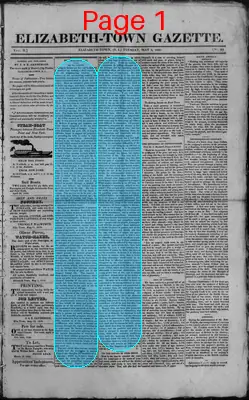
Literary
May 2, 1820
Elizabeth Town Gazette
Elizabeth, Union County, New Jersey
What is this article about?
A reflective essay describes an autumn walk through valleys and hills as an allegory for life's journey, from youthful uniformity to the challenges of passions, old age, and the need for early repentance and piety to attain virtue.
Clipping
OCR Quality
95%
Excellent
Full Text
MISCELLANEOUS.
FOR THE GAZETTE.
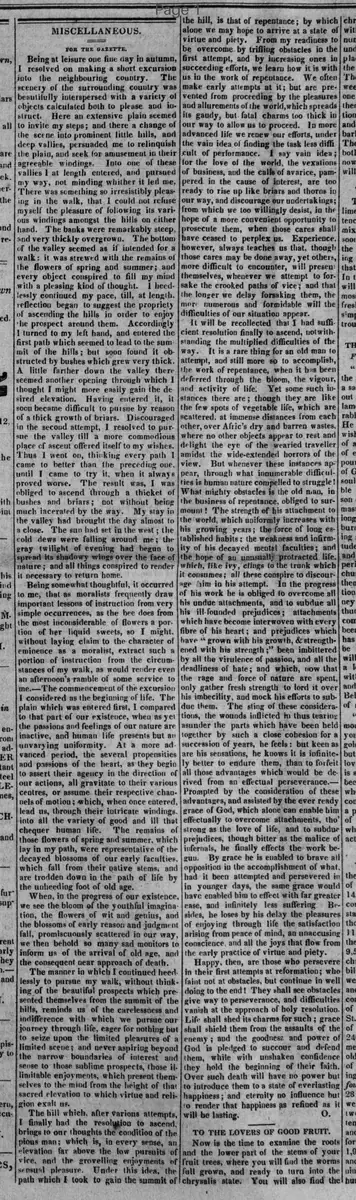
Being at leisure one fine day in autumn, I resolved on making a short excursion into the neighbouring country. The scenery of the surrounding country was beautifully interspersed with a variety of objects calculated both to please and instruct. Here an extensive plain seemed to invite my steps; and there a change of the scene into prominent little hills, and deep vallies, persuaded me to relinquish the plain, and seek for amusement in their agreeable windings. Into one of these vallies I at length entered, and pursued my way, not minding whither it led me. There was something so irresistibly pleasing in the walk, that I could not refuse myself the pleasure of following its various windings amongst the hills on either hand. The banks were remarkably steep and very thickly overgrown. The bottom of the valley seemed as if intended for a walk: it was strewed with the remains of the flowers of spring and summer; and every object conspired to fill my mind with a pleasing kind of thought. I heedlessly continued my pace, till, at length, reflection began to suggest the propriety of ascending the hills in order to enjoy the prospect around them. Accordingly I turned to my left hand, and entered the first path which seemed to lead to the summit of the hills; but soon found it obstructed by bushes which grew very thick. A little farther down the valley there seemed another opening through which I thought I might more easily gain the desired elevation. Having entered it, it soon became difficult to pursue by reason of a thick growth of briars. Discouraged in the second attempt, I resolved to pursue the valley till a more commodious place of ascent offered itself to my wishes. Thus I went on, thinking every path I came to better than the preceding one, until I came to try it, when it always proved worse. The result was, I was obliged to ascend through a thicket of bushes and briars; not without being much lacerated by the way. My stay in the valley had brought the day almost to a close. The sun had set in the west; the cold dews were falling around me; the gray twilight of evening had begun to spread its shadowy wings over the face of nature; and all things conspired to render it necessary to return home. Being somewhat thoughtful, it occurred to me, that as moralists frequently draw important lessons of instruction from very simple occurrences, as the bee does from the most inconsiderable of flowers a portion of her liquid sweets, so I might, without laying claim to the character of eminence as a moralist, extract such a portion of instruction from the circumstances of my walk, as would render even an afternoon's ramble of some service to me.— The commencement of the excursion I considered as the beginning of life. The plain which was entered first, I compared to that part of our existence, when as yet the passions and feelings of our nature are inactive, and human life presents but an unvarying uniformity. At a more advanced period, the several propensities and passions of the heart, as they begin to assert their agency in the direction of our actions, all gravitate to their various centres, or assume their respective channels of motion; which, when once entered, lead us, through their intricate windings, into all the variety of good and ill that chequer human life. The remains of those flowers of spring and summer, which lay in my path, were representative of the decayed blossoms of our early faculties, which fall from their native stems, and are trodden down in the path of life by the unheeding foot of old age. When, in the progress of our existence, we see the bloom of the youthful imagination, the flowers of wit and genius, and the blossoms of early reason and judgment fall, promiscuously scattered in our way, we then behold so many sad monitors to inform us of the arrival of old age, and the consequent near approach of death. The manner in which I continued heedlessly to pursue my walk, without thinking of the beautiful prospects which presented themselves from the summit of the hills, reminds us of the carelessness and indifference with which we pursue our journey through life, eager for nothing but to seize upon the limited pleasures of a limited scene; and never aspiring beyond the narrow boundaries of interest and sense to those sublime prospects, those illimitable enjoyments, which present themselves to the mind from the height of that sacred elevation to which virtue and religion exalt us. The hill which, after various attempts, I finally had the resolution to ascend, brings to our thoughts the condition of the pious man; which is, in every sense, an elevation far above the low pursuits of vice, and the grovelling enjoyments of sensual pleasure. Under this idea, the path which I took to gain the summit of the hill, is that of repentance; by which alone we may hope to arrive at a state of virtue and piety. From my readiness to be overcome by trifling obstacles in the first attempt, and by increasing ones in succeeding efforts, we learn how it is with us in the work of repentance. We often make early attempts at it; but are prevented from proceeding by the pleasures and allurements of the world, which spreads its gaudy, but fatal charms too thick in our way to allow us to proceed. In more advanced life we renew our efforts, under the vain idea of finding the task less difficult of performance. I say vain idea; for the love of the world, the vexations of business, and the calls of avarice, pampered in the cause of interest, are too ready to rise up like briars and thorns in our way, and discourage our undertakings; from which we too willingly desist, in the hope of a more convenient opportunity to prosecute them, when those cares shall have ceased to perplex us. Experience, however, always teaches us that, though those cares may be done away, yet others, more difficult to encounter, will present themselves, whenever we attempt to forsake the crooked paths of vice: and that the longer we delay forsaking them, the more numerous and formidable will the difficulties of our situation appear. It will be recollected that I had sufficient resolution finally to ascend, notwithstanding the multiplied difficulties of the way. It is a rare thing for an old man to attempt, and still more so to accomplish, the work of repentance, when it has been deferred through the bloom, the vigour, and activity of life. Yet some such instances there are; though they are like the few spots of vegetable life, which are scattered, at immense distances from each other, over Afric's dry and barren wastes, where no other objects appear to rest and delight the eye of the wearied traveller amidst the wide-extended horrors of the view. But whenever these instances appear, through what innumerable difficulties is human nature compelled to struggle! What mighty obstacles is the old man, in the business of repentance, obliged to surmount! The strength of his attachment to the world, which uniformly increases with his growing years; the force of long established habits; the weakness and infirmity of his decayed mental faculties; and the hope of an unusually protracted life, which, like ivy, clings to the trunk which it consumes; all these conspire to discourage him in his attempt. In the progress of his work he is obliged to overcome all his undue attachments, and to subdue all his ill-founded prejudices; attachments which have become interwoven with every fibre of his heart; and prejudices which have "grown with his growth, & strengthened with his strength;" been embittered by all the virulence of passion, and all the deadliness of hate; and which, now that the rage and force of nature are spent, only gather fresh strength to lord it over his imbecility, and mock his efforts to subdue them. The sting of these considerations, the wounds inflicted in thus tearing asunder the parts which have been held together by such a close cohesion for a succession of years, he feels: but keen as are his sensations, he knows it is infinitely better to endure them, than to forfeit all those advantages which would be derived from an effectual perseverance.— Prompted by the consideration of these advantages, and assisted by the ever ready grace of God, which alone can enable him effectually to overcome attachments, though strong as the love of life, and to subdue prejudices, though bitter as the malice of infernals, he finally effects the work begun. By grace he is enabled to brave all opposition in the accomplishment of what, had it been attempted and persevered in in younger days, the same grace would have enabled him to effect with far greater ease, and infinitely less suffering. Besides, he loses by his delay the pleasures of enjoying through life the satisfaction arising from peace of mind, an unaccusing conscience, and all the joys that flow from the early practice of virtue and piety. Happy, then, are those who persevere in their first attempts at reformation; who faint not at obstacles, but continue in well doing to the end! They shall see obstacles give way to perseverance, and difficulties vanish at the approach of holy resolution. Life shall shed its charms for such; grace shall shield them from the assaults of the enemy; and the goodness and power of God is pledged to succour and defend them, while with unshaken confidence they hold the beginning of their faith. Over such death will have no power but to introduce them to a state of everlasting happiness; and eternity no influence but to render that happiness as refined as it will be lasting.
O.
FOR THE GAZETTE.
Being at leisure one fine day in autumn, I resolved on making a short excursion into the neighbouring country. The scenery of the surrounding country was beautifully interspersed with a variety of objects calculated both to please and instruct. Here an extensive plain seemed to invite my steps; and there a change of the scene into prominent little hills, and deep vallies, persuaded me to relinquish the plain, and seek for amusement in their agreeable windings. Into one of these vallies I at length entered, and pursued my way, not minding whither it led me. There was something so irresistibly pleasing in the walk, that I could not refuse myself the pleasure of following its various windings amongst the hills on either hand. The banks were remarkably steep and very thickly overgrown. The bottom of the valley seemed as if intended for a walk: it was strewed with the remains of the flowers of spring and summer; and every object conspired to fill my mind with a pleasing kind of thought. I heedlessly continued my pace, till, at length, reflection began to suggest the propriety of ascending the hills in order to enjoy the prospect around them. Accordingly I turned to my left hand, and entered the first path which seemed to lead to the summit of the hills; but soon found it obstructed by bushes which grew very thick. A little farther down the valley there seemed another opening through which I thought I might more easily gain the desired elevation. Having entered it, it soon became difficult to pursue by reason of a thick growth of briars. Discouraged in the second attempt, I resolved to pursue the valley till a more commodious place of ascent offered itself to my wishes. Thus I went on, thinking every path I came to better than the preceding one, until I came to try it, when it always proved worse. The result was, I was obliged to ascend through a thicket of bushes and briars; not without being much lacerated by the way. My stay in the valley had brought the day almost to a close. The sun had set in the west; the cold dews were falling around me; the gray twilight of evening had begun to spread its shadowy wings over the face of nature; and all things conspired to render it necessary to return home. Being somewhat thoughtful, it occurred to me, that as moralists frequently draw important lessons of instruction from very simple occurrences, as the bee does from the most inconsiderable of flowers a portion of her liquid sweets, so I might, without laying claim to the character of eminence as a moralist, extract such a portion of instruction from the circumstances of my walk, as would render even an afternoon's ramble of some service to me.— The commencement of the excursion I considered as the beginning of life. The plain which was entered first, I compared to that part of our existence, when as yet the passions and feelings of our nature are inactive, and human life presents but an unvarying uniformity. At a more advanced period, the several propensities and passions of the heart, as they begin to assert their agency in the direction of our actions, all gravitate to their various centres, or assume their respective channels of motion; which, when once entered, lead us, through their intricate windings, into all the variety of good and ill that chequer human life. The remains of those flowers of spring and summer, which lay in my path, were representative of the decayed blossoms of our early faculties, which fall from their native stems, and are trodden down in the path of life by the unheeding foot of old age. When, in the progress of our existence, we see the bloom of the youthful imagination, the flowers of wit and genius, and the blossoms of early reason and judgment fall, promiscuously scattered in our way, we then behold so many sad monitors to inform us of the arrival of old age, and the consequent near approach of death. The manner in which I continued heedlessly to pursue my walk, without thinking of the beautiful prospects which presented themselves from the summit of the hills, reminds us of the carelessness and indifference with which we pursue our journey through life, eager for nothing but to seize upon the limited pleasures of a limited scene; and never aspiring beyond the narrow boundaries of interest and sense to those sublime prospects, those illimitable enjoyments, which present themselves to the mind from the height of that sacred elevation to which virtue and religion exalt us. The hill which, after various attempts, I finally had the resolution to ascend, brings to our thoughts the condition of the pious man; which is, in every sense, an elevation far above the low pursuits of vice, and the grovelling enjoyments of sensual pleasure. Under this idea, the path which I took to gain the summit of the hill, is that of repentance; by which alone we may hope to arrive at a state of virtue and piety. From my readiness to be overcome by trifling obstacles in the first attempt, and by increasing ones in succeeding efforts, we learn how it is with us in the work of repentance. We often make early attempts at it; but are prevented from proceeding by the pleasures and allurements of the world, which spreads its gaudy, but fatal charms too thick in our way to allow us to proceed. In more advanced life we renew our efforts, under the vain idea of finding the task less difficult of performance. I say vain idea; for the love of the world, the vexations of business, and the calls of avarice, pampered in the cause of interest, are too ready to rise up like briars and thorns in our way, and discourage our undertakings; from which we too willingly desist, in the hope of a more convenient opportunity to prosecute them, when those cares shall have ceased to perplex us. Experience, however, always teaches us that, though those cares may be done away, yet others, more difficult to encounter, will present themselves, whenever we attempt to forsake the crooked paths of vice: and that the longer we delay forsaking them, the more numerous and formidable will the difficulties of our situation appear. It will be recollected that I had sufficient resolution finally to ascend, notwithstanding the multiplied difficulties of the way. It is a rare thing for an old man to attempt, and still more so to accomplish, the work of repentance, when it has been deferred through the bloom, the vigour, and activity of life. Yet some such instances there are; though they are like the few spots of vegetable life, which are scattered, at immense distances from each other, over Afric's dry and barren wastes, where no other objects appear to rest and delight the eye of the wearied traveller amidst the wide-extended horrors of the view. But whenever these instances appear, through what innumerable difficulties is human nature compelled to struggle! What mighty obstacles is the old man, in the business of repentance, obliged to surmount! The strength of his attachment to the world, which uniformly increases with his growing years; the force of long established habits; the weakness and infirmity of his decayed mental faculties; and the hope of an unusually protracted life, which, like ivy, clings to the trunk which it consumes; all these conspire to discourage him in his attempt. In the progress of his work he is obliged to overcome all his undue attachments, and to subdue all his ill-founded prejudices; attachments which have become interwoven with every fibre of his heart; and prejudices which have "grown with his growth, & strengthened with his strength;" been embittered by all the virulence of passion, and all the deadliness of hate; and which, now that the rage and force of nature are spent, only gather fresh strength to lord it over his imbecility, and mock his efforts to subdue them. The sting of these considerations, the wounds inflicted in thus tearing asunder the parts which have been held together by such a close cohesion for a succession of years, he feels: but keen as are his sensations, he knows it is infinitely better to endure them, than to forfeit all those advantages which would be derived from an effectual perseverance.— Prompted by the consideration of these advantages, and assisted by the ever ready grace of God, which alone can enable him effectually to overcome attachments, though strong as the love of life, and to subdue prejudices, though bitter as the malice of infernals, he finally effects the work begun. By grace he is enabled to brave all opposition in the accomplishment of what, had it been attempted and persevered in in younger days, the same grace would have enabled him to effect with far greater ease, and infinitely less suffering. Besides, he loses by his delay the pleasures of enjoying through life the satisfaction arising from peace of mind, an unaccusing conscience, and all the joys that flow from the early practice of virtue and piety. Happy, then, are those who persevere in their first attempts at reformation; who faint not at obstacles, but continue in well doing to the end! They shall see obstacles give way to perseverance, and difficulties vanish at the approach of holy resolution. Life shall shed its charms for such; grace shall shield them from the assaults of the enemy; and the goodness and power of God is pledged to succour and defend them, while with unshaken confidence they hold the beginning of their faith. Over such death will have no power but to introduce them to a state of everlasting happiness; and eternity no influence but to render that happiness as refined as it will be lasting.
O.
What sub-type of article is it?
Essay
Allegory
What themes does it cover?
Moral Virtue
Religious
Death Mortality
What keywords are associated?
Moral Essay
Life Journey
Repentance
Piety
Old Age
Virtue
Grace Of God
What entities or persons were involved?
O.
Literary Details
Author
O.
Subject
Moral Lessons Drawn From An Autumn Walk Analogized To The Journey Of Life And Repentance
Key Lines
The Commencement Of The Excursion I Considered As The Beginning Of Life.
The Hill Which, After Various Attempts, I Finally Had The Resolution To Ascend, Brings To Our Thoughts The Condition Of The Pious Man; Which Is, In Every Sense, An Elevation Far Above The Low Pursuits Of Vice, And The Grovelling Enjoyments Of Sensual Pleasure.
It Is A Rare Thing For An Old Man To Attempt, And Still More So To Accomplish, The Work Of Repentance, When It Has Been Deferred Through The Bloom, The Vigour, And Activity Of Life.
Happy, Then, Are Those Who Persevere In Their First Attempts At Reformation; Who Faint Not At Obstacles, But Continue In Well Doing To The End!