Thank you for visiting SNEWPapers!
Sign up free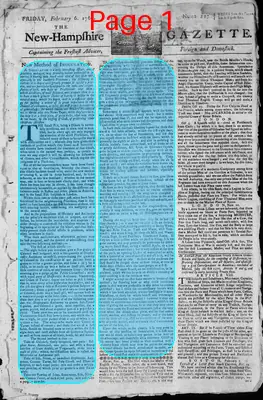
Story
February 6, 1761
The New Hampshire Gazette
Portsmouth, Rockingham County, New Hampshire
What is this article about?
An 18th-century article promotes a new method of smallpox inoculation using mercury and antimony preparations, detailing dosages and care instructions to reduce mortality, especially in American colonies where usage is increasing.
Clipping
OCR Quality
95%
Excellent
Full Text
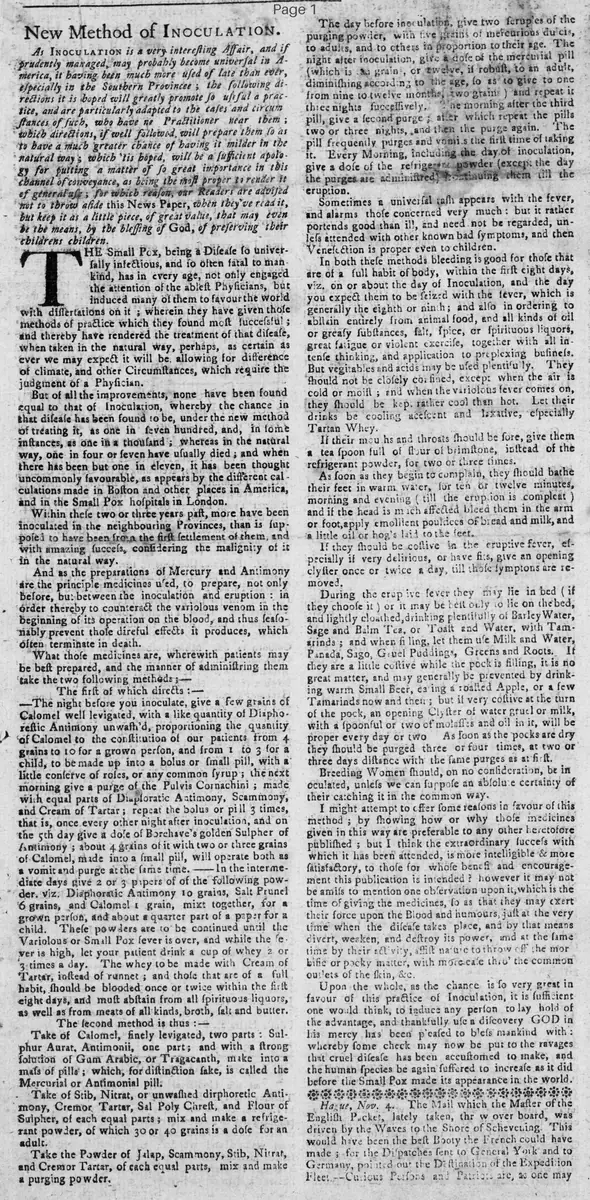
New Method of Inoculation.
As Inoculation is a very interesting Affair, and if Prudently managed may probably become universal in America, it having been much more used of late than ever, especially in the Southern Provinces; the following directions it is hoped will greatly promote so useful a practice, and are particularly adapted to the cases and circumstances of such who have no Practitioner near them; with directions, if well followed, will prepare them so as to have a much greater chance of having it milder in the natural way which 'tis hoped will be a sufficient apology for putting a matter of so great importance in this channel of conveyance, as being the most proper to render it of general use; for which reason, our Readers are advised not to throw aside this News Paper, when they have read it, but keep it as a little piece of great value, that may even be the means, by the blessing of God, of preserving their childrens children.
The Small Pox, being a Disease so universally infectious, and so often fatal to mankind, has in every age, not only engaged the attention of the ablest Physicians, but induced many of them to favour the world with dissertations on it; wherein they have given those methods of practice which they found most successful; and thereby have rendered the treatment of that disease, when taken in the natural way, perhaps, as certain as ever we may expect it will be, allowing for difference of climate, and other Circumstances, which require the judgment of a Physician.
But of all the improvements, none have been found equal to that of Inoculation, whereby the chance in that disease has been found to be, under the new method of treating it, as one in every hundred, and, in some instances, as one in a thousand; whereas in the natural way, one in four or seven have usually died; and when there has been but one in eleven, it has been thought uncommonly favourable, as appears by the different calculations made in Boston and other places in America, and in the Small Pox hospitals in London.
Within these two or three years past, more have been inoculated in the neighbouring Provinces, than is supposed to have been from the first settlement of them, and with amazing success, considering the malignity of it in the natural way.
And as the preparations of Mercury and Antimony are the principal medicines used, to prepare, not only before, but between the inoculation and eruption: in order thereby to counteract the variolous venom in the beginning of its operation on the blood, and thus reasonably prevent those direful effects it produces, which often terminate in death.
What those medicines are, wherewith patients may be best prepared, and the manner of administering them take the two following methods:—
The first of which directs:—
The night before you inoculate, give a few grains of Calomel well levigated, with a like quantity of Diaphoretic Antimony unwashed, proportioning the quantity of Calomel to the constitution of your patients from 4 grains to 10 for a grown person, and from 1 to 3 for a child, to be made up into a bolus or small pill, with a little conserve of roses, or any common syrup; the next morning give a purge of the Pulvis Cornachini; made with equal parts of Diaphoretic Antimony, Scammony, and Cream of Tartar; repeat the bolus or pill 3 times, that is, once every other night after inoculation, and on the 5th day give a dose of Boerhaave's golden Sulphur of Antimony; about 4 grains of it with two or three grains of Calomel, made into a small pill, will operate both as a vomit and purge at the same time.—In the intermediate days give 2 or 3 papers of the following powder. Viz. Diaphoretic Antimony 10 grains, Salt Prunel 6 grains, and Calomel 1 grain, mixt together, for a grown person, and about a quarter part of a paper for a child. These powders are to be continued until the Variolous or Small Pox fever is over, and while the fever is high, let your patient drink a cup of whey 2 or 3 times a day. The whey to be made with Cream of Tartar, instead of rennet; and those that are of a full habit, should be blooded once or twice within the first eight days, and must abstain from all spirituous liquors, as well as from meats of all kinds, broth, salt and butter.
The second method is thus:—
Take of Calomel, finely levigated, two parts: Sulphur Aurat. Antimonii, one part; and with a strong Solution of Gum Arabic or Tragacanth, make into a mass of pills; which, for distinction sake, is called the Mercurial or Antimonial pill.
Take of Stib. Nitrat. or unwashed diaphoretic Antimony, Cremor Tartar, Sal Poly Chret, and Flour of Sulphur, of each equal parts; mix and make a refrigerant powder, of which 30 or 40 grains is a dose for an adult.
Take the Powder of Jalap, Scammony, Stib. Nitrat, and Cremor Tartar, of each equal parts, mix and make a purging powder.
The day before inoculation, give two scruples of the purging powder, with five grains of mercurius dulcis, to adults, and to others in proportion to their age. The night after inoculation, give a dose of the mercurial pill (which is 8 grains, or twelve, if robust, to an adult, diminishing according to the age, so as to give to one from nine to twelve months, two grains) and repeat it three nights successively. The morning after the third pill, give a second purge: after which repeat the pills two or three nights, and then the purge again. The pill frequently purges and vomits the first time of taking it. Every Morning, including the day of inoculation, give a dose of the refrigerant powder (except the day the purges are administered) continuing them till the eruption.
Sometimes a universal rash appears with the fever, and alarms those concerned very much: but it rather portends good than ill, and need not be regarded, unless attended with other known bad symptoms, and then Venesection is proper even to children.
In both these methods bleeding is good for those that are of a full habit of body, within the first eight days, viz. on or about the day of Inoculation, and the day you expect them to be seized with the fever, which is generally the eighth or ninth; and also in order to abstain entirely from animal food, and all kinds of oil or greasy substances, salt, spice, or spirituous liquors, great fatigue or violent exercise, together with all intense thinking, and application to perplexing business.
But vegetables and acids may be used plentifully. They should not be closely confined, except when the air is cold or moist; and when the variolous fever comes on, they should be kept rather cool than hot. Let their drinks be cooling, acescent and laxative, especially Tartar Whey.
If their mouths and throats should be sore, give them a tea spoon full of flour of brimstone, instead of the refrigerant powder, for two or three times.
As soon as they begin to complain, they should bathe their feet in warm water, for ten or twelve minutes, morning and evening (till the eruption is compleat) and if the head is much affected bleed them in the arm or foot, apply emollient poultices of bread and milk, and a little oil or hog's lard to the feet.
If they should be costive in the eruptive fever, especially if very delirious, or have fits, give an opening clyster once or twice a day, till those symptoms are removed.
During the eruptive fever they may lie in bed (if they choose it) or it may be best only to lie on the bed, and lightly clothed, drinking plentifully of Barley Water, Sage and Balm Tea, or Toast and Water, with Tamarinds; and when sitting, let them use Milk and Water, Panada, Sago, Gruel Puddings, Greens and Roots. If they are a little costive while the pock is filling, it is no great matter, and may generally be prevented by drinking warm Small Beer, eating a roasted Apple, or a few Tamarinds now and then; but if very costive at the turn of the pock, an opening Clyster of water gruel or milk, with a spoonful or two of molasses and oil in it, will be proper every day or two As soon as the pocks are dry they should be purged three or four times, at two or three days distance with the same purges as at first.
Breeding Women should, on no consideration, be inoculated, unless we can suppose an absolute certainty of their catching it in the common way.
I might attempt to offer some reasons in favour of this method; by showing how or why those medicines given in this way are preferable to any other heretofore published; but I think the extraordinary success with which it has been attended, is more intelligible & more satisfactory, to those for whose benefit and encouragement this publication is intended; however it may not be amiss to mention one observation upon it, which is the time of giving the medicines, so as that they may exert their force upon the Blood and humours, just at the very time when the disease takes place, and by that means divert, weaken, and destroy its power, and at the same time by their activity, assist nature to throw off the morbific or pocky matter, with more ease thro' the common outlets of the skin, &c.
Upon the whole, as the chance is so very great in favour of this practice of Inoculation, it is sufficient one would think, to induce any person to lay hold of the advantage, and thankfully use a discovery GOD in his mercy has been pleased to bless mankind with: whereby some check may now be put to the ravages that cruel disease has been accustomed to make, and the human species be again suffered to increase as it did before this Small Pox made its appearance in the world.
As Inoculation is a very interesting Affair, and if Prudently managed may probably become universal in America, it having been much more used of late than ever, especially in the Southern Provinces; the following directions it is hoped will greatly promote so useful a practice, and are particularly adapted to the cases and circumstances of such who have no Practitioner near them; with directions, if well followed, will prepare them so as to have a much greater chance of having it milder in the natural way which 'tis hoped will be a sufficient apology for putting a matter of so great importance in this channel of conveyance, as being the most proper to render it of general use; for which reason, our Readers are advised not to throw aside this News Paper, when they have read it, but keep it as a little piece of great value, that may even be the means, by the blessing of God, of preserving their childrens children.
The Small Pox, being a Disease so universally infectious, and so often fatal to mankind, has in every age, not only engaged the attention of the ablest Physicians, but induced many of them to favour the world with dissertations on it; wherein they have given those methods of practice which they found most successful; and thereby have rendered the treatment of that disease, when taken in the natural way, perhaps, as certain as ever we may expect it will be, allowing for difference of climate, and other Circumstances, which require the judgment of a Physician.
But of all the improvements, none have been found equal to that of Inoculation, whereby the chance in that disease has been found to be, under the new method of treating it, as one in every hundred, and, in some instances, as one in a thousand; whereas in the natural way, one in four or seven have usually died; and when there has been but one in eleven, it has been thought uncommonly favourable, as appears by the different calculations made in Boston and other places in America, and in the Small Pox hospitals in London.
Within these two or three years past, more have been inoculated in the neighbouring Provinces, than is supposed to have been from the first settlement of them, and with amazing success, considering the malignity of it in the natural way.
And as the preparations of Mercury and Antimony are the principal medicines used, to prepare, not only before, but between the inoculation and eruption: in order thereby to counteract the variolous venom in the beginning of its operation on the blood, and thus reasonably prevent those direful effects it produces, which often terminate in death.
What those medicines are, wherewith patients may be best prepared, and the manner of administering them take the two following methods:—
The first of which directs:—
The night before you inoculate, give a few grains of Calomel well levigated, with a like quantity of Diaphoretic Antimony unwashed, proportioning the quantity of Calomel to the constitution of your patients from 4 grains to 10 for a grown person, and from 1 to 3 for a child, to be made up into a bolus or small pill, with a little conserve of roses, or any common syrup; the next morning give a purge of the Pulvis Cornachini; made with equal parts of Diaphoretic Antimony, Scammony, and Cream of Tartar; repeat the bolus or pill 3 times, that is, once every other night after inoculation, and on the 5th day give a dose of Boerhaave's golden Sulphur of Antimony; about 4 grains of it with two or three grains of Calomel, made into a small pill, will operate both as a vomit and purge at the same time.—In the intermediate days give 2 or 3 papers of the following powder. Viz. Diaphoretic Antimony 10 grains, Salt Prunel 6 grains, and Calomel 1 grain, mixt together, for a grown person, and about a quarter part of a paper for a child. These powders are to be continued until the Variolous or Small Pox fever is over, and while the fever is high, let your patient drink a cup of whey 2 or 3 times a day. The whey to be made with Cream of Tartar, instead of rennet; and those that are of a full habit, should be blooded once or twice within the first eight days, and must abstain from all spirituous liquors, as well as from meats of all kinds, broth, salt and butter.
The second method is thus:—
Take of Calomel, finely levigated, two parts: Sulphur Aurat. Antimonii, one part; and with a strong Solution of Gum Arabic or Tragacanth, make into a mass of pills; which, for distinction sake, is called the Mercurial or Antimonial pill.
Take of Stib. Nitrat. or unwashed diaphoretic Antimony, Cremor Tartar, Sal Poly Chret, and Flour of Sulphur, of each equal parts; mix and make a refrigerant powder, of which 30 or 40 grains is a dose for an adult.
Take the Powder of Jalap, Scammony, Stib. Nitrat, and Cremor Tartar, of each equal parts, mix and make a purging powder.
The day before inoculation, give two scruples of the purging powder, with five grains of mercurius dulcis, to adults, and to others in proportion to their age. The night after inoculation, give a dose of the mercurial pill (which is 8 grains, or twelve, if robust, to an adult, diminishing according to the age, so as to give to one from nine to twelve months, two grains) and repeat it three nights successively. The morning after the third pill, give a second purge: after which repeat the pills two or three nights, and then the purge again. The pill frequently purges and vomits the first time of taking it. Every Morning, including the day of inoculation, give a dose of the refrigerant powder (except the day the purges are administered) continuing them till the eruption.
Sometimes a universal rash appears with the fever, and alarms those concerned very much: but it rather portends good than ill, and need not be regarded, unless attended with other known bad symptoms, and then Venesection is proper even to children.
In both these methods bleeding is good for those that are of a full habit of body, within the first eight days, viz. on or about the day of Inoculation, and the day you expect them to be seized with the fever, which is generally the eighth or ninth; and also in order to abstain entirely from animal food, and all kinds of oil or greasy substances, salt, spice, or spirituous liquors, great fatigue or violent exercise, together with all intense thinking, and application to perplexing business.
But vegetables and acids may be used plentifully. They should not be closely confined, except when the air is cold or moist; and when the variolous fever comes on, they should be kept rather cool than hot. Let their drinks be cooling, acescent and laxative, especially Tartar Whey.
If their mouths and throats should be sore, give them a tea spoon full of flour of brimstone, instead of the refrigerant powder, for two or three times.
As soon as they begin to complain, they should bathe their feet in warm water, for ten or twelve minutes, morning and evening (till the eruption is compleat) and if the head is much affected bleed them in the arm or foot, apply emollient poultices of bread and milk, and a little oil or hog's lard to the feet.
If they should be costive in the eruptive fever, especially if very delirious, or have fits, give an opening clyster once or twice a day, till those symptoms are removed.
During the eruptive fever they may lie in bed (if they choose it) or it may be best only to lie on the bed, and lightly clothed, drinking plentifully of Barley Water, Sage and Balm Tea, or Toast and Water, with Tamarinds; and when sitting, let them use Milk and Water, Panada, Sago, Gruel Puddings, Greens and Roots. If they are a little costive while the pock is filling, it is no great matter, and may generally be prevented by drinking warm Small Beer, eating a roasted Apple, or a few Tamarinds now and then; but if very costive at the turn of the pock, an opening Clyster of water gruel or milk, with a spoonful or two of molasses and oil in it, will be proper every day or two As soon as the pocks are dry they should be purged three or four times, at two or three days distance with the same purges as at first.
Breeding Women should, on no consideration, be inoculated, unless we can suppose an absolute certainty of their catching it in the common way.
I might attempt to offer some reasons in favour of this method; by showing how or why those medicines given in this way are preferable to any other heretofore published; but I think the extraordinary success with which it has been attended, is more intelligible & more satisfactory, to those for whose benefit and encouragement this publication is intended; however it may not be amiss to mention one observation upon it, which is the time of giving the medicines, so as that they may exert their force upon the Blood and humours, just at the very time when the disease takes place, and by that means divert, weaken, and destroy its power, and at the same time by their activity, assist nature to throw off the morbific or pocky matter, with more ease thro' the common outlets of the skin, &c.
Upon the whole, as the chance is so very great in favour of this practice of Inoculation, it is sufficient one would think, to induce any person to lay hold of the advantage, and thankfully use a discovery GOD in his mercy has been pleased to bless mankind with: whereby some check may now be put to the ravages that cruel disease has been accustomed to make, and the human species be again suffered to increase as it did before this Small Pox made its appearance in the world.
What sub-type of article is it?
Medical Curiosity
Curiosity
What themes does it cover?
Recovery
Providence Divine
Triumph
What keywords are associated?
Smallpox Inoculation
Medical Preparation
Mercury Antimony
Colonial Medicine
Patient Care
Disease Prevention
Where did it happen?
America, Southern Provinces, Boston
Story Details
Location
America, Southern Provinces, Boston
Event Date
Within These Two Or Three Years Past
Story Details
Detailed instructions for preparing patients with mercury and antimony-based medicines before and after smallpox inoculation to mitigate symptoms and reduce mortality, emphasizing dietary restrictions, bleeding, and post-eruption care, with warnings against inoculating pregnant women.