Thank you for visiting SNEWPapers!
Sign up free
Literary
November 17, 1849
The North Carolinian
Fayetteville, Cumberland County, North Carolina
What is this article about?
Dr. Oliver Wendell Holmes, as chairman, delivers a witty, satirical report on judging a ploughing match in Berkshire, Mass., highlighting the importance of practical rural knowledge and poking fun at urban visitors' ignorance of farming.
Clipping
OCR Quality
95%
Excellent
Full Text
A POET'S AGRICULTURAL REPORT.
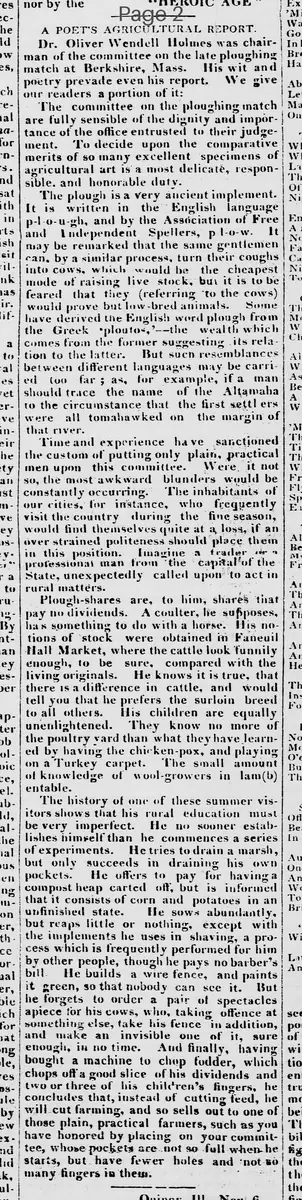
Dr. Oliver Wendell Holmes was chairman of the committee on the late ploughing match at Berkshire, Mass. His wit and poetry pervade even his report. We give our readers a portion of it:
The committee on the ploughing match are fully sensible of the dignity and importance of the office entrusted to their judgment. To decide upon the comparative merits of so many excellent specimens of agricultural art is a most delicate, responsible, and honorable duty.
The plough is a very ancient implement. It is written in the English language p-l-o-u-g-h, and by the Association of Free and Independent Spellers, p-l-o-w. It may be remarked that the same gentlemen can, by a similar process, turn their coughs into cows, which would be the cheapest mode of raising live stock, but it is to be feared that they (referring to the cows) would prove but low-bred animals. Some have derived the English word plough from the Greek ploutos,—the wealth which comes from the former suggesting its relation to the latter. But such resemblances between different languages may be carried too far; as, for example, if a man should trace the name of the Altamaha to the circumstance that the first settlers were all tomahawked on the margin of that river.
Time and experience have sanctioned the custom of putting only plain, practical men upon this committee. Were it not so, the most awkward blunders would be constantly occurring.
The inhabitants of our cities, for instance, who frequently visit the country during the fine season, would find themselves quite at a loss, if an over-strained politeness should place them in this position. Imagine a trader or a professional man from the capital of the State, unexpectedly called upon to act in rural matters. Plough-shares are, to him, shares that pay no dividends. A coulter, he supposes, has something to do with a horse. His notions of stock were obtained in Faneuil Hall Market, where the cattle look funnily enough, to be sure, compared with the living originals. He knows it is true, that there is a difference in cattle, and would tell you that he prefers the sirloin breed to all others. His children are equally unenlightened. They know no more of the poultry yard than what they have learned by having the chicken-pox, and playing on a Turkey carpet. The small amount of knowledge of wool-growers in lam(b) entable.
The history of one of these summer visitors shows that his rural education must be very imperfect. He no sooner establishes himself than he commences a series of experiments. He tries to drain a marsh, but only succeeds in draining his own pockets. He offers to pay for having a compost heap carted off, but is informed that it consists of corn and potatoes in an unfinished state. He sows abundantly, but reaps little or nothing, except with the implements he uses in shaving, a process which is frequently performed for him by other people, though he pays no barber's bill. He builds a wire fence, and paints it green, so that nobody can see it. But he forgets to order a pair of spectacles apiece for his cows, who, taking offence at something else, take his fence in addition, and make an invisible one of it, sure enough, in no time. And finally, having bought a machine to chop fodder, which chops off a good slice of his dividends and two or three of his children's fingers, he concludes that, instead of cutting feed, he will cut farming, and so sells out to one of those plain, practical farmers, such as you have honored by placing on your committee, whose pockets are not so full when he starts, but have fewer holes and not so many fingers in them.
Dr. Oliver Wendell Holmes was chairman of the committee on the late ploughing match at Berkshire, Mass. His wit and poetry pervade even his report. We give our readers a portion of it:
The committee on the ploughing match are fully sensible of the dignity and importance of the office entrusted to their judgment. To decide upon the comparative merits of so many excellent specimens of agricultural art is a most delicate, responsible, and honorable duty.
The plough is a very ancient implement. It is written in the English language p-l-o-u-g-h, and by the Association of Free and Independent Spellers, p-l-o-w. It may be remarked that the same gentlemen can, by a similar process, turn their coughs into cows, which would be the cheapest mode of raising live stock, but it is to be feared that they (referring to the cows) would prove but low-bred animals. Some have derived the English word plough from the Greek ploutos,—the wealth which comes from the former suggesting its relation to the latter. But such resemblances between different languages may be carried too far; as, for example, if a man should trace the name of the Altamaha to the circumstance that the first settlers were all tomahawked on the margin of that river.
Time and experience have sanctioned the custom of putting only plain, practical men upon this committee. Were it not so, the most awkward blunders would be constantly occurring.
The inhabitants of our cities, for instance, who frequently visit the country during the fine season, would find themselves quite at a loss, if an over-strained politeness should place them in this position. Imagine a trader or a professional man from the capital of the State, unexpectedly called upon to act in rural matters. Plough-shares are, to him, shares that pay no dividends. A coulter, he supposes, has something to do with a horse. His notions of stock were obtained in Faneuil Hall Market, where the cattle look funnily enough, to be sure, compared with the living originals. He knows it is true, that there is a difference in cattle, and would tell you that he prefers the sirloin breed to all others. His children are equally unenlightened. They know no more of the poultry yard than what they have learned by having the chicken-pox, and playing on a Turkey carpet. The small amount of knowledge of wool-growers in lam(b) entable.
The history of one of these summer visitors shows that his rural education must be very imperfect. He no sooner establishes himself than he commences a series of experiments. He tries to drain a marsh, but only succeeds in draining his own pockets. He offers to pay for having a compost heap carted off, but is informed that it consists of corn and potatoes in an unfinished state. He sows abundantly, but reaps little or nothing, except with the implements he uses in shaving, a process which is frequently performed for him by other people, though he pays no barber's bill. He builds a wire fence, and paints it green, so that nobody can see it. But he forgets to order a pair of spectacles apiece for his cows, who, taking offence at something else, take his fence in addition, and make an invisible one of it, sure enough, in no time. And finally, having bought a machine to chop fodder, which chops off a good slice of his dividends and two or three of his children's fingers, he concludes that, instead of cutting feed, he will cut farming, and so sells out to one of those plain, practical farmers, such as you have honored by placing on your committee, whose pockets are not so full when he starts, but have fewer holes and not so many fingers in them.
What sub-type of article is it?
Essay
Satire
What themes does it cover?
Agriculture Rural
Social Manners
What keywords are associated?
Ploughing Match
Agricultural Report
Rural Life
Urban Ignorance
Farming Satire
Practical Farmers
What entities or persons were involved?
Dr. Oliver Wendell Holmes
Literary Details
Title
A Poet's Agricultural Report.
Author
Dr. Oliver Wendell Holmes
Subject
Report On The Ploughing Match At Berkshire, Mass.
Form / Style
Witty Prose Report
Key Lines
The Plough Is A Very Ancient Implement. It Is Written In The English Language P L O U G H, And By The Association Of Free And Independent Spellers, P L O W.
Plough Shares Are, To Him, Shares That Pay No Dividends. A Coulter, He Supposes, Has Something To Do With A Horse.
He Tries To Drain A Marsh, But Only Succeeds In Draining His Own Pockets.
He Builds A Wire Fence, And Paints It Green, So That Nobody Can See It.
Having Bought A Machine To Chop Fodder, Which Chops Off A Good Slice Of His Dividends And Two Or Three Of His Children's Fingers