Thank you for visiting SNEWPapers!
Sign up free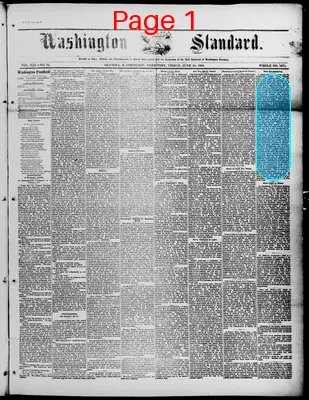
Literary
June 24, 1881
Washington Standard
Olympia, Thurston County, Washington
What is this article about?
An essay advocating for genuine neatness and cleanliness in housekeeping as a moral virtue and health necessity. It praises a woman who cleans cellars before guests arrive and quotes a housekeeper preferring visible dirt over hidden filth. Emphasizes that true order cannot be faked and distinguishes disorder from untidiness. By E. W. B. in New York Post.
Clipping
OCR Quality
95%
Excellent
Full Text
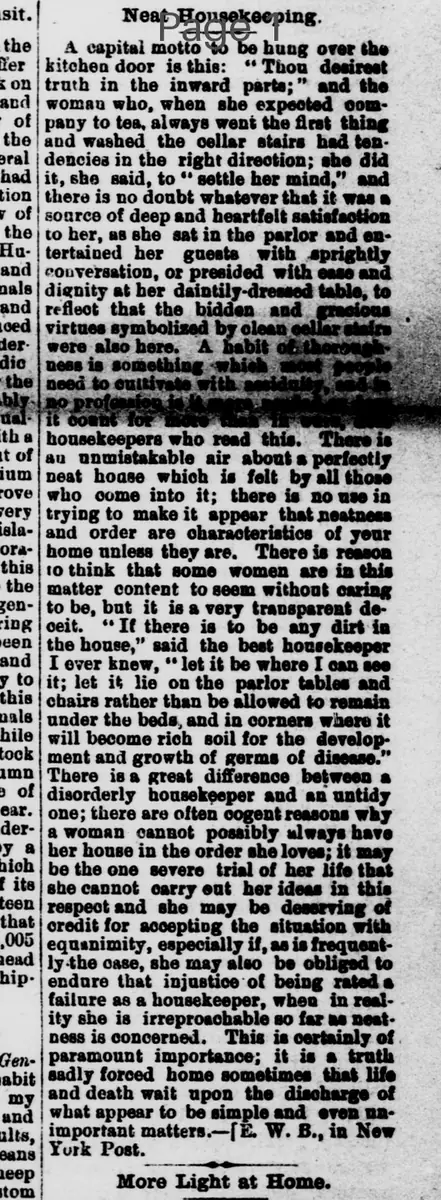
A capital motto to be hung over the kitchen door is this: "Thou desirest truth in the inward parts;" and the woman who, when she expected company to tea, always went the first thing and washed the cellar stairs had tendencies in the right direction: she did it, she said, to "settle her mind," and there is no doubt whatever that it was a source of deep and heartfelt satisfaction to her, as she sat in the parlor and entertained her guests with sprightly conversation, or presided with ease and dignity at her daintily-dressed table, to reflect that the hidden and precious virtues symbolized by clean cellars were also here. A habit of neatness is something which we need to cultivate with no pretense; it costs no more than its opposite, and is within the reach of all housekeepers who read this. There is an unmistakable air about a perfectly neat house which is felt by all those who come into it; there is no use in trying to make it appear that neatness and order are characteristics of your home unless they are. There is reason to think that some women are in this matter content to seem without caring to be, but it is a very transparent deceit. "If there is to be any dirt in the house," said the best housekeeper I ever knew, "let it be where I can see it; let it lie on the parlor tables and chairs rather than be allowed to remain under the beds, and in corners where it will become rich soil for the development and growth of germs of disease."
There is a great difference between a disorderly housekeeper and an untidy one; there are often cogent reasons why a woman cannot possibly always have her house in the order she loves; it may be the one severe trial of her life that she cannot carry out her ideas in this respect and she may be deserving of credit for accepting the situation with equanimity, especially if, as is frequently—the case, she may also be obliged to endure that injustice of being rated a failure as a housekeeper, when in reality she is irreproachable so far as neatness is concerned. This is certainly of paramount importance; it is a truth sadly forced home sometimes that life and death wait upon the discharge of what appear to be simple and even unimportant matters.—[E. W. B., in New York Post.
There is a great difference between a disorderly housekeeper and an untidy one; there are often cogent reasons why a woman cannot possibly always have her house in the order she loves; it may be the one severe trial of her life that she cannot carry out her ideas in this respect and she may be deserving of credit for accepting the situation with equanimity, especially if, as is frequently—the case, she may also be obliged to endure that injustice of being rated a failure as a housekeeper, when in reality she is irreproachable so far as neatness is concerned. This is certainly of paramount importance; it is a truth sadly forced home sometimes that life and death wait upon the discharge of what appear to be simple and even unimportant matters.—[E. W. B., in New York Post.
What sub-type of article is it?
Essay
What themes does it cover?
Moral Virtue
Social Manners
What keywords are associated?
Housekeeping
Neatness
Cleanliness
Moral Virtue
Domestic Advice
Health Hygiene
What entities or persons were involved?
E. W. B., In New York Post
Literary Details
Author
E. W. B., In New York Post
Subject
On The Importance Of Neatness And Cleanliness In Housekeeping
Key Lines
"Thou Desirest Truth In The Inward Parts;"
"If There Is To Be Any Dirt In The House," Said The Best Housekeeper I Ever Knew, "Let It Be Where I Can See It; Let It Lie On The Parlor Tables And Chairs Rather Than Be Allowed To Remain Under The Beds, And In Corners Where It Will Become Rich Soil For The Development And Growth Of Germs Of Disease."