Thank you for visiting SNEWPapers!
Sign up free
Daily National Intelligencer
Washington, District Of Columbia
What is this article about?
Article praises Commodore Perry's eulogy of Kentucky volunteers' bravery and humanity in Harrison's 1813 expedition, highlighting their conquest through arms and mercy, Indian submission, and contrast with federalist views, emphasizing western patriotism during War of 1812.
Clipping
OCR Quality
Full Text
From the Albany Argus.
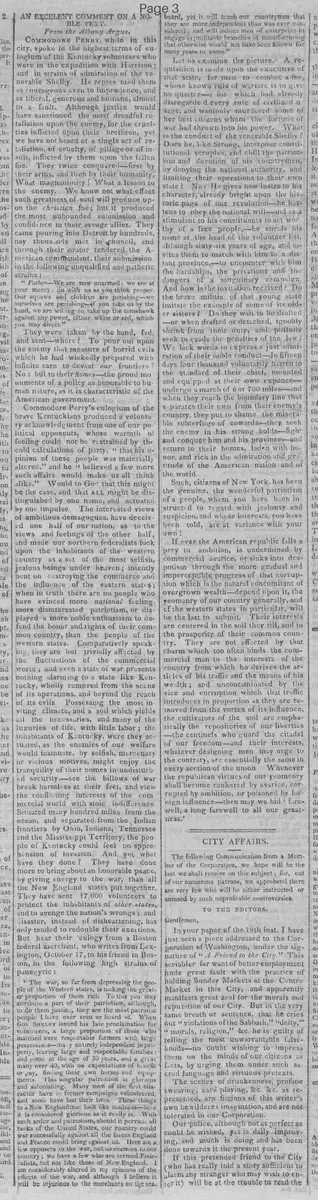
COMMODORE PERRY, While in this city, spoke in the highest terms of eulogium of the Kentucky volunteers who were in the expedition with Harrison; and in strains of admiration of the venerable Shelby. He represented them as courageous even to imprudence, and as liberal, generous and humane, almost to a fault. Although justice would have sanctioned the most dreadful retaliation upon the enemy, for the cruelties inflicted upon their brethren, yet we have not heard of a single act of retaliation, of cruelty, of pillage or of insult, inflicted by them upon the fallen foe. They twice conquered-first by their arms, and then by their humanity. What magnanimity! What a lesson to the enemy. We know not what effect such greatness of soul will produce upon the christian foe; but it produced the most unbounded submission and confidence in their savage allies. They came pouring into Detroit by hundreds. nay thousands met in council, and through their orator tendered the American commandant, their submission in the following unqualified and pathetic strains:
"Father--We are now unarmed: we are at your mercy: do with us as you think proper. Our squaws and children are perishing--we ourselves are perishing--if you take us by the hand, we are willing to take up the tomahawk against any power, either white or red, which you may direct."
They were taken by the hand, fed and sent--where? To pour out upon the enemy that measure of horrid evils which he had wickedly prepared with infinite care to devast our frontiers? No: but to their homes--the proud monuments of a policy as honorable to human nature, as it is characteristic of the American government.
Commodore Perry's eulogium of the brave Kentuckians produced a voluntary acknowledgment from one of our political opponents, whose warmth of feeling could not be restrained by the cold calculations of party, "that his opinion of these people was materially altered," and he "believed a few more such affairs would make us all think alike." Would to God that this might be the case, and that ALL might be distinguished by one name, and actuated by one impulse. The interested views of ambitious demagogues, have deceived one half of our nation, as to the views and feelings of the other half. and made our northern federalists look upon the inhabitants of the western country as a set of the most selfish, jealous beings under heaven; intently bent on destroying the commerce and the influence of the eastern states; when in truth there are no people who have evinced more national feeling, more disinterested patriotism, or displayed a more noble enthusiasm to defend the honor and rights of their common country, than the people of the western states. Comparatively speaking, they are but trivially affected by the fluctuations of the commercial world; and even a state of war presents nothing alarming to a state like Kentucky, wholly removed from the scene of its operations, and beyond the reach of its evils Possessing the most inviting climate, and a soil which yields all the necessaries, and many of the luxuries of life, with little labor; the inhabitants of Kentucky, were they actuated, as the enemies of our welfare would insinuate, by selfish, mercenary or vicious motives, might enjoy the tranquility of their homes in undisturbed security,--see the billows of war break harmless at their feet, and view the conflicting interests of the commercial world with stoic indifference Situated many hundred miles from the ocean, and separated from the Indian frontiers by Ohio, Indiana, Tennessee and the Mississippi Territory, the people of Kentucky could feel no apprehension of invasion. And yet what have they done? They have done more to bring about an honorable peace, by giving energy to the war, than all the New England states put together. They have sent 17,000 volunteers to protect the inhabitants of other states, and to avenge the nation's wrongs; and disaster, instead of disheartening, has only tended to redouble their exertions. But hear their eulogy from a Boston federal merchant, who writes from Lexington, October 17, to his friend in Boston, in the following high strains of panegyric:
The war, so far from depressing the people of the Western states, is making the greater proportion of them rich To this you may attribute a part of their patriotism, although, to do them justice, they are the most patriotic people I have ever seen or heard of. When Gov. Shelby issued his late proclamation for volunteers, a large proportion of those who marched were respectable farmers with large possessions--many entirely independent in property, leaving large and respectable families: and some at the age of 50 years, and a great many over 40, with no expectations of benefit or pay, finding their own horses and equip- ments. This singular patriotism is glorious and astonishing. Many men of the first character have in former campaigns volunteered, and some have lost their lives. These things to a New Englandman look like madness--here it is considered glorious as it really is. With such ardor and patriotism, should it pervade all ranks of the United States, our country could war successfully against all the forces England and France could bring against us. Here are a few opposers to the war, but no enemies to our country; we have a few who are termed Federalists, but not like those of New England. I am considerably altered in my opinions of the effects of the war, and although I believe it will be injurious to the merchants on the sea board. yet it will teach our countrymen that they are more independent than was ever considered; and will induce men of enterprize to engage in profitable branches of manufacturing that otherwise would not have been known for many years to come.
Let us examine the picture. A requisition is made upon the executive of that state, for men to combat a foe, whose known rule of warfare is to give no quarter--a foe which had already disregarded every rule of civilized usage, and wantonly murdered some of her best citizens whom the fortune of war had thrown into his power. What is the conduct of the venerable Shelby? Does he, like Strong, interpose constitutional scruples, and chill the patriotism and devotion of his countrymen, by denying the national authority. and limiting their operations to their own state? No: He gives new lustre to his character, already bright upon the historic page of our revolution--he hastens to obey the national will--and as a stimulant to his constituents to act worthy of a free people,--he enrols his name at the head of the volunteer list, although sixty-six years of age, and invites them to march with him to a distant province,--to encounter with him the hardships, the privations and the dangers of a sanguinary campaign. And how is the invitation received? Do the brave militia of that young state imitate the example of some of its older sisters? Do they wait to be drafted--or when drafted or detached, ignobly shrink from their duty, and pitifully seek to evade the penalties of the law? We lack words to express a just admiration of their noble conduct--In fifteen days four thousand voluntarily hasten to the standard of their chief, mounted and equipped at their own expence-- undergo a march of 6 or 700 miles--and when they reach the boundary line that separates their own from their enemy's country. they put to shame the miserable subterfuge of cowards--they seek the enemy in his strong holds--fight and conquer him and his province--and return to their homes, laden with honor, and rich in the admiration and gratitude of the American nation and of the world.
Such, citizens of New York, has been the genuine, the wonderful patriotism of a people, whom you have been instructed to regard with jealousy and suspicion, and whose interests, you have been told, are at variance with your own! If ever the American republic falls a prey to ambition, is undermined by commercial avarice, or sinks into despotism through the more gradual and imperceptible progress of that corruption which is the natural concomitant of overgrown wealth--depend upon it, the yeomanry of our country generally, and of the western states in particular, will be the last to submit. Their interests are centered in the soil they till, and in the prosperity of their common country. They are not affected by that charm which too often binds the commercial man to the interests of the country from which he derives the articles of his traffic and the means of his wealth; and uncontaminated by the vice and corruption which that traffic introduces in proportion as they are removed from the vortex of its influence, the cultivators of the soil are emphatically the repositories of our liberties--the centinels who guard the citadel of our freedom--and their interests, whatever designing men may urge to the contrary, are essentially the same in every section of the union Whenever the republican virtues of our yeomanry shall become cankered by avarice, corrupted by ambition, or poisoned by foreign influence--then may we bid 'farewell, a long farewell to all our greatness.
What sub-type of article is it?
What themes does it cover?
What keywords are associated?
What entities or persons were involved?
Where did it happen?
Story Details
Key Persons
Location
Kentucky, Detroit, Lexington, New York
Event Date
October 17
Story Details
Commodore Perry praises Kentucky volunteers' courage and humanity in Harrison's expedition; they conquer British and Indians through arms and mercy, leading to Indian submission and return home; contrasts with federalist views, highlighting western patriotism and Shelby's leadership in volunteering at age 66, with 4000 mounting a 600-700 mile march to victory.