Thank you for visiting SNEWPapers!
Sign up free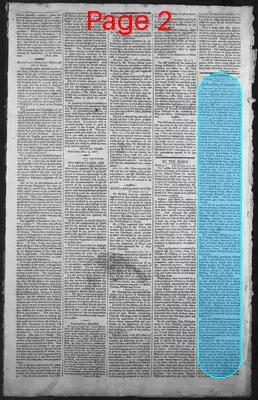
The New Hampshire Gazette
Portsmouth, Rockingham County, New Hampshire
What is this article about?
A devastating fire erupted in Portsmouth stores on the morning of December 24, 1806, rapidly spreading to adjacent buildings, including St. John's Church and a new parsonage, destroying property worth nearly $130,000. Several houses were demolished to contain the blaze; principal sufferers included N.A. & J. Haven, Abel and Robert Harris, and others. Business remains unaffected.
Clipping

OCR Quality
Full Text
Tuesday, December 30, 1806.
Distressing Calamity!
Four years ago this day we were called to the painful duty of recording in our Gazette a distressing calamity which befell this town by FIRE,—We could have wished this might have been the only one of the kind, we should have ever been called to witness,—But alas! our every feeling was again horrified upon beholding another column of flames which threatened destruction to an alarming degree,—As on Wednesday morning last between 6 & 7 o'clock, a fire burst with terrific fury from the stores occupied by Stephen Little, Benjamin Hill, Daniel Weeks & Washington Peirce. These stores were so completely enveloped in flames, and having great quantities of rum, brandy & combustible articles, the fire communicated with great rapidity to the adjoining stores of Nathaniel Adams & Son, on the west, & Ebenezer Thompson, on the east, and from the latter to the adjoining store of said Thompson, & improved by N.A & J. Haven, John Rindge, and Gilman Leavitt; from these it communicated to C. Rimes' shop, Abel & Robert Harris store, Edward Cutts' store, improved by himself and brother, George Cutts from thence to James Day's dwelling-house and work shop; then to Christopher Rimes' and Samuel Cotton's dwelling-houses; then to St. John's Church, and the elegant three-story parsonage house, entirely new and nearly finished; and to prevent further ravages four dwelling-houses were pulled down, owned by John Staples, widow Tuttle, Mark Simes and George Wendell; and a work-Shop of Mr. Giles. The fire was, by this means, got under, about eleven o'clock.
The loss of property by this terrible catastrophe, is estimated at nearly one hundred and thirty thousand dollars. The Messrs. Haven's had one hundred hhds. of sugar and rum in one store, entirely consumed; the Messrs. Harris's had a whole ship's cargo of flax seed and pot and pearl ashes, nearly ready to take on board, besides a large amount in other goods entirely consumed.
The principal sufferers are N. A. & J. Haven, Abel and Robert Harris, Ebenezer Thompson, Edward & George Cutts, Nathaniel Adams & Son, James Day, Stephen Little, Benjamin Hill, & Washington Peirce. Some of the above gentlemen lost their books, notes and papers.
The following gentlemen suffered greatly in the removal of their goods from the stores, which were in imminent danger, viz. Jeremiah Libbey, William Walker, Daniel Brown, B. & F. Weare, George & Jacob Wendell. William, Thomas, and Charles Neal, Mark Simes, and several others.
The above buildings were all wooden, and almost all the stores burnt have been erected since the dreadful conflagration in this town, four years ago. Only one brick partition wall, completely saved a row of buildings.
This, we think, should most thoroughly convince the people not only of this, but every seaport town, of the utility and importance of building with brick. Had the store been built of brick, with walls carried to a sufficient height above the roof, it would probably have been the only building destroyed.
It is with pleasure we mention the prompt attention and energetic exertions of the Dover Engine Company, which arrived at an early hour at the fire, and rendered much assistance. Such conduct is entitled to the grateful acknowledgments of the citizens of Portsmouth.
Though the loss of property has been very great, the consequences of the fire will not be felt as in 1802— The greater part of the stores in the town were then burnt, but now it is not so; and we have the pleasure of informing our brethren in the country that the business in this town will suffer no interruption, and that they may calculate on finding as good prices for their produce and as prompt pay as they did last year, which we have understood was highly satisfactory to those who came here.
What sub-type of article is it?
What keywords are associated?
What entities or persons were involved?
Where did it happen?
Domestic News Details
Primary Location
Portsmouth
Event Date
Wednesday Morning Last Between 6 & 7 O'clock
Key Persons
Outcome
loss of property estimated at nearly one hundred and thirty thousand dollars; fire contained by eleven o'clock after pulling down four dwelling-houses; no deaths mentioned; business in town unaffected.
Event Details
Fire burst from stores occupied by Stephen Little, Benjamin Hill, Daniel Weeks & Washington Peirce, spreading rapidly due to combustible materials to adjoining stores and buildings including St. John's Church and parsonage; four dwelling-houses pulled down to stop spread.