Thank you for visiting SNEWPapers!
Sign up free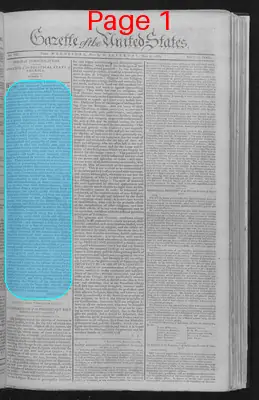
Editorial
May 9, 1789
Gazette Of The United States
New York, New York County, New York
What is this article about?
The editorial recounts the failures of the Articles of Confederation, the Annapolis Convention of 1786, and the Philadelphia Convention of 1787, praising the delegates for creating a new constitutional system that balances government energy with popular freedom to address national weaknesses in commerce, revenue, and governance.
Clipping
OCR Quality
98%
Excellent
Full Text
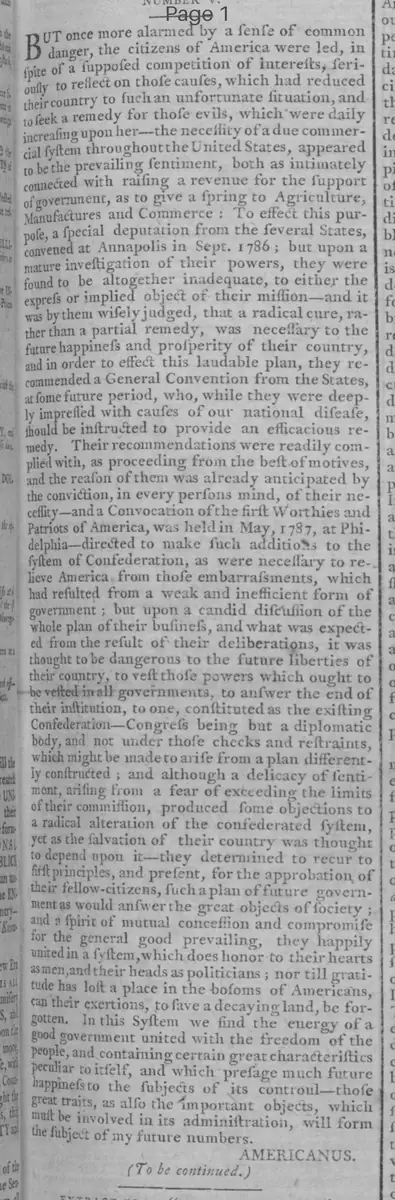
But once more alarmed by a sense of common danger, the citizens of America were led, in spite of a supposed competition of interests, seriously to reflect on those causes, which had reduced their country to such an unfortunate situation, and to seek a remedy for those evils, which were daily increasing upon her—the necessity of a due commercial system throughout the United States, appeared to be the prevailing sentiment, both as intimately connected with raising a revenue for the support of government, as to give a spring to Agriculture, Manufactures and Commerce: To effect this purpose, a special deputation from the several States, convened at Annapolis in Sept. 1786; but upon a mature investigation of their powers, they were found to be altogether inadequate, to either the express or implied object of their mission—and it was by them wisely judged, that a radical cure, rather than a partial remedy, was necessary to the future happiness and prosperity of their country, and in order to effect this laudable plan, they recommended a General Convention from the States, at some future period, who, while they were deeply impressed with causes of our national disease, should be instructed to provide an efficacious remedy. Their recommendations were readily complied with, as proceeding from the best of motives, and the reason of them was already anticipated by the conviction, in every person's mind, of their necessity—and a Convocation of the first Worthies and Patriots of America, was held in May, 1787, at Philadelphia—directed to make such additions to the system of Confederation, as were necessary to relieve America from those embarrassments, which had resulted from a weak and inefficient form of government; but upon a candid discussion of the whole plan of their business, and what was expected from the result of their deliberations, it was thought to be dangerous to the future liberties of their country, to vest those powers which ought to be vested in all governments, to answer the end of their institution, to one, constituted as the existing Confederation—Congress being but a diplomatic body, and not under those checks and restraints, which might be made to arise from a plan differently constructed; and although a delicacy of sentiment, arising from a fear of exceeding the limits of their commission, produced some objections to a radical alteration of the confederated system, yet as the salvation of their country was thought to depend upon it—they determined to recur to first principles, and present, for the approbation of their fellow-citizens, such a plan of future government as would answer the great objects of society; and a spirit of mutual concession and compromise for the general good prevailing, they happily united in a system, which does honor to their hearts as men, and their heads as politicians; nor till gratitude has lost a place in the bosoms of Americans, can their exertions, to save a decaying land, be forgotten. In this System we find the energy of a good government united with the freedom of the people, and containing certain great characteristics peculiar to itself, and which presage much future happiness to the subjects of its controul—those great traits, as also the important objects, which must be involved in its administration, will form the subject of my future numbers.
AMERICANUS.
(To be continued.)
AMERICANUS.
(To be continued.)
What sub-type of article is it?
Constitutional
Economic Policy
What keywords are associated?
Constitutional Convention
Articles Of Confederation
Federal Government
Commercial System
Annapolis Convention
Philadelphia Convention
What entities or persons were involved?
Annapolis Convention
Philadelphia Convention
Congress
Confederation
Editorial Details
Primary Topic
Formation Of A New Federal Government To Replace The Articles Of Confederation
Stance / Tone
Praiseworthy And Supportive Of The Constitutional Convention's Outcomes
Key Figures
Annapolis Convention
Philadelphia Convention
Congress
Confederation
Key Arguments
Inadequacy Of The Articles Of Confederation For Commerce And Revenue
Need For A Radical Cure Over Partial Remedies
Danger Of Vesting Powers In The Existing Diplomatic Congress
Recurrence To First Principles For A New Government Plan
Mutual Concession Led To A Balanced System Of Energy And Freedom