Thank you for visiting SNEWPapers!
Sign up free
Alexandria Gazette
Alexandria, Alexandria County, District Of Columbia
What is this article about?
In the U.S. House, Mr. Wise proposes a resolution for a committee to probe Executive Departments amid criticisms of corruption under President Andrew Jackson. His speech lauds Jackson's past heroism but condemns his administration's abuses, defends public trust, and demands investigation of the final message's claims.
Clipping
OCR Quality
Full Text
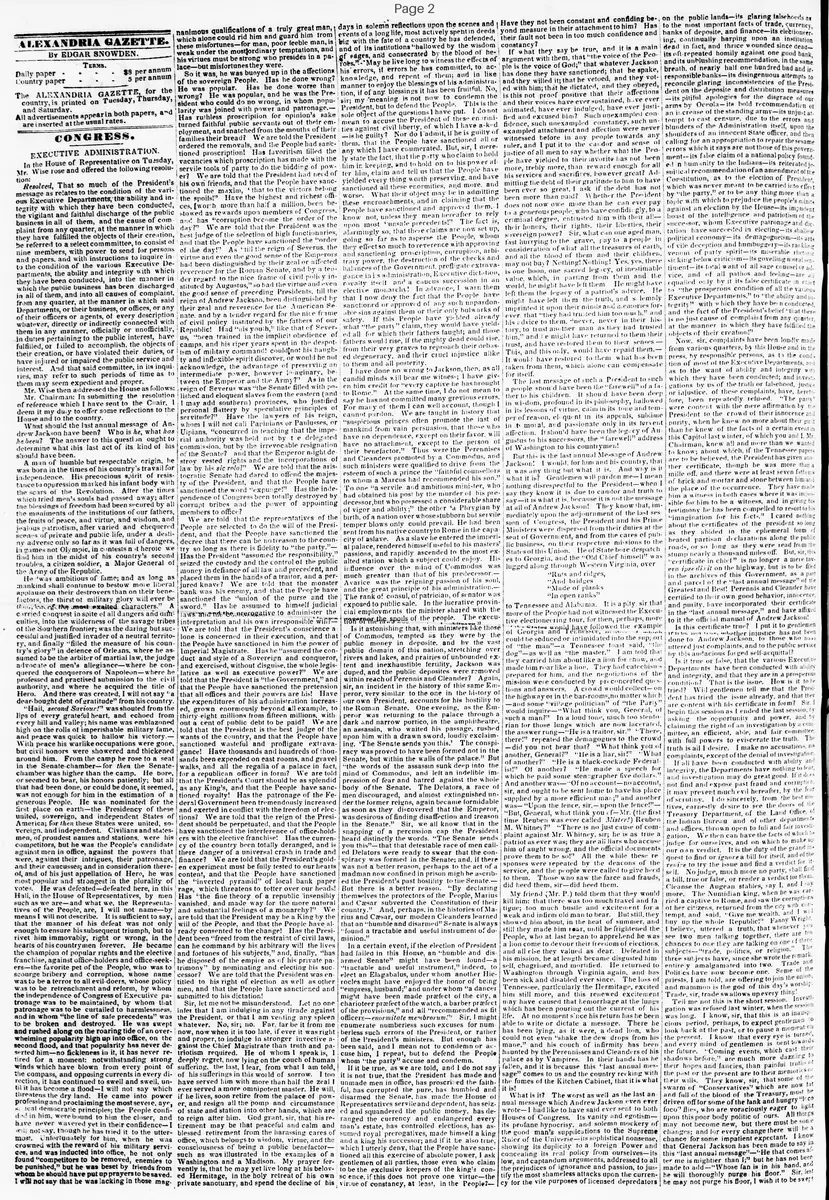
In the House of Representatives on Tuesday.
Mr. Wise rose and offered the following resolution:
Resolved, That so much of the President's message as relates to the condition of the various Executive Departments, the ability and integrity with which they have been conducted, the vigilant and faithful discharge of the public business in all of them, and the cause of complaint from any quarter, at the manner in which they have fulfilled the objects of their creation, be referred to a select committee, to consist of nine members, with power to send for persons and papers, and with instructions to inquire into the condition of the various Executive Departments, the ability and integrity with which they have been conducted, into the manner in which the public business has been discharged in all of them, and into all causes of complaint from any quarter, at the manner in which said Departments, or their business, or offices, or any of their officers or agents, of every description whatever, directly or indirectly connected with them in any manner, officially or unofficially, in duties pertaining to the public interest, have fulfilled, or failed to accomplish, the objects of their creation, or have violated their duties, or have injured or impaired the public service and interest. And that said committee, in its inquiries, may refer to such periods of time as to them may seem expedient and proper.
Mr. Wise then addressed the House as follows:
Mr. Chairman: In submitting the resolution of reference which I have sent to the Chair, I deem it my duty to offer some reflections to the House and to the country.
What should the last annual message of Andrew Jackson have been? Who is he, what has he been? The answer to this question ought to determine what this last act of its kind of his should have been.
A man of humble but respectable origin, he was born in the times of his country's travail for independence. His precocious spirit of resistance to oppression marked his infant body with the scars of the Revolution. After the times which tried men's souls had passed away; after the blessings of freedom had been secured by all the muniments of the institutions of our fathers, the fruits of peace, and virtue, and wisdom, and jealous patriotism, after varied and chequered scenes of private and public life, under a destiny adverse only so far as it was full of dangers, in games not Olympic, in contests not heroic we find him in the midst of his country's second troubles, a citizen soldier, a Major General of the Army of the Republic.
He was ambitious of fame; and as long as mankind shall continue to bestow more liberal applause on their destroyers than on their benefactors, the thirst of military glory will ever be found in the most exalted characters. A curried conquest in spite of all dangers and difficulties, into the wilderness of the savage tribes of the Southern frontier; was the daring but successful and justified invader of a neutral territory, and finally 'filled the measure of his country's glory' in defence of Orleans, where he assumed to be the arbiter of martial law, the judge advocate of men's allegiance—where he conquered the conquerors of Napoleon—where he professed and practised submission to the civil authority, and where he acquired the title of Hero. And there was created, I will not say 'a dear-bought debt of gratitude' from his country. 'Hail, second Saviour!' was shouted from the lips of every grateful heart, and echoed from every hill and valley; his name was emblazoned high on the rolls of imperishable military fame and peace was quick to hallow his victory.
With peace his warlike occupations were gone, but civil honors were showered and thickened around him. From the camp he rose to a seat in the Senate-chamber—for then the Senate chamber was higher than the camp. He bore, or seemed to bear, his honors patiently; but all that had been done, or could be done, it seemed, was not enough for him in the estimation of a generous People. He was nominated for the first place on earth—the Presidency of these united, sovereign, and independent States of America; for then these States were united, sovereign, and independent. Civilians and statesmen, of proudest names and stations, were his competitors, but he was the People's candidate against men in office, against the powers that were, against their intrigues, their patronage, and their caucusses; and in consideration thereof, and of his just appellation of Hero, he was most popular and strongest in the plurality of votes. He was defeated—defeated here, in this Hall, in the House of Representatives, by men such as we are—and what we, the Representatives of the People, are, I will not name—by means I will not describe. It is sufficient to say, that the manner of his defeat was not only enough to ensure his subsequent triumph, but to rivet him immovably, right or wrong, in the hearts of his countrymen forever. He became the champion of popular rights and the elective franchise, against office-holders and office-seekers—the favorite pet of the People, who was to scourge bribery and corruption, whose name was to be a terror to all evil-doers, whose policy was to be retrenchment and reform, by whom the independence of Congress of Executive patronage was to be maintained, by whom that patronage was to be curtailed to harmlessness, and in whom 'the line of safe precedents' was to be broken and destroyed. He was swept and rushed along on the roaring tide of an overwhelming popularity high up into office, on the second flood, and that popularity has never deserted him—no fickleness in it, it has never retired for a moment; notwithstanding strong winds which have blown from every point of the compass, and opposing currents in every direction, it has continued to swell and swell, until it has become a flood—I will not say which threatens the dry land. He came into power professing and proclaiming the most severe, aye, the most ultra democratic principles: the People confided in him, were bound to him the closer, and have never wavered yet in their confidence—I will not say, though he has tried it to the utmost. Unfortunately for him, when he was crowned with the reward of his military services, and was inducted into office, he not only found 'competitors to be removed, enemies to be punished,' but he was beset by friends from whom he should have put up prayers to be saved. I will not say that he was lacking in those magnanimous qualifications of a truly great man, which alone could rid him and guard him from these misfortunes—for man, poor feeble man, is weak under the most ordinary temptations, and his virtues must be strong who presides in a palace—but misfortunes they were.
So it was, he was buoyed up in the affections of the sovereign People. Has he done wrong? He was popular. Has he done worse than wrong? He was popular, and he was the President who could do no wrong, in whom popularity was joined with power and patronage.— Has ruthless proscription for opinion's sake turned faithful public servants out of their employment, and snatched from the mouths of their families their bread? We are told the President ordered the removals, and the People had sanctioned proscription! Has favoritism filled the vacancies which proscription has made with the servile tools of party to do the bidding of power? We are told that the President had need of his own friends, and that the People have sanctioned the maxim, 'that to the victors belong the spoils!' Have the highest and richest offices, worth more than half a million, been bestowed as rewards upon members of Congress, and, has 'corruption become the order of the day?' We are told that the President was the best judge of the selection of high functionaries, and that the People have sanctioned the 'order of the day!' As 'till the reign of Severus, the virtue and even the good sense of the Emperors had been distinguished by their zeal or affected reverence for the Roman Senate, and by a tender regard to the nice frame of civil policy instituted by Augustus.' so had the virtue and even the good sense of preceding Presidents, till the reign of Andrew Jackson, been distinguished by their zeal and reverence for the American Senate, and by a tender regard for the nice frame of civil policy instituted by the fathers of our Republic! Had 'his youth,' like that of Severus, 'been trained in the implicit obedience of camps, and his riper years spent in the despotism of military command!' could not his haughty and inflexible spirit discover, or would he not acknowledge, the advantage of preserving an intermediate power, however imaginary, between the Emperor and the Army? As in the reign of Severus was 'the Senate filled with polished and eloquent slaves from the eastern (and I may add southern) provinces, who justified personal flattery by speculative principles of servitude?' Have the lawyers of his reign, whom I will not call Papinians or Ulpians, 'concurred in teaching that the imperial authority was held not by the delegated commission, but by the irrevocable resignation of the Senate? and that the Emperor might destroy vested rights and the incorporations of law by his sic volo?' We are told that the aristocratic Senate had dared to offend the majesty of the President, and that the People have sanctioned the word 'expunge!' Has the independence of Congress been totally destroyed by corrupt bribes and the power of appointing members to office?
We are told that the representatives of the People are selected to do the will of the President, and that the People have sanctioned the decree that there can be no reason to the country so long as there is fidelity to 'the party.' Has the President 'assumed the responsibility,' seized the custody and the control of the public money in defiance of all law and precedent, and placed them in the hands of a traitor, and a perjured knave? We are told that the monster bank was his enemy, and that the People have sanctioned the 'union of the purse and the sword.' Has he assumed to himself judicial laws and the prerogative to administer the interpretation and his own irresponsible will? We are told that the President's conscience alone is concerned in their execution, and that the People have sanctioned in him the power of Imperial Magistrate. Has he 'assumed the conduct and style of a Sovereign and conqueror and exercised, without disguise, the whole legislative as well as executive power?' We are told that the President is 'the Government,' and that the People have sanctioned the pretension that all offices and their powers are his! Have the expenditures of his administration increased, grown enormously beyond all example, to thirty-eight millions from fifteen millions, without a cent of public debt to be paid? We are told that the President is the best judge of the wants of the country, and that the People have sanctioned wasteful and profligate extravagance! Have thousands and hundreds of thousands been expended on east rooms, and gravel walks, and all the regalia of a palace in fact, for a republican officer in form? We are told that the President's Court should be as splendid as any King's, and that the People have sanctioned royalty! Has the patronage of the Federal Government been tremendously increased and exerted in conflict with the freedom of elections? We are told that the reign of the President should be perpetuated, and that the People have sanctioned the interference of office-holders with the elective franchise! Has the currency of the country been totally deranged, and is there danger of a universal crash in trade and finance? We are told that the President's golden experiment must be fully tested to our heart's content, and that the People have sanctioned the 'inverted pyramid' of local bank paper rags, which threatens to totter over our heads! Has 'the fine theory of a republic insensibly vanished, and made way for the more natural and substantial feelings of a monarchy?' We are told that the President may be a King by the will of the People, and that the People have already consented to the change! Has the President been 'freed from the restraint of civil laws, can he command by his arbitrary will the lives and fortunes of his subjects,' and, finally, 'has he disposed of the empire as of his private patrimony' by nominating and electing his successor? We are told that the President was entitled to his right of election as well as other men, and that the People have sanctioned and submitted to his dictation!
Sir, let me not be misunderstood. Let no one infer that I am indulging in any tirade against the President, or that I am venting any spleen whatever. No, sir; no. Far, far be it from me now, now when it is too late, if ever it was right and proper, to indulge in stronger invective against the Chief Magistrate than truth and patriotism required. He of whom I speak is, I deeply regret, now lying on the couch of human suffering, the last, I fear, from what I am told, of his sufferings in this world of sorrow. I too have served him with more than half the zeal ever served a more omnipotent master. He will, if he lives, soon retire from the palace of power, and resign all the pomp and circumstance of state and station into other hands, which are to reign after him. God grant, sir, that his retirement may be that peaceful and calm and blessed retirement from the harassing cares of office, which belongs to wisdom, virtue, and the consciousness of being a public benefactor— such as was illustrated in the examples of a Washington and a Madison. My prayer fervently is, that he may yet live long at his beloved Hermitage, in the holy retreat of his own private sanctuary, and spend the decline of his days in solemn reflections upon the scenes and events of a long life, most actively spent in deeds big with the fate of a country he has defended, and of its institutions 'hallowed by the wisdom of sages, and consecrated by the blood of heroes.' 'May he live long to witness the effects of his errors, if errors he has committed, to acknowledge, and repent of them; and in like manner to enjoy the blessings of his administration, if of any, blessings it has been fruitful.' No, sir; my meaning is not now to condemn the President, but to defend the People. This is the sole object of the questions I have put. I do not mean to accuse the President of these enormities against civil liberty, of which I have asked—is he guilty? Nor do I admit, if he is guilty of any which I have enumerated. But, sir, I merely state the fact, that the party who claim to hold him in keeping, and to hold on to his power after him, claim and tell us that the People have sanctioned all these enormities, and more, and worse. What their object may be in admitting these encroachments, and in claiming that the People have sanctioned and approved them, I know not, unless they mean hereafter to rely upon most 'unsafe precedents!' The fact is, going so far as to asperse the People, whom they affect so much to reverence with approving smiles, alarmingly so, that these claims are now set up, and sanctioning proscription, corruption, arbitrary power, the destruction of the checks and balances of the Government, profligate extravagance in this administration, Executive dictation, royalty itself and a caucus succession in an elective monarchy! In advance, I warn them that I now deny the fact that the People have sanctioned or approved of any such unpardonable sins against them or their only bulwarks of safety. If this People have yielded already what 'the party' claim, they would have yielded all for which their fathers fought; and those fathers would rise, if the mighty dead could rise, from their very graves to reproach their debased degeneracy, and their cruel injustice alike to them and all posterity.
I have done no wrong to Jackson, then, as all candid minds will bear me witness; I have given him credit for 'every captive he has brought to Rome.' At the same time, I do not mean to say he has not committed many grievous errors. For many of them I can well account, though I cannot pardon. We are taught in history that 'suspicious princes often promote the justest of mankind from vain persuasion, that those who have no dependence, except on their favor, will have no attachment, except to the person of their benefactor.' Thus were the Perennis and Cleanders promoted by a Commodus, and such ministers were qualified to drive from the esteem of such a prince the 'faithful counsellors to whom a Marcus had recommended his son.' To one 'a servile and ambitious minister, who had obtained his post by the murder of his predecessor, but who possessed a considerable share of vigor and ability;' the other 'a Phrygian by birth, of a nation over whose stubborn but servile temper blows only could prevail. He had been sent from his native country to Rome in the capacity of a slave. As a slave he entered the imperial palace, rendered himself useful to his masters' passions, and rapidly ascended to the most exalted station which a subject could enjoy. His influence over the mind of Commodus was much greater than that of his predecessor. Avarice was the reigning passion of his soul, and the great principle of his administration. The rank of consul, of patrician, of senator was exposed to public sale. In the lucrative provincial employments the minister shared with the emperor the spoils of the people. The execution...'
Is it astonishing that, with ministers like those of Commodus, tempted as they were by the public money in deposit, and by the vast public domain of this nation, stretching over rivers and lakes, and prairies of unbounded extent and inexhaustible fertility, Jackson was duped, and the public deposits were removed within reach of Perennis and Cleander? Again, sir, an incident in the history of this same Emperor, very similar to the one in the history of our own President, accounts for his hostility to the Roman Senate. One evening, as the Emperor was returning to the palace through a dark and narrow portico, in the amphitheatre, an assassin, who waited his passage, rushed upon him with a drawn sword, loudly exclaiming, 'The Senate sends you this.' The conspiracy was proved to have been formed not in the Senate, but within the walls of the palace. But 'the words of the assassin sunk deep into the mind of Commodus, and left an indelible impression of fear and hatred against the whole body of the Senate. The Delators, a race of men discouraged, and almost extinguished under the former reigns, again became formidable as soon as they discovered that the Emperor was desirous of finding disaffection and treason in the Senate.' Sir, we all know that in the snapping of a percussion cap the President heard distinctly the words, 'The Senate sends you this'—that that detestable race of men called Delators were ready to swear that the conspiracy was formed in the Senate; and, if there was not a better reason, perhaps to the act of a madman now confined in prison might be ascribed the President's past hostility to the Senate. But there is a better reason. 'By declaring themselves the protectors of the People, Marius and Caesar subverted the Constitution of their country.' And, perhaps, in the histories of Marius and Caesar, our modern Cleanders learned that an 'humble and disarmed' Senate is always 'found a tractable and useful instrument of dominion.'
In a certain event, if the election of President had failed in this House, an 'humble and disarmed Senate' might have been found—a 'tractable and useful instrument,' indeed, to elect an Elagabalus, under whom another Hierocles might have enjoyed the honor of being 'empress, husband;' and under whom 'a dancer might have been made præfect of the city, a charioteer præfect of the watch, a barber præfect of the provisions,' and all 'recommended as fit officers—enormitate membrorum!' Sir, I might enumerate numberless such excuses for numberless such errors of the President, or rather of the President's ministers. But enough has been said, and I mean not to condemn or accuse him, I repeat, but to defend the People whom 'the party' accuse and condemn.
If it be true, as we are told, and I do not say it is not true, that the President has made and unmade men in office, has proscribed the faithful, has corrupted the pure, has humbled and disarmed the Senate, has made the House of Representatives servile and dependent, has seized and squandered the public money, has deranged the currency and endangered every man's estate, has controlled elections, has assumed royal prerogatives, made himself a king and a king his successor; and if it be also true, which I utterly deny, that the People have sanctioned all this exercise of absolute power, I ask gentlemen of all parties, those even who claim to be the exclusive keepers of the king's conscience, if this does not prove one virtue—the virtue of constancy, at least, in the People?— Have they not been constant and confiding beyond measure in their attachment to him? Has their fault not been in too much confidence and constancy?
If what they say be true, and it is a main argument with them, that 'the voice of the People is the voice of God;' that whatever Jackson has done they have sanctioned; that he spake and they willed it; that he vetoed, and they voted with him; that he dictated, and they obeyed, is this not proof positive that their affections and their voices have ever sustained, have ever animated, have ever indulged, have ever justified and excused him? Such unexampled confidence, such unexampled constancy, such unexampled attachment and affection were never witnessed before in any people towards any ruler, and I put it to the candor and sense of justice of all men to say whether what the People have yielded to their favorite has not been more, trebly more, than reward enough for all his services and sacrifices, however great? Admitting the debt of their gratitude to him to have been ever so great, I ask if the debt has not been more than paid? Whether the President does not now owe more than he can ever pay to a generous people, who have confidingly, to a criminal degree, entrusted him with their all—their honors, their rights, their liberties, their sovereign power? Sir, what can one aged man, fast hurrying to the grave, pay to a people in consideration of what all the treasures of earth, and all the blood of them and their children, may not buy? Nothing! Nothing! Yes, yes, there is one boon, one sacred legacy, of inestimable value, which, in parting from them and the world, he might have left them. He might have left them the legacy of a patriot's advice. He might have left them the truth, and solemnly imprinted it upon their minds and memories forever, that 'they had trusted him too much,' and his advice to them, 'never, never in their history, to trust another man as they had trusted him,' and he might have returned to them their trust, and have restored them to their senses— This, and this only, would have repaid them. It would have restored to them what has been taken from them, which alone can compensate for itself.
The last message of such a President to such a people should have been the 'farewell' of a father to his children. It should have been deep in wisdom, profound in its philosophy, hallowed in its lessons of virtue, calm in its tone and temper of reason, eloquent in its appeals, sublime in its moral, and passionate only in its fervent affection. It should have been the legacy of Augustus to his successors, the 'farewell' address of Washington to his countrymen!
But this is the last annual Message of Andrew Jackson! I would, for him and his country, that it was any thing but what it is. And why is it what it is? Gentlemen will pardon me—I mean nothing disrespectful to the President—when I say they know it is due to candor and truth to say—it is what it is, because it is not the message at all of Andrew Jackson! They know that, immediately upon the adjournment of the last session of Congress, the President and his Prime Ministers were dispersed from their duties at the seat of Government, and from the cares of public business, on their respective missions to the States of this Union. He of State bore despatches to Georgia, and the 'Old Chief himself' was lugged along through Western Virginia, over ruts and ridges, 'And bridges Made of planks In open ranks' to Tennessee and Alabama. It is a pity, sir, that more of the People had not witnessed the Executive electioneering tour, for then, perhaps, more States would have followed the example of Georgia and Tennessee, who could be seduced or intimidated into the support of 'the man'—a Tennessee toast said, 'the dog'—as well as 'the master.' I am told that they carried him about like a lion for show, and made him roar like a lion. They had catechisms prepared for him, and the negotiations of the mission were conducted by pre concerted questions and answers. A crowd would collect—on the highway or in the bar-rooms, no matter which—and some 'village politician' of 'the Party' would inquire—'What think you, General, of such a man?' In a loud tone, much too stentorian for those lungs which are now lacerated, the answer rung—'He is a traitor, sir.' 'There, there!' repeated the demagogues to the crowd—did you not hear that? 'What think you of another, General?' 'He is a liar, sir!' What of another?' 'He is a black-cockade Federalist!' Of another? 'He made a speech for which he paid some stenographer five dollars.' And another was—'Of no account—no account, sir, and ought to be sent home to have his place supplied by a more efficient man;' and another was—'Upon the fence, sir,—upon the fence!' 'But, General, what think you of—Mr. (the first time Reuben was ever called Mister!) Reuben M. Whitney?' 'There is no just cause of complaint against Mr. Whitney, sir; he is as true a patriot as ever was; they are all liars who accuse him of aught wrong, and the official documents prove them to be so!' All the while these responses were repeated by the deacons of the service, and the people were called to give heed to them. Those who saw the farce and frauds, did heed them, sir—did heed them.
My friend (Mr. P.) told them that they would kill him: that there was too much travel and fatigue; too much bustle and excitement for a weak and infirm old man to bear. But still, they showed him about, in the heat of summer, and still they made him roar, until he frightened the People, who at last began to apprehend he was a lion come to devour their freedom of elections, and all else they valued as dear. Defeated in his mission, he at length became disgusted himself, chagrined, and mortified. He returned to Washington through Virginia again, and has been sick and disabled ever since. The loss of Tennessee, particularly the Hermitage, excited him still more, and this renewed excitement may have caused that hemorrhage at the lungs which has been pouring out the current of his life. At no moment since his return has he been able to write or dictate a message. There he has been lying, as it were, a dead lion, who could not even 'shake the dew drops from his mane,' and his couch of infirmity has been haunted by the Perennises and Cleanders of his palace as by Vampires. In their hands has he fallen, and it is because this last annual message comes to us and the country reeking with the fumes of the Kitchen Cabinet, that it is what it is!
What is it? The worst as well as the last annual message which Andrew Jackson ever wrote—I had like to have said ever sent to both Houses of Congress. Its vanity and egotism—its profane hypocrisy, and solemn mockery of the good man's supplications to the Supreme Ruler of the Universe—its sophistical nonsense, showing its duplicity to a foreign Power and concealing its real policy from ourselves—its low, and captandum arguments, addressed to all the prejudices of ignorance and passion, to justify the most shameless attacks upon the currency for the vile purposes of licensed depredators on the public lands—its glaring falsehoods as to the most important facts of trade, currency, banks of deposit, and finance—its electioneering, continually harping upon an institution dead in fact, and thrice wounded since dead—its oft-repeated homily against one good bank, and its unblushing recommendation, in the same breath, of nearly half one hundred bad and irresponsible banks—its disingenuous attempts to reconcile glaring inconsistencies of the President on the deposit and distribution measures—its pitiful apologies for the disgrace of our arms by Osceola—its bold recommendation of an increase of the standing army—its unjust attempt to cast censure, due to the errors and blunders of the Administration itself, upon the shoulders of an innocent State officer, and then calling for an appropriation to repair the same errors which it says are not those of this government—its false claim of a national policy founded in humanity to the Indians—its reiterated jesuitical recommendation of an amendment of the Constitution, as to the election of President, which was never meant to be carried into effect by 'the party,' or to be any thing more than a topic with which to prejudice the people's minds against an election by the House—its impudent boast of the intelligence and patriotism of the successor, whom Executive patronage and dictation have succeeded in electing—its shallow political economy—its demagogueism—its arts of vile deception and humbuggery—its rankling venom of party spirit—its miserable rhetoric sir king below criticism—its grovelling moral sentiment—its total want of all sage counsel or advice, and of all pathos and feeling—are all equalled only by its false certificate in chief to 'the prosperous condition of all the various Executive Departments,' to 'the ability and integrity' with which they have been conducted, and the fact of the President's belief 'that there is no just cause of complaint from any quarter, at the manner in which they have fulfilled the objects of their creation!'
Now, sir, complaints have been loudly made from various quarters, by this House and in the press, by responsible persons, as to the condition of most of the Executive Departments, and as to the want of ability and integrity with which they have been conducted; and investigations by us of the truth or falsehood, justice or injustice, of these complaints, have, heretofore, been repeatedly refused. 'The party' were content with the mere affirmation by the President to the crowd of their innocence and purity, when he knew no more about their guilt than he knew of the facts of a certain event in this Capitol last winter, of which you and I, Mr. Chairman, knew all and more than we wanted to know; about which, if the Tennessee papers are to be believed, the President has given another certificate, though he was more than a mile off, and there were at least seven fathoms of brick and mortar and stone between him and the place of the occurrence. They have made him a witness in both cases where it was impossible for him to be a witness, and in giving his testimony he has been compelled to resort to his 'imagination for his facts.' I cared nothing about the certificates of the president so long as they abided in the ephemeral form of heated partisan declarations along the public roads, or so long as they were read from the stump nearly a thousand miles off. But, sir, this 'certificate in chief' is no longer a mere tavern ipse dixit on the highway, but is to be filed in the archives of this Government, as a part and parcel of the 'last annual message' of the Greatest and Best! Perennis and Cleander have certified to their own good behavior, innocence, and purity, have incorporated their certificate in the 'last annual message,' and have affixed to it the official manual of Andrew Jackson!
Is this certificate true? I put it to gentlemen in whose noses we have, whether injustice has not been done to Andrew Jackson, to those who have uttered just complaints, and to the public service by this audacious forged self-acquittal?
Is it true or false, that the various Executive Departments have been conducted with ability and integrity, and that they are in a prosperous condition? That is the issue. How is it to be tried? Will gentlemen tell me that the President has tried the issue already, and that they are content with his certificate in form? Sir, I begin this session as I ended the last session, by asking the opportunity and power, and by claiming the right of an investigation by a committee, an efficient, able, and fair committee, with full powers to eviscerate the truth. The truth is all I desire. I make no accusations, no complaints, except of the denial of investigation. If all have been conducted with ability and integrity, the Departments have nothing to fear, and investigation may do great good. If it does not find and expose past fraud and corruption, it may prevent much evil hereafter, by the fear of scrutiny. I do sincerely, from the best motives, earnestly desire to see the doors of the Treasury Department, of the Land Office, of the Indian Bureau and of other departments and offices, thrown open to full and fair investigation. We then can have the facts of which to judge for ourselves, and on which to make up our own verdict. It is the duty of the grand inquest to find or ignore a bill for itself, and of the petit jury to try the issue and find a verdict for itself. No judge, much more no party, shall find a bill, true or false, or render a verdict for them. Cleanse the Augean stables, say I, and I say more. The Numidian king, when he was carried captive to Rome and saw the corruptions of her citizens, returned from the city with contempt, and said, 'Give me wealth, and I will buy up the whole Republic!' Fanny Wright, I believe, uttered a truth, that whenever you see two men talking together, there are ten chances to one they are talking on one of three subjects— trade politics religion The three subjects have, since she wrote the remark, entirely amalgamated into two. Trade and Politics have now become one. Some of the priests, I am told, are offering to join the union, and mammon is the god of this day's worship. Trade, sir, trade swallows up every thing!
Tell me not this is the short session. Investigation was refused last winter, when the session was long. I know, sir, that this is an inauspicious period, perhaps, to expect gentlemen to look back at the past, or to pause a moment on the present and every mind of gentlemen is bent towards future Coming events which cast their hopes and fancies, than painful truths of the present are to their memories or the shadows before. They know, sir, that some of the present are to their memories or the Conservatives which are now fat lor some of the loco foco flies, who are voraciously eager to light upon this poor body politic of ours. All things changes; and for every change there will be a chance for some impatient expectant know that General Jackson has been made to say in this 'last annual message' 'He that comes after me is mightier than I;' but he has not been made to add—'Whose fan is in his hand, and he will thoroughly purge his floor.' Sir, lest he may not purge his floor, I wish it to be sure!
What sub-type of article is it?
What themes does it cover?
What keywords are associated?
What entities or persons were involved?
Where did it happen?
Story Details
Key Persons
Location
House Of Representatives
Event Date
Tuesday
Story Details
Mr. Wise offers a resolution for a select committee to investigate the Executive Departments' condition, ability, integrity, and complaints against them. He delivers a speech critiquing Andrew Jackson's last annual message, recounting Jackson's life and rise to power, accusing his administration of corruption, proscription, extravagance, and overreach, while defending the People's trust and calling for truth through investigation.