Thank you for visiting SNEWPapers!
Sign up free
The Caledonian
Saint Johnsbury, Caledonia County, Vermont
What is this article about?
M. Longchamp proposes to the French Minister of War a method of feeding army horses with bread made from three-fourths potatoes and one-fourth oatmeal, replacing oats to save 13 sous per horse daily, totaling 11,680,000 francs yearly for 80,000 horses. He claims it is more nutritious and suggests shifting land to potatoes for cheaper meat and improved national diet.
Clipping
OCR Quality
Full Text
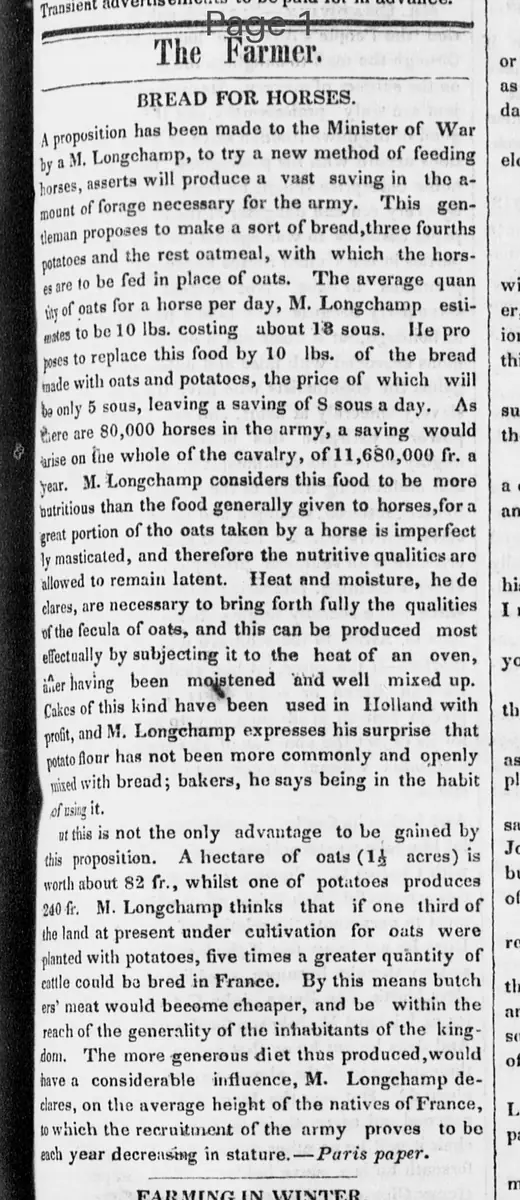
BREAD FOR HORSES.
A proposition has been made to the Minister of War by a M. Longchamp, to try a new method of feeding horses, which he asserts will produce a vast saving in the amount of forage necessary for the army. This gentleman proposes to make a sort of bread, three fourths potatoes and the rest oatmeal, with which the horses are to be fed in place of oats. The average quantity of oats for a horse per day, M. Longchamp estimates to be 10 lbs. costing about 18 sous. He proposes to replace this food by 10 lbs. of the bread made with oats and potatoes, the price of which will be only 5 sous, leaving a saving of 13 sous a day. As there are 80,000 horses in the army, a saving would arise on the whole of the cavalry, of 11,680,000 fr. a year. M. Longchamp considers this food to be more nutritious than the food generally given to horses, for a great portion of the oats taken by a horse is imperfectly masticated, and therefore the nutritive qualities are allowed to remain latent. Heat and moisture, he declares, are necessary to bring forth fully the qualities of the fecula of oats, and this can be produced most effectually by subjecting it to the heat of an oven, after having been moistened and well mixed up. Cakes of this kind have been used in Holland with profit, and M. Longchamp expresses his surprise that potato flour has not been more commonly and openly mixed with bread; bakers, he says being in the habit of using it.
But this is not the only advantage to be gained by this proposition. A hectare of oats (1 1/4 acres) is worth about 82 fr., whilst one of potatoes produces 240 fr. M. Longchamp thinks that if one third of the land at present under cultivation for oats were planted with potatoes, five times a greater quantity of cattle could be bred in France. By this means butchers' meat would become cheaper, and be within the reach of the generality of the inhabitants of the kingdom. The more generous diet thus produced, would have a considerable influence, M. Longchamp declares, on the average height of the natives of France, to which the recruitment of the army proves to be each year decreasing in stature.--Paris paper.
What sub-type of article is it?
What keywords are associated?
What entities or persons were involved?
Where did it happen?
Foreign News Details
Primary Location
France
Key Persons
Outcome
potential annual savings of 11,680,000 francs for 80,000 army horses; increased cattle breeding and cheaper meat if one third of oat land shifted to potatoes; improved national diet and stature.
Event Details
M. Longchamp proposes bread made from three-fourths potatoes and one-fourth oatmeal to replace 10 lbs. daily oats for horses, costing 5 sous instead of 18 sous, claiming it more nutritious due to better processing. Similar cakes used profitably in Holland. Broader benefits include higher potato yields enabling more cattle and cheaper meat, countering decreasing army recruit stature.