Thank you for visiting SNEWPapers!
Sign up free
The National Intelligencer And Washington Advertiser
Washington, District Of Columbia
What is this article about?
A Cherokee deputation of five chiefs, led by orator the GLASS, visited the US seat of government to address concerns over land treaties, troop removals, boundary maps, cultural progress, and justice for murders. The Secretary of War, on behalf of President, assured protection, friendship, and treaty adherence, providing written pledges and gifts.
Clipping
OCR Quality
Full Text
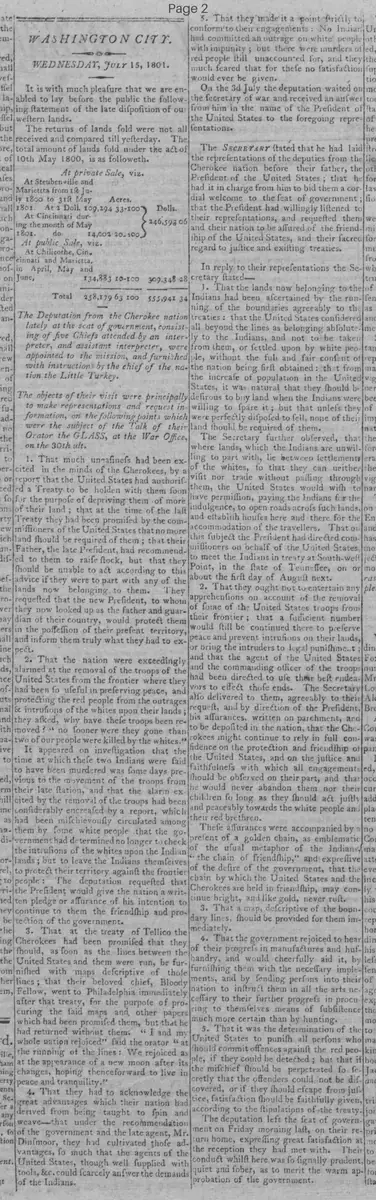
The objects of their visit were principally to make representations and request information, on the following points which were the subject of the Talk of their Orator the GLASS, at the War Office, on the 30th ult.
1. That much uneasiness had been excited in the minds of the Cherokees, by a report that the United States had authorized a Treaty to be holden with them soon for the purpose of depriving them of more of their land; that at the time of the last Treaty they had been promised by the commissioners of the United States that no more land should be required of them; that their Father, the late President, had recommended to them to raise stock, but that they should be unable to act according to this advice if they were to part with any of the lands now belonging to them. They requested that the new President, to whom they now looked up as the father and guardian of their country, would protect them in the possession of their present territory, and inform them truly what they had to expect.
2. That the nation were exceedingly alarmed at the removal of the troops of the United States from the frontier where they had been so useful in preserving peace, and protecting the red people from the outrages & intrusions of the whites upon their lands; they asked, why have these troops been removed? "no sooner were they gone than two of our people were killed by the whites."
It appeared on investigation that the time at which these two Indians were said to have been murdered was some days previous to the movement of the troops from their late station, and that the alarm excited by the removal of the troops had been considerably increased by a report, which had been mischievously circulated among them by some white people that the government had determined no longer to check the intrusions of the whites upon the Indian lands : but to leave the Indians themselves to protect their territory against the frontier people : The deputation requested that the President would give the nation a written pledge or assurance of his intention to continue to them the friendship and protection of the government.
3. That at the treaty of Tellico the Cherokees had been promised that they should, as soon as the lines between the United States and them were run, be furnished with maps descriptive of those lines; that their beloved chief, Bloody Fellow, went to Philadelphia immediately after that treaty, for the purpose of procuring the said maps and, other papers which had been promised them, but that he had returned without them. " I and my whole nation rejoiced" said the orator " at the running of the lines : We rejoiced as at the appearance of a new moon after its changes, hoping thenceforward to live in peace and tranquility."
4. That they had to acknowledge the great advantages which their nation had derived from being taught to spin and weave--that under the recommendation of the government and the late agent, Mr. Dinsmoor, they had cultivated those advantages, so much that the agents of the United States, though well supplied with tools, &c. could scarcely answer the demands of the Indians.
5. That they made it a point strictly to conform to their engagements: No Indian had committed an outrage on white people with impunity ; but there were murders of red people till unaccounted for, and they much feared that for these no satisfaction would ever be given.
On the 3d July the deputation waited on the Secretary of war and received an answer from him in the name of the President of the United States to the foregoing representations.
The Secretary stated that he had laid the representations of the deputies from the Cherokee nation before their father, the President of the United States ; that he had it in charge from him to bid them a cordial welcome to the seat of government; that the President had willingly listened to their representations, and requested them and their nation to be assured of the friendship of the United States, and their sacred regard to justice and existing treaties.
In reply to their representations the Secretary stated-
1. That the lands now belonging to the Indians had been ascertained by the running of the boundaries agreeably to the treaties: that the United States considered all beyond the lines as belonging absolutely to the Indians, and not to be taken from them, or settled upon by white people, without the full and fair consent of the nation being first obtained: that from the increase of population in the United States, it was natural that they should be desirous to buy land when the Indians were willing to part with it; but that unless they were perfectly disposed to sell, none of their land should be required of them.
The Secretary further observed, that where lands, which the Indians are unwilling to part with, lie between settlements of the whites, so that they can neither visit nor trade without passing through them, the United States would wish to have permission, paying the Indians for the indulgence, to open roads across such lands, and establish houses here and there for the accommodation of the travellers. That on this subject the President had directed commissioners on behalf of the United States to meet the Indians in treaty at South-west Point, in the state of Tennessee, on or about the first day of August next.
2. That they ought not to entertain any apprehensions on account of the removal of some of the United States troops from their frontier; that a sufficient number would still be continued there to preserve peace and prevent intrusions on their lands, or bring the intruders to legal punishment ; and that the agent of the United States and the commanding officer of the troops had been directed to use their best endeavors to effect those ends. The Secretary also delivered to them, agreeably to their request, and by direction of the President, his assurances, written on parchment, and to be deposited in the nation, that the Cherokees might continue to rely in full confidence on the protection and friendship of the United States, and on the justice and faithfulness with which all engagements should be observed on their part, and that he would never abandon them nor their children so long as they should act justly and peaceably towards the white people and their red brethren.
These assurances were accompanied by a present of a golden chain, as emblematic of the usual metaphor of the Indians, " the chain of friendship," and expressive of the desire of the government, that the chain by which the United States and the Cherokees are held in friendship, may continue bright, and like gold, never rust.
3. That a map, descriptive of the boundary lines, should be provided for them immediately.
4. That the government rejoiced to hear of their progress in manufactures and husbandry, and would cheerfully aid it, by furnishing them with the necessary implements, and by sending persons into their nation to instruct them in all the arts necessary to their further progress in procuring to themselves means of subsistence much more certain than by hunting.
5. That it was the determination of the United States to punish all persons who should commit offences against the red people, if they could be detected ; but that if the mischief should be perpetrated so secretly that the offenders could not be discovered, or if they should escape from justice, satisfaction should be faithfully given, according to the stipulations of the treaty.
The deputation left the seat of government on Friday morning last, on their return home, expressing great satisfaction at the reception they had met with. Their conduct whilst here was so signally prudent, quiet and sober, as to merit the warm approbation of the government.
What sub-type of article is it?
What themes does it cover?
What keywords are associated?
What entities or persons were involved?
Where did it happen?
Story Details
Key Persons
Location
Seat Of Government
Event Date
30th Ult. And 3d July
Story Details
Cherokee deputation addresses concerns on land cessions, troop removals, boundary maps, cultural advancements, and justice for murders; receives assurances of protection, friendship, and treaty adherence from the Secretary of War on behalf of the President, including written pledges and a golden chain.