Thank you for visiting SNEWPapers!
Sign up free
Berkeley And Jefferson Intelligencer
Martinsburg, Berkeley County, Virginia
What is this article about?
In the U.S. House of Representatives on January 5, 1805, J. Randolph moved for a committee to investigate Judge Chase's judicial conduct for possible impeachment, based on personal observations and reports from a Pennsylvania gentleman. Debate included Smilie's anecdote of Chase limiting counsel's arguments in a treason trial, Griswold's defense, and ended in adjournment by a vote of 57-aye.
Merged-components note: Continuation across pages of the article on the impeachment inquiry into Judge Chase's conduct.
Clippings
1 of 2
OCR Quality
Full Text
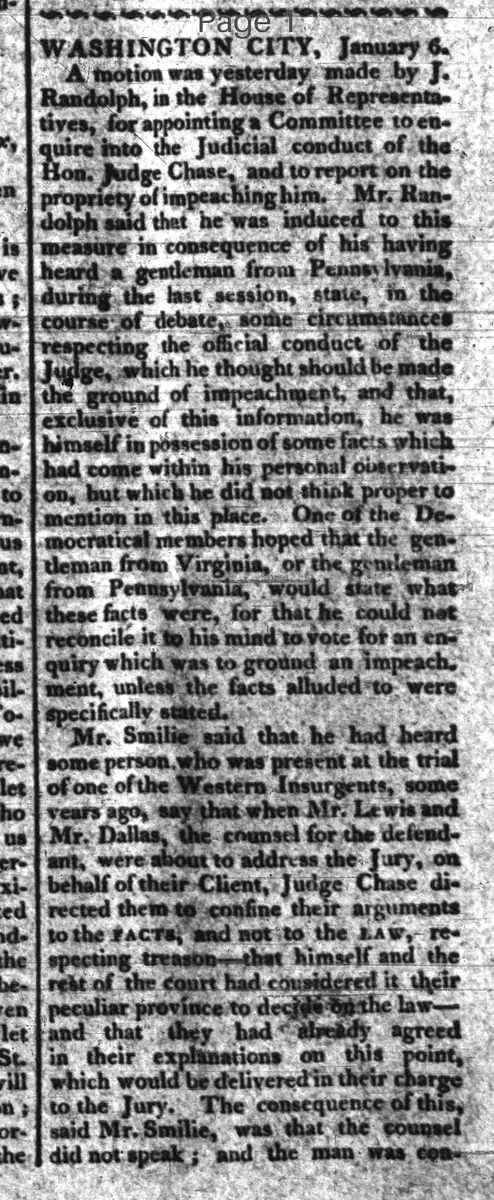
A motion was yesterday made by J. Randolph, in the House of Representatives, for appointing a Committee to enquire into the Judicial conduct of the Hon. Judge Chase and to report on the propriety of impeaching him. Mr. Randolph said that he was induced to this measure in consequence of his having heard a gentleman from Pennsylvania, during the last session, state, in the course of debate, some circumstances respecting the official conduct of the Judge which he thought should be made the ground of impeachment, and that, exclusive of this information, he was himself in possession of some facts which had come within his personal observation, but which he did not think proper to mention in this place. One of the Democratical members hoped that the gentleman from Virginia, or the gentleman from Pennsylvania, would state what these facts were, for that he could not reconcile it to his mind to vote for an enquiry which was to ground an impeachment, unless the facts alluded to were specifically stated.
Mr. Smilie said that he had heard some person who was present at the trial of one of the Western Insurgents, some years ago, say that when Mr. Lewis and Mr. Dallas, the counsel for the defendant, were about to address the Jury, on behalf of their Client, Judge Chase directed them to confine their arguments to the Facts, and not to the LAW, respecting treason, that himself and the rest of the court had considered it their peculiar province to decide on the law and that they had "already agreed in their explanations on this point which would be delivered in their charge to the Jury. The consequence of this said Mr. Smilie, was that the counsel did not speak; and the man was convicted, condemned, and had like to have been hung, but was pardoned by the executive.
[Here Mr. Smilie sat down, put his hand to his neck, and looked around with some degree of exultation as much as to say if this is not sufficient to impeach him what the devil is.]
Mr. Griswold, said that respecting the right which the bench might have to confine the bar within a certain latitude in their observations to the Jury, in criminal cases, various opinions were entertained by various persons. Some legal characters were inclined to think that the bench could not limit forensic discussion to any particular point, but that they had the right of descanting not only on the fact but on the law arising from the fact to the Jury. While others were of opinion, that the observations of the bar in points of law must be addressed to the court only. Mr. G. said he did not perceive the necessity of investigating the correctness of these opinions on this occasion; for even admitting that the Judge might have been mistaken, he rather thought that such mistake should not become the subject of impeachment. Unless that opinion expressed resulted from a corrupt and improper motive; and he could not but think it strange, that when there had been a plurality of persons on the bench, coinciding in this opinion, one only should be singled out for reprehension.
But, said Mr. Griswold even this fact is not substantiated. The amount of the gentleman's statement is, merely that he heard some body say something and the amount of the statement of the gentleman from Virginia is, that he knows something which he does not choose to tell; for his own part he was at present of opinion that when a committee of this kind was appointed, it was necessary that there should be some facts previously ascertained, on which the inquiry was to be instituted. He might be mistaken on this point; perhaps it was not necessary but lest an improper precedent might be established on this occasion, he hoped a few hours would be allowed for considering it; and moved a postponement.
This motion was supported by Mr. Huger and Mr. Dennis, and opposed by Mr. Randolph and M'Clay, and a lengthy discussion was terminated by a motion to adjourn, which was carried—Ayes 57.
What sub-type of article is it?
What keywords are associated?
What entities or persons were involved?
Where did it happen?
Domestic News Details
Primary Location
Washington City
Event Date
January 6
Key Persons
Outcome
motion to adjourn carried—ayes 57. no immediate impeachment inquiry outcome.
Event Details
J. Randolph moved for a committee to inquire into Judge Chase's judicial conduct for possible impeachment, citing personal observations and reports from a Pennsylvania gentleman. Mr. Smilie recounted an incident where Judge Chase limited counsel's arguments on law in a treason trial, leading to conviction and near-execution of the defendant, who was later pardoned. Mr. Griswold argued against the inquiry, questioning the facts and suggesting no corrupt motive, and moved for postponement. Debate supported by Huger and Dennis, opposed by Randolph and M'Clay, ended in adjournment.