Thank you for visiting SNEWPapers!
Sign up free
Letter to Editor
May 10, 1871
The Greenville Enterprise
Greenville, Greenville County, South Carolina
What is this article about?
A letter to the editors of the Greenville Enterprise proposes repurposing the Old Court House as a City Hall for archives, records, public meetings, library, and exhibitions of science, art, and historical portraits, highlighting its historical significance and suitability amid high taxation.
Clipping
OCR Quality
85%
Good
Full Text
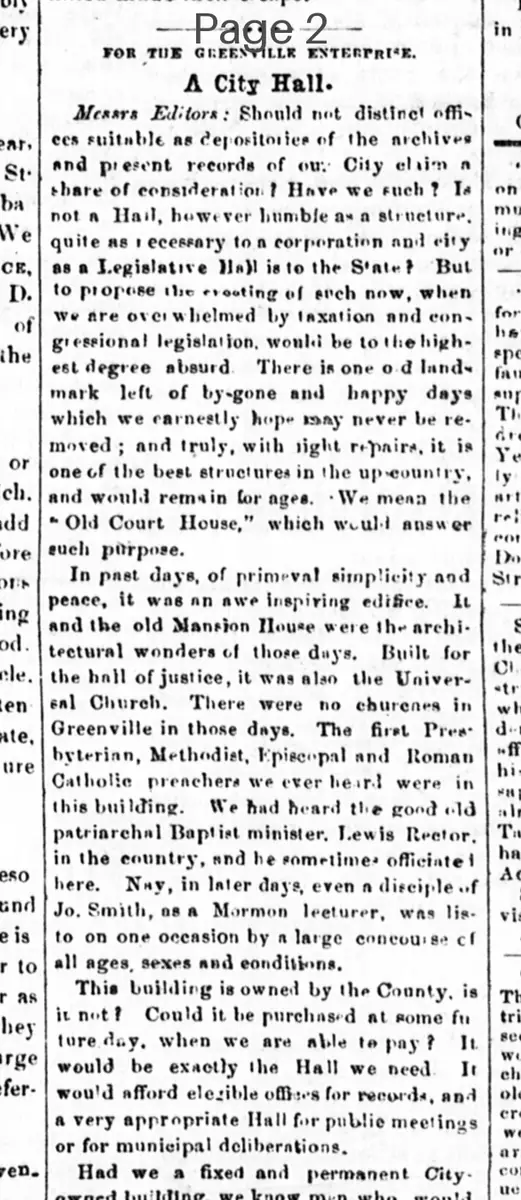
FOR THE GREENVILLE ENTERPRISE.
A City Hall
Messrs Editors: Should not distinct offices suitable as depositories of the archives and present records of our City claim a share of consideration? Have we such? I know not a Hall, however humble as a structure quite as necessary to a corporation and city as a Legislative Hall is to the State? But to propose the erecting of such now, when we are overwhelmed by taxation and congressional legislation, would be to the highest degree absurd. There is one old land-mark left of by-gone and happy days which we earnestly hope may never be removed; and truly, with slight repairs, it is one of the best structures in the upcountry, and would remain for ages. We mean the Old Court House, which would answer such purpose.
In past days, of primeval simplicity and peace, it was an awe inspiring edifice. It and the old Mansion House were the architectural wonders of those days. Built for the hall of justice, it was also the Universal Church. There were no churches in Greenville in those days. The first Presbyterian, Methodist, Episcopal and Roman Catholic preachers we ever heard were in this building. We had heard the good old patriarchal Baptist minister, Lewis Rector, in the country, and he sometimes officiated here. Nay, in later days, even a disciple of Jo. Smith, as a Mormon lecturer, was listened to on one occasion by a large concourse of all ages, sexes and conditions.
This building is owned by the County, is it not? Could it be purchased at some future day, when we are able to pay? It would be exactly the Hall we need. It would afford eligible offices for records, and a very appropriate Hall for public meetings or for municipal deliberations.
Had we a fixed and permanent City owned building, we know men who would exert themselves in getting up a useful City Library-a citizens' library, accessible to all. Amusing and instructive books have saved many a promising girl or boy from profligacy.
Again, no community can take an elevated plan on the scale of society who disregards science and art. To show an appreciation of each, there must be some exhibitions pertaining to each. A public building like this would be a store-house for the mineral and geological specimens which our country friends would freely bring in; and by that means contribute to agricultural chemistry. Whilst we write, we know that it would be a matter of ease to secure a rare collection of Carolina specimens.
Nor could a better hall be found to exhibit some good oil paintings, portraits of public and beloved men who have passed before us, prominent for virtue and patriotism, and prominent for wisdom and as counsellors of the nation. Among these, let that of Joel R. Poinsett, the school teacher, statesman, philosopher and artist, be conspicuously placed: and Poinsett was once our neighbor. It is that planner this old building. and Mr. Mills, an esteemed Carolina architect, reduced it to a building reale.
A City Hall
Messrs Editors: Should not distinct offices suitable as depositories of the archives and present records of our City claim a share of consideration? Have we such? I know not a Hall, however humble as a structure quite as necessary to a corporation and city as a Legislative Hall is to the State? But to propose the erecting of such now, when we are overwhelmed by taxation and congressional legislation, would be to the highest degree absurd. There is one old land-mark left of by-gone and happy days which we earnestly hope may never be removed; and truly, with slight repairs, it is one of the best structures in the upcountry, and would remain for ages. We mean the Old Court House, which would answer such purpose.
In past days, of primeval simplicity and peace, it was an awe inspiring edifice. It and the old Mansion House were the architectural wonders of those days. Built for the hall of justice, it was also the Universal Church. There were no churches in Greenville in those days. The first Presbyterian, Methodist, Episcopal and Roman Catholic preachers we ever heard were in this building. We had heard the good old patriarchal Baptist minister, Lewis Rector, in the country, and he sometimes officiated here. Nay, in later days, even a disciple of Jo. Smith, as a Mormon lecturer, was listened to on one occasion by a large concourse of all ages, sexes and conditions.
This building is owned by the County, is it not? Could it be purchased at some future day, when we are able to pay? It would be exactly the Hall we need. It would afford eligible offices for records, and a very appropriate Hall for public meetings or for municipal deliberations.
Had we a fixed and permanent City owned building, we know men who would exert themselves in getting up a useful City Library-a citizens' library, accessible to all. Amusing and instructive books have saved many a promising girl or boy from profligacy.
Again, no community can take an elevated plan on the scale of society who disregards science and art. To show an appreciation of each, there must be some exhibitions pertaining to each. A public building like this would be a store-house for the mineral and geological specimens which our country friends would freely bring in; and by that means contribute to agricultural chemistry. Whilst we write, we know that it would be a matter of ease to secure a rare collection of Carolina specimens.
Nor could a better hall be found to exhibit some good oil paintings, portraits of public and beloved men who have passed before us, prominent for virtue and patriotism, and prominent for wisdom and as counsellors of the nation. Among these, let that of Joel R. Poinsett, the school teacher, statesman, philosopher and artist, be conspicuously placed: and Poinsett was once our neighbor. It is that planner this old building. and Mr. Mills, an esteemed Carolina architect, reduced it to a building reale.
What sub-type of article is it?
Persuasive
Reflective
Historical
What themes does it cover?
Infrastructure
Education
Science Nature
What keywords are associated?
City Hall
Old Court House
Greenville
Public Building
Historical Preservation
City Library
Geological Specimens
Joel R Poinsett
Agricultural Chemistry
What entities or persons were involved?
Messrs Editors
Letter to Editor Details
Recipient
Messrs Editors
Main Argument
the old court house should be purchased and repurposed as a city hall for records, public meetings, library, and exhibitions, given its historical value and the current burden of taxation preventing new construction.
Notable Details
Historical Use As Court, Church For Various Denominations Including Baptist Minister Lewis Rector And A Mormon Lecturer
Potential For City Library To Prevent Profligacy
Storage For Mineral And Geological Specimens Contributing To Agricultural Chemistry
Exhibition Of Portraits Including Joel R. Poinsett
Designed By Mr. Mills