Thank you for visiting SNEWPapers!
Sign up free
Evansville Weekly Journal
Evansville, Vanderburgh County, Indiana
What is this article about?
On February 1, 1848, an unnamed Indiana representative speaks in the House against a bill incorporating a railroad from Evansville to Terre Haute, claiming it would interfere with the Wabash and Erie Canal, breach the state's contract with bondholders, and jeopardize Indiana's credit by allowing bondholders to escape their obligations.
Clipping
OCR Quality
Full Text
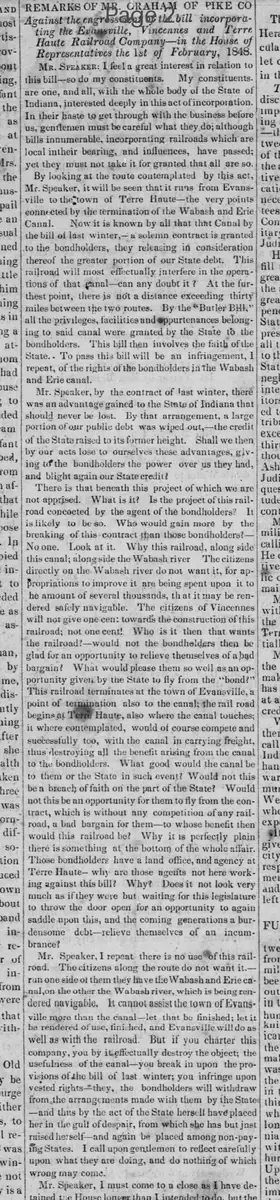
Mr. Speaker: I feel a great interest in relation to this bill—so do my constituents. My constituents, are one, and all, with the whole body of the State of Indiana, interested deeply in this act of incorporation. In their haste to get through with the business before us, gentlemen must be careful what they do; although bills innumerable, incorporating railroads which are local in their bearing, and influences, have passed: yet they must not take it for granted that all are so. By looking at the route contemplated by this act, Mr. Speaker, it will be seen that it runs from Evansville to the town of Terre Haute—the very points connected by the termination of the Wabash and Erie Canal. Now it is known by all that that Canal by the bill of last winter,—a solemn contract is granted to the bondholders, they releasing in consideration thereof the greater portion of our State debt. This railroad will most effectually interfere in the operations of that canal—can any doubt it? At the furthest point, there is not a distance exceeding thirty miles between the two routes. By the Butler Bill, all the privileges, facilities and appurtenances belonging to said canal were granted by the State to the bondholders. This bill then involves the faith of the State. To pass this bill will be an infringement, I repeat, of the rights of the bondholders in the Wabash and Erie canal.
Mr. Speaker, by the contract of last winter, there was an advantage gained to the State of Indiana that should never be lost. By that arrangement, a large portion of our public debt was wiped out,—the credit of the State raised to its former height. Shall we then by our acts lose to ourselves these advantages, giving to the bondholders the power over us they had, and blight again our State credit?
There is that beneath this project of which we are not apprised. What is it? Is the project of this railroad concocted by the agent of the bondholders? It is likely to be so. Who would gain more by the breaking of this contract than those bondholders?— No one. Look at it. Why this railroad, along side this canal; along side the Wabash river The citizens directly on the Wabash river do not want it, for appropriations to improve it are being spent upon it to the amount of several thousands, that it may be rendered safely navigable. The citizens of Vincennes will not give one cent: towards the construction of this railroad: not one cent! Who is it then that wants the railroad?—would not the bondholders then be glad for an opportunity to relieve themselves of a bad bargain? What would please them so well as an opportunity given by the State to fly from the "bond?"
This railroad terminates at the town of Evansville, a point of termination also to the canal: the rail road begins at Terre Haute, also where the canal touches: it where contemplated, would of course compete and successfully too, with the canal in carrying freight. thus destroying all the benefit arising from the canal to the bondholders. What good would the canal be to them or the State in such event? Would not this be a breach of faith on the part of the State? Would not this be an opportunity for them to fly from the contract, which is without any competition of any railroad, a bad bargain for them—to whose benefit then would this railroad be? Why it is perfectly plain there is something at the bottom of the whole affair.
Those bondholders have a land office, and agency at Terre Haute— why are those agents not here working against this bill? Why? Does it not look very much as if they were but waiting for this legislature to throw the door open for an opportunity to again saddle upon this, and the coming generations a burdensome debt—relieve themselves of an incumbrance?
Mr. Speaker, I repeat there is no use of this railroad. The citizens along the route do not want it.— on one side of them they have the Wabash and Erie canal, on the other the Wabash river, which is being rendered navigable. It cannot assist the town of Evansville more than the canal—let that be finished; let it be rendered of use, finished, and Evansville will do as well as with the railroad. But if you charter this company, you by it effectually destroy the object; the usefulness of the canal—you break in upon the provisions of the bill of last winter; you infringe upon vested rights they, the bondholders will withdraw from the arrangements made with them by the State -and thus by the act of the State herself have placed her in the gulf of despair, from which she has but just raised herself—and again be placed among non-paying States. I call upon gentlemen to reflect carefully upon what they are doing, and do nothing of which wrong may come.
Mr. Speaker. I must come to a close as I have detained the House longer than I intended to do, but the people whom I have the honor to represent, have a great interest in the matter, and for them, I must and will stand up at all hazards, whether I meet the frowns of other members or not.
What sub-type of article is it?
What themes does it cover?
What keywords are associated?
Where did it happen?
Story Details
Location
House Of Representatives, State Of Indiana
Event Date
1848 02 01
Story Details
An Indiana representative opposes a railroad incorporation bill from Evansville to Terre Haute, arguing it breaches the state's contract with Wabash and Erie Canal bondholders by competing with the canal, potentially allowing bondholders to escape their obligations and harming Indiana's state credit and debt relief.