Thank you for visiting SNEWPapers!
Sign up free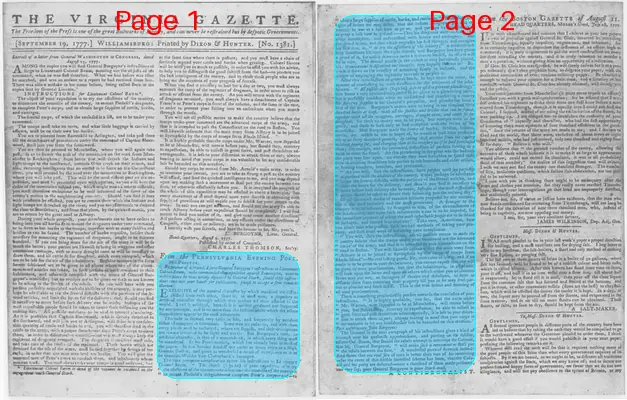
The Virginia Gazette
Richmond, Williamsburg, Richmond County, Virginia
What is this article about?
A letter from the Pennsylvania Evening Post critiques General Burgoyne's instructions to Lt. Col. Baum for the Bennington expedition, mocking his pompous style, exposing plans for deception and plundering, and celebrating the American victory under General Stark.
Merged-components note: These two components form a single continuous letter to the editor from the Pennsylvania Evening Post, providing remarks on General Burgoyne's instructions; the text flows directly, with the second picking up mid-sentence from the first. The resulting label is letter_to_editor, differing from the 'story' label of the second component.
Clippings
1 of 2
OCR Quality
Full Text
Mr. PRINTER,
By favour of a friend, I saw General Burgoyne's instructions to Lieutenant Colonel Baum, who commanded the expedition against Bennington, near to which place he was totally defeated by General Stark; should those instructions come into your hands for publication, please to accept a few remarks thereon.
Exclusive of the natural character by which mankind are distinguished from each other, there is, in most men, a secondary or artificial character through which they present all their actions to the world. I call it artificial, because it is neither produced nor supported by any principle, and is no more than the fashion under which the actors suppose they appear to the most advantage.
This taste is formed very early in life, and frequently by accident either of company or education. Some men are pedantic, and with them every phrase must be technical; others are foppish, and their descriptions are always intended to be light and novel: But Burgoyne's turn, or artificial character, is that of a mountebank, in which every thing must be wonderful. In his Proclamation, which has already been in most of the papers, he has handed himself out under as many titles as a High German Doctor, and given as wonderful a detail of enterprises as is to be found in Waltho Van Clutterbank's harangue.
The same pompous complication opens his instructions to Lieutenant Colonel Baum.
The object (says he) of your expedition is to try the affections of the country—to disconcert the councils of the enemy—to mount Riedesel's dragoons—to complete Peters's corps—and to
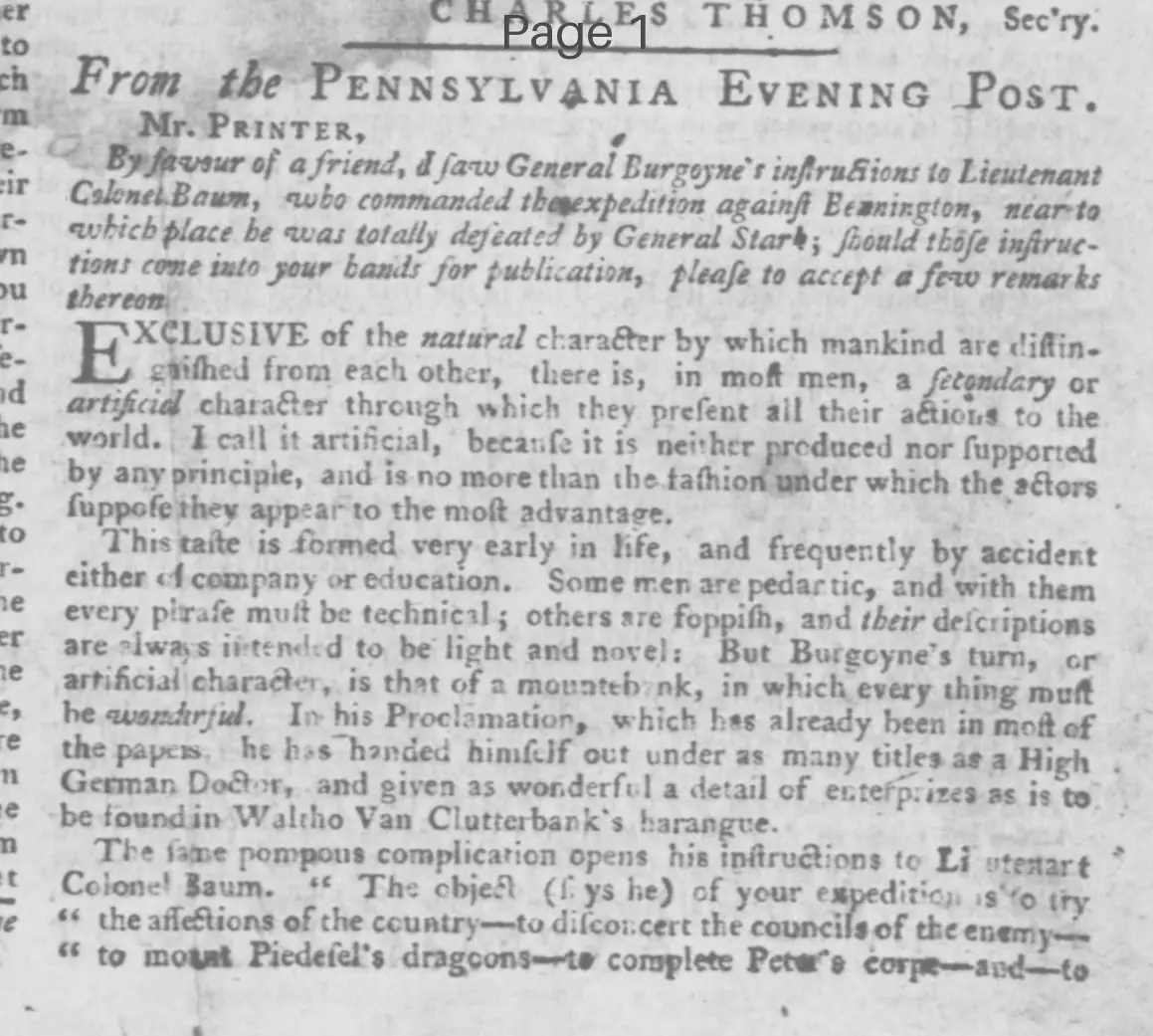
From this catalogue of orders we may infer, that the instant Burgoyne got into the country he was at a loss how to go on, and perhaps by this time is at as great a loss how to get out. --That his dragoons were on foot, his army incomplete, and unfurnished with horses and carriages: But his first line, is, "to try the affections of the country;" a mountebank may sometimes hit upon the right disease, and Burgoyne has here given a proof of it, for unless America turns a traitor to herself, his efforts will be in vain. The second article in the orders is very judiciously placed, viz. to endeavour to disconcert our councils; very happily shown in! Be. cue it shows us the necessity of attending firmly to business, and the danger of employing our ingenuity to evade or perplex it. After this introduction of general heads, he lays down the route, the manner of conducting it, with directions for the treatment of the inhabitants; and upon such information a tax is to be imposed, for the immediate payment of which the most respectable people are to be seized as hostages, and carried into captivity! Take care, Americans, how you admit men who practice such wicked methods of taking your property, and such cruel ways of enforcing your compliance. "All possible care (says he) is to be used to prevent plundering;" this seems a very extraordinary order to be given to a plundering party, but is perfectly consistent when we understand that plundering a country of horses, or forage or supplies is the General's perquisite, and plundering houses slaughter, for these no money was to be paid, but receipts were to be given, and those to such only as had complied with the terms of his manifesto. Had Burgoyne made the sweep of horses, saddles, bridles, cattle, &c. which he was in hopes of, he would at least have pocketed thirty or forty thousand pounds, by taking those articles from the country without paying for, and charging them to the treasury as if he had purchased them; the receipts, and the pretended distinction of persons serving as a mask to cover the fraud. As this plundering in the great was the business of the party was sent upon, no wonder they were forbidden to spend their time in dividing themselves into parties to rob henroosts and cider cellars, or stealing blankets, breeches, and petticoats. "As you will, says the instructions, have persons with you perfectly acquainted with the abilities of the country, it may perhaps be advisable to tax the several districts with the portions of the several articles, and limit the hours for the delivery, and should you find it necessary to move before such delivery can be made, hostages of the most respectable people should be taken to secure their following you the ensuing day." Of all the unjust modes of taxation hitherto proposed by our enemies, this is the most summary and the most pernicious. A stranger to the country is to be informed, by strangers to him, of the circumstances of the inhabitants; "You will, says the instructions, use all possible means to make the country believe that the troops under your command are the advanced corps of the army, and that it is intended to pass Connecticut on the road to Boston. You will likewise insinuate that the main army from Albany is to be joined at Springfield by the corps of troops from Rhode-Island." No real lasting good, Sir, ever came of lying, and if no credit is to be given to your proclamation, but that the inhabitants, in all places, will look upon the latter and upon all others which either you or General Howe may put out, as farragoes of threats and delusions, to dissuade them from removing their property till you or he may send parties to plunder and fetch it off. This is the true intent and meaning of all your proclamations. There is something prophetically pensive towards the conclusion of your instructions. "It is highly probable, you say, that the corps under Mr. Warner, now supposed to be at Manchester, will retreat before you, but should they, contrary to expectation, be able to collect in great force and post themselves advantageously, it is left to your discretion to attack them or not; always bearing in mind that your corps is too valuable to let any considerable loss be hazarded on this occasion." The General in the next paragraph of his instructions gives a kind of assurance Col. Baum, that should the rebels attempt to interrupt the Colonel, that he, General Burgoyne, "will make such a movement as shall put the rebels between two fires." A wonderful piece of fireworks indeed! And hews that one real fire of ours is better than two of his contriving --for the event of this double barrelled scheme has been, that the Colonel and his party are defeated near a thousand of them made prisoners, and they say, poor General Burgoyne is gone Stark-mad, triumph over his qualmish apprehensions, and putting on the soldier.
What sub-type of article is it?
What themes does it cover?
What keywords are associated?
What entities or persons were involved?
Letter to Editor Details
Recipient
Mr. Printer
Main Argument
general burgoyne's instructions to lt. col. baum reveal a pompous, deceptive, and plundering strategy that has failed, as evidenced by the defeat at bennington, urging americans to resist such british tactics.
Notable Details