Thank you for visiting SNEWPapers!
Sign up free
Letter to Editor
January 5, 1818
Daily National Intelligencer
Washington, District Of Columbia
What is this article about?
A letter to the National Intelligencer advocating an income tax as a fair, equitable alternative to land taxes, particularly burdensome on landowners during war. It argues the tax is productive, cites Adam Smith on proportional contribution, addresses potential fraud concerns, and estimates revenue to cover war deficits.
Clipping
OCR Quality
95%
Excellent
Full Text
FOR THE NATIONAL INTELLIGENCER.
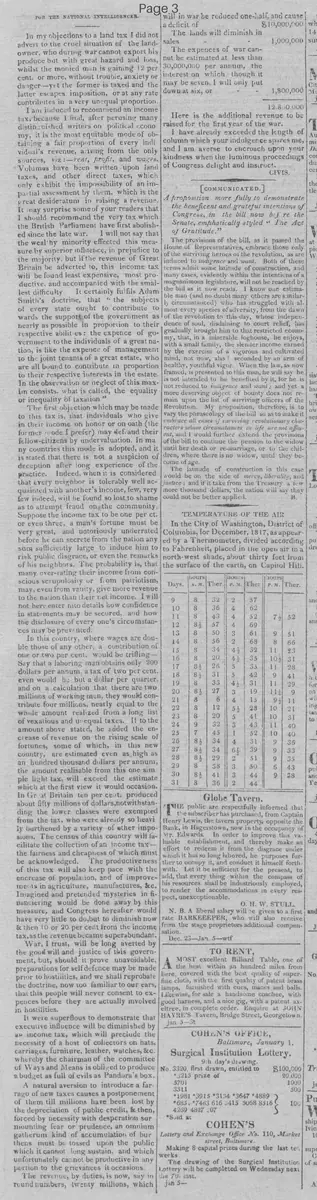
In my objections to a land tax I did not advert to the cruel situation of the land-owner, who during war cannot export his produce but with great hazard and loss, whilst the monied man is gaining 12 per cent. or more, without trouble, anxiety or danger—yet the former is taxed and the latter escapes imposition, or at any rate contributes in a very unequal proportion.
I am induced to recommend an income tax, because I find, after perusing many distinguished writers on political economy, it is the most equitable mode of obtaining a fair proportion of every individual's revenue, arising from the only sources, viz:—rent, profit, and wages.
Volumes have been written upon land taxes, and other direct taxes, which only exhibit the impossibility of an impartial assessment by them, which is the great desideratum in raising a revenue.
It may surprise some of your readers that I should recommend the very tax which the British Parliament have first abolished since the late war. I will not say that the wealthy minority effected this measure by superior influence, in prejudice to the majority, but if the revenue of Great Britain be adverted to, this income tax will be found least expensive, most productive, and accompanied with the smallest difficulty. It certainly fulfils Adam Smith's doctrine, that "the subjects of every state ought to contribute towards the support of the government as nearly as possible in proportion to their respective abilities: the expence of government to the individuals of a great nation, is like the expence of management to the joint tenants of a great estate, who are all bound to contribute in proportion to their respective interests in the estate. In the observation or neglect of this maxim consists, what is called, the equality or inequality of taxation."
The first objection which may be made to this tax is, that individuals who give in their income on honor or on oath (the former mode I prefer) may defraud their fellow-citizens by undervaluation. In many countries this mode is adopted, and it is stated that there is not a suspicion of deception after long experience of the practice. Indeed, when it is considered that every neighbor is tolerably well acquainted with another's income, few, very few indeed, will be found so lost to shame as to attempt fraud on the community.
Suppose the income tax to be one per ct. or even three, a man's fortune must be very great, and notoriously underrated before he can secrete from the nation any sum sufficiently large to induce him to risk public disgrace, or even the remarks of his neighbors. The probability is, that many over-rating their income from conscientious scrupulosity or from patriotism, may, even from vanity, give more revenue to the nation than their net income. I will not here enter into details how confidence in statements may be secured, and how the disclosure of every one's circumstances may be prevented.
In this country, where wages are double those of any other, a contribution of one or two per cent. would be trifling—Say that a laboring man obtains only 200 dollars per annum, a tax of two per cent. even would be but a dollar per quarter and on a calculation that there are two millions of working men, they would contribute four millions, nearly equal to the whole amount realized from a long list of vexatious and unequal taxes. If to the amount above stated, be added the increase of revenue on the rising scale of fortunes, some of which, in this new country, are estimated even as high as an hundred thousand dollars per annum, the amount realisable from this one simple light tax, will exceed the estimate which at the first view it would occasion.
In Gr. Britain ten per cent. produced about fifty millions of dollars, notwithstanding the lower classes were exempted from the tax. who were already so heavily burthened by a variety of other impositions. The census of this country will facilitate the collection of an income tax—the fairness and cheapness of which must be acknowledged. The productiveness of this tax will also keep pace with the encrease of population, and of improvements in agriculture, manufactures, &c.
Imagined and pretended mysteries in financiering would be done away by this measure, and Congress hereafter would have very little to do, but to diminish now & then 10 or 20 per cent from the income tax, as the revenue became superabundant.
War, I trust, will be long averted by the good will and justice of this government, but, should it prove unavoidable, preparations for self defence may be made prior to hostilities, and we shall reprobate the doctrine, now too familiar to our ears, that this people will never consent to expences before they are actually involved in hostilities.
It were superfluous to demonstrate that executive influence will be diminished by an income tax, which will preclude the necessity of a host of collectors on hats, carriages, furniture, leather, watches, &c. whereby the chairman of the committee of Ways and Means is obliged to produce a budget as full of evils as Pandora's box.
A natural aversion to introduce a farrago of new taxes causes a postponement of them till millions have been lost by the depreciation of public credit, & then, forced by necessity with desperation surmounting fear or prudence, an omnium gatherum kind of accumulation of burthens must be tossed upon the public which it cannot long sustain. and which unfortunately cannot be productive in any portion to the grievances it occasions.
The revenue, by duties, is now, say in round numbers, twenty millions, which will in war be reduced one-half, and cause a deficit of $10,000,000
The lands will diminish in sales 1,000,000
The expences of war cannot be estimated at less than 30,000,000 per annum, the interest on which though it may be seven, I will only put down at six, or 1,800,000
12,800,000
Here is the additional revenue to be raised for the first year of the war.
I have already exceeded the length of column which your indulgence spares me, and I am averse to encroach upon your kindness when the luminous proceedings of Congress delight and instruct.
CIVIS.
In my objections to a land tax I did not advert to the cruel situation of the land-owner, who during war cannot export his produce but with great hazard and loss, whilst the monied man is gaining 12 per cent. or more, without trouble, anxiety or danger—yet the former is taxed and the latter escapes imposition, or at any rate contributes in a very unequal proportion.
I am induced to recommend an income tax, because I find, after perusing many distinguished writers on political economy, it is the most equitable mode of obtaining a fair proportion of every individual's revenue, arising from the only sources, viz:—rent, profit, and wages.
Volumes have been written upon land taxes, and other direct taxes, which only exhibit the impossibility of an impartial assessment by them, which is the great desideratum in raising a revenue.
It may surprise some of your readers that I should recommend the very tax which the British Parliament have first abolished since the late war. I will not say that the wealthy minority effected this measure by superior influence, in prejudice to the majority, but if the revenue of Great Britain be adverted to, this income tax will be found least expensive, most productive, and accompanied with the smallest difficulty. It certainly fulfils Adam Smith's doctrine, that "the subjects of every state ought to contribute towards the support of the government as nearly as possible in proportion to their respective abilities: the expence of government to the individuals of a great nation, is like the expence of management to the joint tenants of a great estate, who are all bound to contribute in proportion to their respective interests in the estate. In the observation or neglect of this maxim consists, what is called, the equality or inequality of taxation."
The first objection which may be made to this tax is, that individuals who give in their income on honor or on oath (the former mode I prefer) may defraud their fellow-citizens by undervaluation. In many countries this mode is adopted, and it is stated that there is not a suspicion of deception after long experience of the practice. Indeed, when it is considered that every neighbor is tolerably well acquainted with another's income, few, very few indeed, will be found so lost to shame as to attempt fraud on the community.
Suppose the income tax to be one per ct. or even three, a man's fortune must be very great, and notoriously underrated before he can secrete from the nation any sum sufficiently large to induce him to risk public disgrace, or even the remarks of his neighbors. The probability is, that many over-rating their income from conscientious scrupulosity or from patriotism, may, even from vanity, give more revenue to the nation than their net income. I will not here enter into details how confidence in statements may be secured, and how the disclosure of every one's circumstances may be prevented.
In this country, where wages are double those of any other, a contribution of one or two per cent. would be trifling—Say that a laboring man obtains only 200 dollars per annum, a tax of two per cent. even would be but a dollar per quarter and on a calculation that there are two millions of working men, they would contribute four millions, nearly equal to the whole amount realized from a long list of vexatious and unequal taxes. If to the amount above stated, be added the increase of revenue on the rising scale of fortunes, some of which, in this new country, are estimated even as high as an hundred thousand dollars per annum, the amount realisable from this one simple light tax, will exceed the estimate which at the first view it would occasion.
In Gr. Britain ten per cent. produced about fifty millions of dollars, notwithstanding the lower classes were exempted from the tax. who were already so heavily burthened by a variety of other impositions. The census of this country will facilitate the collection of an income tax—the fairness and cheapness of which must be acknowledged. The productiveness of this tax will also keep pace with the encrease of population, and of improvements in agriculture, manufactures, &c.
Imagined and pretended mysteries in financiering would be done away by this measure, and Congress hereafter would have very little to do, but to diminish now & then 10 or 20 per cent from the income tax, as the revenue became superabundant.
War, I trust, will be long averted by the good will and justice of this government, but, should it prove unavoidable, preparations for self defence may be made prior to hostilities, and we shall reprobate the doctrine, now too familiar to our ears, that this people will never consent to expences before they are actually involved in hostilities.
It were superfluous to demonstrate that executive influence will be diminished by an income tax, which will preclude the necessity of a host of collectors on hats, carriages, furniture, leather, watches, &c. whereby the chairman of the committee of Ways and Means is obliged to produce a budget as full of evils as Pandora's box.
A natural aversion to introduce a farrago of new taxes causes a postponement of them till millions have been lost by the depreciation of public credit, & then, forced by necessity with desperation surmounting fear or prudence, an omnium gatherum kind of accumulation of burthens must be tossed upon the public which it cannot long sustain. and which unfortunately cannot be productive in any portion to the grievances it occasions.
The revenue, by duties, is now, say in round numbers, twenty millions, which will in war be reduced one-half, and cause a deficit of $10,000,000
The lands will diminish in sales 1,000,000
The expences of war cannot be estimated at less than 30,000,000 per annum, the interest on which though it may be seven, I will only put down at six, or 1,800,000
12,800,000
Here is the additional revenue to be raised for the first year of the war.
I have already exceeded the length of column which your indulgence spares me, and I am averse to encroach upon your kindness when the luminous proceedings of Congress delight and instruct.
CIVIS.
What sub-type of article is it?
Persuasive
Informative
Political
What themes does it cover?
Economic Policy
Taxation
Politics
What keywords are associated?
Income Tax
Land Tax
War Finance
Adam Smith
Economic Equity
Revenue Estimation
Tax Fairness
What entities or persons were involved?
Civis.
For The National Intelligencer.
Letter to Editor Details
Author
Civis.
Recipient
For The National Intelligencer.
Main Argument
an income tax is the most equitable and practical way to raise revenue, proportionally from rent, profit, and wages, avoiding the inequalities of land taxes, especially in wartime, and fulfilling adam smith's principle of taxation according to ability.
Notable Details
Quotes Adam Smith's Doctrine On Proportional Taxation
References British Income Tax Abolition And Productivity
Estimates Revenue From 1 2% Tax On Workers And Higher Fortunes
Projects War Deficit Of $12,800,000 Requiring Additional Revenue