Thank you for visiting SNEWPapers!
Sign up free
Alexandria Gazette & Daily Advertiser
Alexandria, Virginia
What is this article about?
Quaker farmer David Lawton in Washington, Dutchess County, successfully renovated 20 acres of abandoned land using clover, plaster, and crop rotation, yielding a fine wheat harvest sold at $2/bushel and later valued at $50/acre.
Clipping
OCR Quality
Full Text
From the Albany Plough Boy.
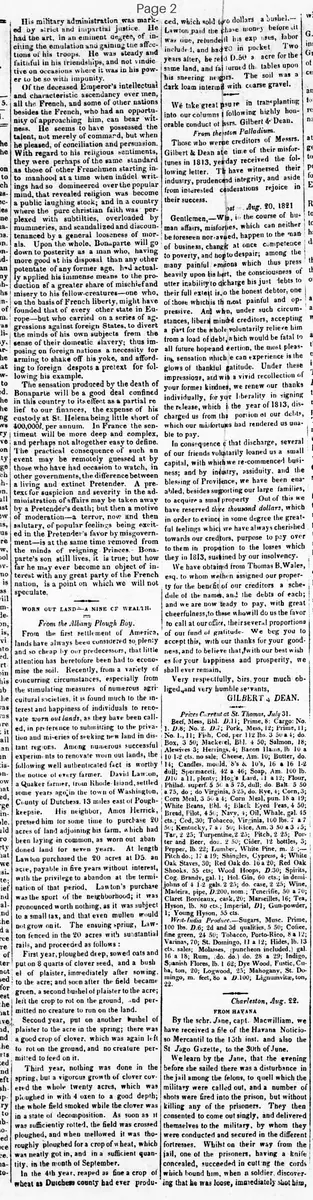
From the first settlement of America, lands have always been considered so plenty and so cheap by our predecessors, that little attention has heretofore been had to economise the soil. Recently, from a variety of concurring circumstances, especially from the stimulating measures of numerous agricultural societies, it is found much to the interest and happiness of individuals to renovate worn out lands, as they have been called, in preference to submitting to the privation and miseries of seeking new land in distant regions. Among numerous successful experiments to renovate worn out lands, the following well authenticated fact is worthy the notice of every farmer. David Lawton, a Quaker farmer, from Rhode Island, settled some years ago in the town of Washington, County of Dutchess, 13 miles east of Poughkeepsie. His neighbor, Amos Herrick, pressed him for some time to purchase 20 acres of land adjoining his farm, which had been laying in common, as worn out abandoned land for seven years. At length Lawton purchased the 20 acres at $5. an acre, payable in five years without interest, with the privilege to abandon at the termination of that period, Lawton's purchase was the sport of the neighborhood: it was pronounced worth nothing, as it was subject to a small tax, and that even mullen would not grow on it. The ensuing spring, Lawton fenced in the 20 acres with substantial rails, and proceeded as follows:
First year, ploughed deep, sowed oats and put on 8 quarts of clover seed, and a bushel of plaster, immediately after sowing to the acre; and soon after the field became green, a second bushel of plaster to the acre: left the crop to rot on the ground, and permitted no creature to run on the land.
Second year, put on another bushel of plaster to the acre in the spring; there was a good crop of clover, which was again left to rot on the ground, and no creature permitted to feed on it.
Third year, nothing was done in the spring, but a vigorous growth of clover covered the whole twenty acres, which was ploughed in with 4 oxen to a good depth; the whole field smoked while the clover was in a state of decomposition. As soon as it was sufficiently rotted, the field was cross ploughed, and when mellowed it was thoroughly ploughed for a crop of wheat, which was neatly got in, and in a sufficient quantity, in the month of September.
In the 4th year, reaped as fine a crop of wheat as Duchess county had ever produced, which sold two dollars a bushel.
Lawton paid the purchase money before it was due, refunded all his expenses, labor included, and had $20 in pocket Two years after, he refused $50 an acre for the same land, and fairly turned the tables upon his sneering neighbors. The soil was a dark loam intermix with coarse gravel.
What sub-type of article is it?
What keywords are associated?
What entities or persons were involved?
Where did it happen?
Domestic News Details
Primary Location
Town Of Washington, County Of Dutchess
Key Persons
Outcome
reaped fine wheat crop sold at two dollars a bushel; paid purchase money early, refunded expenses, had $20 profit; two years later refused $50 an acre.
Event Details
David Lawton purchased 20 acres of worn-out abandoned land at $5 per acre. Fenced it and applied treatment: first year deep ploughed, sowed oats and clover seed, applied plaster, left crop to rot. Second year more plaster, clover left to rot. Third year ploughed in clover, then prepared for wheat sown in September. Fourth year harvested fine wheat crop. Soil was dark loam intermixed with coarse gravel.