Thank you for visiting SNEWPapers!
Sign up free
Story
February 8, 1861
The Liberator
Boston, Suffolk County, Massachusetts
What is this article about?
Satirical article mocks Bishop Stephen Elliot's January 1861 directive to Georgia clergy to alter prayers amid secession: cease praying for U.S. President Lincoln and Congress, substitute prayers for Georgia's governor and legislature, highlighting Southern confidence in divine favor.
Clipping
OCR Quality
98%
Excellent
Full Text
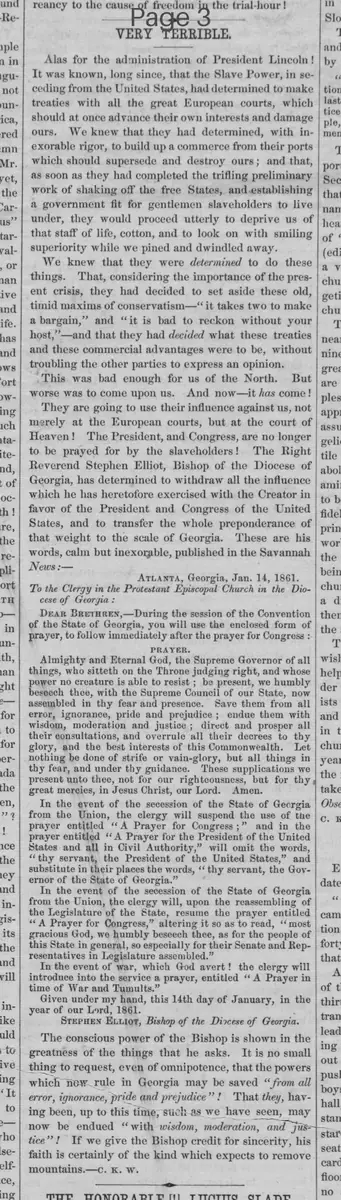
VERY TERRIBLE.
Alas for the administration of President Lincoln!
It was known, long since, that the Slave Power, in seceding from the United States, had determined to make treaties with all the great European courts, which should at once advance their own interests and damage ours. We knew that they had determined, with inexorable rigor, to build up a commerce from their ports which should supersede and destroy ours; and that, as soon as they had completed the trifling preliminary work of shaking off the free States, and establishing a government fit for gentlemen slaveholders to live under, they would proceed utterly to deprive us of that staff of life, cotton, and to look on with smiling superiority while we pined and dwindled away.
We knew that they were determined to do these things. That, considering the importance of the present crisis, they had decided to set aside these old, timid maxims of conservatism—'it takes two to make a bargain,' and 'it is bad to reckon without your host'—and that they had decided what these treaties and these commercial advantages were to be, without troubling the other parties to express an opinion.
This was bad enough for us of the North. But worse was to come upon us. And now—it has come!
They are going to use their influence against us, not merely at the European courts, but at the court of Heaven! The President, and Congress, are no longer to be prayed for by the slaveholders! The Right Reverend Stephen Elliot, Bishop of the Diocese of Georgia, has determined to withdraw all the influence which he has heretofore exercised with the Creator in favor of the President and Congress of the United States, and to transfer the whole preponderance of that weight to the scale of Georgia. These are his words, calm but inexorable, published in the Savannah News:
ATLANTA, Georgia, Jan. 14, 1861.
To the Clergy in the Protestant Episcopal Church in the Diocese of Georgia:
DEAR BRETHREN,—During the session of the Convention of the State of Georgia, you will use the enclosed form of prayer, to follow immediately after the prayer for Congress:
PRAYER.
Almighty and Eternal God, the Supreme Governor of all things, who sitteth on the Throne judging right, and whose power no creature is able to resist; be present, we humbly beseech thee, with the Supreme Council of our State, now assembled in thy fear and presence. Save them from all error, ignorance, pride and prejudice; endue them with wisdom, moderation and justice: direct and prosper all their consultations, and overrule all their decrees to thy glory, and the best interests of this Commonwealth. Let nothing be done of strife or vain-glory, but all things in thy fear, and under thy guidance. These supplications we present unto thee, not for our righteousness, but for thy great mercies, in Jesus Christ, our Lord. Amen.
In the event of the secession of the State of Georgia from the Union, the clergy will suspend the use of the prayer entitled 'A Prayer for Congress;' and in the prayer entitled 'A Prayer for the President of the United States and all in Civil Authority,' will omit the words, 'thy servant, the President of the United States,' and substitute in their places the words, 'thy servant, the Governor of the State of Georgia.'
In the event of the secession of the State of Georgia from the Union, the clergy will, upon the reassembling of the Legislature of the State, resume the prayer entitled 'A Prayer for Congress,' altering it so as to read, 'most gracious God, we humbly beseech thee, as for the people of this State in general, so especially for their Senate and Representatives in Legislature assembled.'
In the event of war, which God avert! the clergy will introduce into the service a prayer, entitled 'A Prayer in time of War and Tumults.'
Given under my hand, this 14th day of January, in the year of our Lord, 1861.
STEPHEN ELLIOT, Bishop of the Diocese of Georgia.
The conscious power of the Bishop is shown in the greatness of the things that he asks. It is no small thing to request, even of omnipotence, that the powers which now rule in Georgia may be saved 'from all error, ignorance, pride and prejudice'! That they, having been, up to this time, such as we have seen, may now be endued 'with wisdom, moderation, and justice'! If we give the Bishop credit for sincerity, his faith is certainly of the kind which expects to remove mountains.—C. K. W.
Alas for the administration of President Lincoln!
It was known, long since, that the Slave Power, in seceding from the United States, had determined to make treaties with all the great European courts, which should at once advance their own interests and damage ours. We knew that they had determined, with inexorable rigor, to build up a commerce from their ports which should supersede and destroy ours; and that, as soon as they had completed the trifling preliminary work of shaking off the free States, and establishing a government fit for gentlemen slaveholders to live under, they would proceed utterly to deprive us of that staff of life, cotton, and to look on with smiling superiority while we pined and dwindled away.
We knew that they were determined to do these things. That, considering the importance of the present crisis, they had decided to set aside these old, timid maxims of conservatism—'it takes two to make a bargain,' and 'it is bad to reckon without your host'—and that they had decided what these treaties and these commercial advantages were to be, without troubling the other parties to express an opinion.
This was bad enough for us of the North. But worse was to come upon us. And now—it has come!
They are going to use their influence against us, not merely at the European courts, but at the court of Heaven! The President, and Congress, are no longer to be prayed for by the slaveholders! The Right Reverend Stephen Elliot, Bishop of the Diocese of Georgia, has determined to withdraw all the influence which he has heretofore exercised with the Creator in favor of the President and Congress of the United States, and to transfer the whole preponderance of that weight to the scale of Georgia. These are his words, calm but inexorable, published in the Savannah News:
ATLANTA, Georgia, Jan. 14, 1861.
To the Clergy in the Protestant Episcopal Church in the Diocese of Georgia:
DEAR BRETHREN,—During the session of the Convention of the State of Georgia, you will use the enclosed form of prayer, to follow immediately after the prayer for Congress:
PRAYER.
Almighty and Eternal God, the Supreme Governor of all things, who sitteth on the Throne judging right, and whose power no creature is able to resist; be present, we humbly beseech thee, with the Supreme Council of our State, now assembled in thy fear and presence. Save them from all error, ignorance, pride and prejudice; endue them with wisdom, moderation and justice: direct and prosper all their consultations, and overrule all their decrees to thy glory, and the best interests of this Commonwealth. Let nothing be done of strife or vain-glory, but all things in thy fear, and under thy guidance. These supplications we present unto thee, not for our righteousness, but for thy great mercies, in Jesus Christ, our Lord. Amen.
In the event of the secession of the State of Georgia from the Union, the clergy will suspend the use of the prayer entitled 'A Prayer for Congress;' and in the prayer entitled 'A Prayer for the President of the United States and all in Civil Authority,' will omit the words, 'thy servant, the President of the United States,' and substitute in their places the words, 'thy servant, the Governor of the State of Georgia.'
In the event of the secession of the State of Georgia from the Union, the clergy will, upon the reassembling of the Legislature of the State, resume the prayer entitled 'A Prayer for Congress,' altering it so as to read, 'most gracious God, we humbly beseech thee, as for the people of this State in general, so especially for their Senate and Representatives in Legislature assembled.'
In the event of war, which God avert! the clergy will introduce into the service a prayer, entitled 'A Prayer in time of War and Tumults.'
Given under my hand, this 14th day of January, in the year of our Lord, 1861.
STEPHEN ELLIOT, Bishop of the Diocese of Georgia.
The conscious power of the Bishop is shown in the greatness of the things that he asks. It is no small thing to request, even of omnipotence, that the powers which now rule in Georgia may be saved 'from all error, ignorance, pride and prejudice'! That they, having been, up to this time, such as we have seen, may now be endued 'with wisdom, moderation, and justice'! If we give the Bishop credit for sincerity, his faith is certainly of the kind which expects to remove mountains.—C. K. W.
What sub-type of article is it?
Historical Event
Curiosity
What themes does it cover?
Providence Divine
Fate Providence
What keywords are associated?
Secession
Prayer Change
Bishop Elliot
Georgia Clergy
Civil War Prelude
Divine Influence
What entities or persons were involved?
President Lincoln
Stephen Elliot
Governor Of The State Of Georgia
Where did it happen?
Georgia, Atlanta
Story Details
Key Persons
President Lincoln
Stephen Elliot
Governor Of The State Of Georgia
Location
Georgia, Atlanta
Event Date
Jan. 14, 1861
Story Details
Bishop Stephen Elliot instructs Georgia clergy to modify prayers in anticipation of secession: replace prayers for U.S. President and Congress with those for Georgia's governor and legislature, satirized as withdrawing divine influence from the North.