Thank you for visiting SNEWPapers!
Sign up free
The Laurens Advertiser
Laurens, Laurens County, South Carolina
What is this article about?
The State Reform Convention in Columbia, SC, on August 10, 1894, nominated John Gary Evans for Governor and Dr. W.H. Timmerman for Lieutenant Governor by acclamation, rejected a full state ticket, endorsed Farmers' Alliance demands, supported the Dispensary law, and enthusiastically greeted Gov. B.R. Tillman while endorsing his Senate candidacy.
Clipping
OCR Quality
Full Text
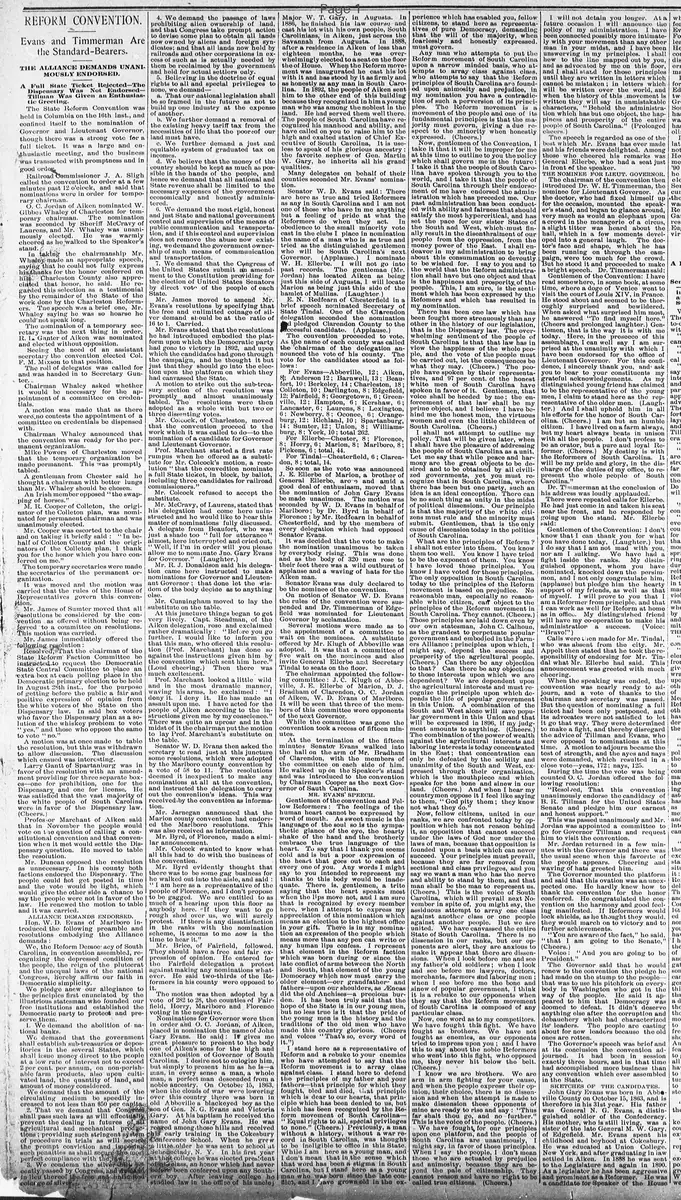
Evans and Timmerman Are the Standard-Bearers.
THE ALLIANCE DEMANDS UNANIMOUSLY ENDORSED.
A Full State Ticket Rejected—The Dispensary Was Not Endorsed—Tillman Was Given an Enthusiastic Greeting.
The State Reform Convention was held in Columbia on the 10th inst., and confined itself to the nomination of Governor and Lieutenant Governor, though there was a strong vote for a full ticket. It was a large and enthusiastic meeting, and the business was transacted with promptness and in good order.
Railroad Commissioner J. A. Sligh called the convention to order at a few minutes past 12 o'clock, and said that nominations were in order for temporary chairman.
O. C. Jordan of Aiken nominated W. Gibbes Whaley of Charleston for temporary chairman. The nomination was seconded by Sheriff McCravy of Laurens, and Mr. Whaley was unanimously elected. He was warmly cheered as he walked to the Speaker's stand.
In taking the chairmanship Mr. Whaley made an appropriate speech, saying that he could not fully express his thanks for the honor conferred on him. Charleston County also appreciated that honor, he said. He regarded this selection as a testimonial by the remainder of the State of the work done by the Charleston Reformers. The speech was a brief one, Mr. Whaley saying he was so hoarse he could not speak long.
The nomination of a temporary secretary was the next thing in order. R. L. Gunter of Aiken was nominated and elected without opposition. Seeing the need of an assistant secretary the convention elected Col. F. M. Mixson to that position.
The roll of delegates was called for and was handed in to Secretary Gunter.
Chairman Whaley asked whether it would be necessary for the appointment of a committee on credentials.
A motion was made that as there were no contests the appointment of a committee on credentials be dispensed with.
Chairman Whaley announced that the convention was ready for the permanent organization.
Mike Powers of Charleston moved that the temporary organization be made permanent. This was promptly tabled.
A gentleman from Chester said he thought a chairman with better lungs than Mr. Whaley should be chosen.
An Irish member opposed 'the swapping of horses.'
M. R. Cooper of Colleton, the originator of the Colleton plan, was nominated for permanent chairman and was unanimously elected.
Mr. Cooper was escorted to the chair and on taking it briefly said: 'In behalf of Colleton County and the originators of the Colleton plan, I thank you for the honor which you have conferred on me.'
The temporary secretaries were made the secretaries of the permanent organization.
It was moved and the motion was carried that the rules of the House of Representatives govern this convention.
Mr. James of Sumter moved that all resolutions be considered by the convention as offered without being referred to a committee on resolutions. This motion was carried.
Mr. James immediately offered the following resolution:
Resolved, That the chairman of the State Reform Executive Committee be instructed to request the Democratic State Central Committee to place an extra box at each polling place in the Democratic primary election to be held in August 28th inst., for the purpose of getting before the public a fair and positive expression of opinion from the white voters of the State on the Dispensary law. In said box voters who favor the Dispensary plan as a solution of the whiskey problem to vote 'yes,' and those who oppose the same to vote 'no.'
A motion was at once made to table the resolution, but this was withdrawn to allow discussion. The discussion which ensued was interesting.
Larkey Gantt of Spartanburg was in favor of the resolution with an amendment providing for three separate boxes—one for prohibition, one for the Dispensary and one for license. He was satisfied that the vast majority of the white people of South Carolina were in favor of the Dispensary law. (Cheers.)
Professor Marchant of Aiken said that in November the people would vote on the question of calling a constitutional convention and that convention when it met would settle the Dispensary question. He moved to table the resolution.
Mr. Duncan opposed the resolution as unnecessary. In his county both factions endorsed the Dispensary. The people could not get posted in time and the vote would be light, which would give the other side a chance to say the people were not in favor of the law. He renewed the motion to table and it was carried.
ALLIANCE DEMANDS ENDORSED
Hon. W. D. Evans of Marlboro introduced the following preamble and resolutions embodying the Alliance demands:
We, the Reform Democracy of South Carolina, in convention assembled, recognizing the depressed condition of the people, the reign of the plutocrat and the unequal laws of the national Congress, hereby affirm our faith in Democratic simplicity.
We pledge anew our allegiance to the principles first enunciated by the illustrious statesman who founded our free institutions and established the Democratic party to protect and preserve them.
We demand the abolition of national banks.
We demand that the government shall establish sub-treasuries or depositories in the several States, which shall issue money direct to the people at a low rate of interest not to exceed 2 per cent. per annum, on non-perishable farm products, also upon cultivated land, the quantity of land and amount of money considered.
We demand that the amount of the circulating medium be speedily increased to not less than $50 per capita.
2. That we demand that Congress shall pass such laws as will effectually prevent the dealing in futures of all agricultural and mechanical productions; providing such stringent system of procedure in trials as will secure the prompt conviction and imposing such penalties as shall secure the most perfect compliance with the law.
3. We condemn the silver bill recently passed by Congress, and in lieu thereof demand the free and unlimited coinage of silver at the ratio of 16 to 1.
4. We demand the passage of laws prohibiting alien ownership of land, and that Congress take prompt action to devise some plan to obtain all lands now owned by aliens and foreign syndicates; and that all lands now held by railroads and other corporations in excess of such as is actually needed by them be reclaimed by the government and held for actual settlers only.
5. Believing in the doctrine of equal rights to all and special privileges to none, we demand
a. That our national legislation shall be so framed in the future as not to build up one industry at the expense of another.
b. We further demand a removal of the existing heavy tariff tax from the necessities of life that the poor of our land must have.
c. We further demand a just and equitable system of graduated tax on incomes.
d. We believe that the money of the country should be kept as much as possible in the hands of the people, and hence we demand that all national and State revenue shall be limited to the necessary expenses of the government economically and honestly administered.
We demand the most rigid, honest and just State and national government control and supervision of the means of public communication and transportation, and if this control and supervision does not remove the abuse now existing, we demand the government ownership of such means of communication and transportation.
7. We demand that the Congress of the United States submit an amendment to the Constitution providing for the election of United States Senators by direct vote of the people of each State.
Mr. James moved to amend Mr. Evans's resolutions by specifying that the free and unlimited coinage of silver demand should be at the ratio of 16 to 1. Carried.
Mr. Evans stated that the resolutions he had introduced embodied the platform upon which the Democratic party had gone to victory in 1892, and upon which the candidates had gone through the campaign, and he thought it but just that they should go into the election upon the platform on which they had canvassed the State.
A motion to strike out the sub-treasury section of the resolution was promptly and almost unanimously tabled. The resolutions were then adopted as a whole with but two or three dissenting votes.
Mr. Colcock, of Charleston, moved that the convention proceed to the work which it was called to do—to the nomination of a candidate for Governor and Lieutenant Governor.
Prof. Marchant started a first rate rumpus when he offered as a substitute for Mr. Colcock's motion, a resolution 'that the convention nominate a full State ticket, in block, by ballot, including three candidates for railroad commissioners.'
Mr. Colcock refused to accept the substitute.
Mr. McCravy, of Laurens, stated that his delegation had come here uninstructed and he would like to hear this matter of nominations fully discussed.
A delegate from Beaufort, who was just a shade too 'full for utterance' almost, here interrupted and cried out, 'Well, if I'm in order will you please allow me to nominate Jno. Gary Evans for Governor.' (Laughter.)
Mr. R. J. Donaldson said his delegation came here instructed to make nominations for Governor and Lieutenant Governor; that done let the wisdom of the body decide as to anything else.
Mr. Cunningham moved to lay the substitute on the table.
At this juncture things began to get very lively. Capt. Steadman, of the Aiken delegation, rose and exclaimed rather dramatically: 'Before you go further, I would like to inform you that this man, who offered this resolution (Prof. Marchant) has done so against the instructions given him by the convention which sent him here.' (Loud cheering.) Then there was much excitement.
Prof. Marchant looked a little wild and in the most dramatic manner waving his arms, he exclaimed: 'I deny it. I deny it. He has made an assault upon me. I have acted for the people of Aiken according to the instructions given me by my conscience.'
There was quite an uproar and in the midst of it the chairman put the motion to lay Prof. Marchant's substitute on the table.
Senator W. D. Evans then asked the secretary to read just at this juncture some resolutions, which were adopted by the Marlboro county convention by a vote of 58 to 11. The resolutions deemed it inexpedient to make any nominations at all at the convention, and instructed the delegation to carry out the convention's ideas. This was received by the convention as information.
Mr. Jarnegan announced that the Marion county convention had endorsed the Marlboro resolutions. This was also received as information.
Mr. Byrd, of Florence, made a similar announcement.
Mr. Colcock wanted to know what all this had to do with the business of the convention.
Mr. Byrd evidently thought that there was to be some gag business for he walked out into the aisle, and said: 'I am here as a representative of the people of Florence, and I don't propose to be gagged. We are entitled to as much of a hearing upon this floor as anybody here. If they want to go rough shod over us, we will surely protest. If there is any dissatisfaction in the ranks with the nomination scheme, it seems to me now is the time to hear it.'
Mr. Brice, of Fairfield, followed. They should have a free and fair expression of opinion. He entered for the Fairfield delegation a protest against making any nominations whatever. He said two-thirds of the Reformers in his county were opposed to it.
The motion was then adopted by a vote of 282 to 28, the counties of Fairfield, Horry, Marlboro and Florence voting in the negative.
Nominations for Governor were then in order and O. C. Jordan, of Aiken, placed in nomination the name of John Gary Evans. He said: I gives me great pleasure to present to the body one of Aiken's sons for the high and exalted position of Governor of South Carolina. I desire not to eulogize him, but simply to present him as he is—a man, in every sense a man, a whole man, a perfect man descended from a noble ancestry. On October 15, 1863, when the clouds of war were lowering over this country there was born in old Abbeville a black-eyed boy as the son of Gen. N. G. Evans and Victoria Gary. At his baptism he received the name of John Gary Evans. He was reared among those hills and received his early training in the Cokesbury Conference School. When he grew a little older he was sent to school at Schenectady, N. Y. In his first year at that college he was elected president of his class, an honor which had never before been conferred upon any Southern boy. After leaving college he studied law in the office of his uncle, Major W. T. Gary, in Augusta. In 1886, he finished his law course and cast his lot with his own people, South Carolinians, in Aiken, just across the Savannah from Augusta. In 1888, after a residence in Aiken of less than eighteen months, he was overwhelmingly elected to a seat on the floor of the House. When the Reform movement was inaugurated he cast his lot with it and has stood by it as firmly and as honestly as any man in South Carolina. In 1892, the people of Aiken sent him to the other end of this building because they recognized in him a young man who was among the noblest in the land. He had served them well there. The people of South Carolina have recognized his manhood and ability, and have called on you to raise him to the high and exalted station of Chief Executive of South Carolina. It is useless to speak of his glorious ancestry: the favorite nephew of Gen. Martin W. Gary, he inherits all his grand qualities.
Many delegates on behalf of their counties seconded Mr. Evans' nomination.
Senator W. D. Evans said: There are here as true and tried Reformers as any in South Carolina and I am not one of those who have in me anything but a feeling of pride at what the Reformers do when they act. In obedience to the small minority vote cast in the clubs I place in nomination the name of a man who is as true and tried as the distinguished gentlemen who will be South Carolina's next Governor. (Applause.) I nominate W. H. Ellerbe. I will not go into past records. The gentleman (Mr. Jordan) has located Aiken as being just this side of Augusta, I will locate Marion as being just this side of the hamlet of Mullins. (Laughter.)
E. N. Redfearn of Chesterfield in a brief speech nominated Secretary of State Tindal. One of the Clarendon delegation seconded the nomination and pledged Clarendon County to the successful candidate. (Applause.)
The convention proceeded to vote. As the name of each county was called the chairman of the delegation announced the vote of his county. The vote for the candidates stood as follows:
For Evans—Abbeville, 12; Aiken, 8; Anderson 12; Barnwell, 13; Beaufort, 10; Berkeley, 14; Charleston, 18; Colleton, 10; Darlington, 8; Edgefield, 12; Fairfield, 8; Georgetown, 6; Greenville, 12; Hampton, 6; Kershaw, 6; Lancaster, 6; Laurens, 8; Lexington, 6; Newberry, 8; Oconee, 6; Orangeburg, 12; Richland, 10; Spartanburg, 14; Sumter, 12; Union, 8; Williamsburg, 8; York, 10; total 262.
For Ellerbe—Chester, 8; Florence, 8; Horry, 6; Marion, 8; Marlboro, 8; Pickens, 6; total, 44.
For Tindal—Chesterfield, 6; Clarendon, 8; total, 14.
So soon as the vote was announced J. E. Ellerbe of Marion, a brother of General Ellerbe, arose and amid a good deal of enthusiasm, moved that the nomination of John Gary Evans be made unanimous. The motion was seconded by W. D. Evans in behalf of Marlboro; by Dr. Byrd in behalf of Florence; by Mr. Redfearn in behalf of Chesterfield, and by the members of every delegation which had opposed Senator Evans.
It was decided that the vote to make the nomination unanimous be taken by everybody rising. This was done and as the body of 320 men rose to their feet there was a wild outburst of applause and a waving of hats for the Aiken man.
Senator Evans was duly declared to be the nominee of the convention.
On motion of Senator W. D. Evans the rules of the convention were suspended and Dr. Timmerman of Edgefield was nominated for Lieutenant Governor by acclamation.
Several motions were made as to the appointment of a committee to wait on the nominees. A substitute offered by Mr. Klugh of Abbeville was adopted. It was that a committee of five wait on the nominees and also invite General Ellerbe and Secretary Tindal to seats on the floor.
The chairman appointed the following committee: J. C. Klugh of Abbeville, J. E. Ellerbe of Marion, D. J. Bradham of Clarendon, O. C. Jordan of Aiken, W. D. Evans of Marlboro.
It will be seen that three of the members of this committee were opponents of the next Governor.
While the committee was gone the convention took a recess of fifteen minutes.
At the termination of the fifteen minutes Senator Evans walked into the hall on the arm of Mr. Bradham of Clarendon, with the members of the committee on each side of him.
He walked up on the Speaker's stand and was introduced to the convention by Chairman Cooper as the next Governor of South Carolina.
MR. EVANS' SPEECH
Gentlemen of the convention and Fellow Reformers: The feelings of the human heart cannot be expressed by word of mouth. As sweet music is the language of the soul so is the sympathetic glance of the eye, the hearty shake of the hand and the brotherly embrace the true language of the heart. To say that I thank you seems cold and is but a poor expression of the heart that goes out to each and every one of you. Any words I might say to you intended to represent my thanks to this body would be inadequate. There is, gentlemen, a trite saying that the heart speaks most when the lips move not, and I am sure that is recognized by every member here, when I attempt to express my appreciation of this nomination which means an election to the highest office in your gift. There is in my nomination an expression of the people which means more than any pen can write or any human lips confess. I represent that element in the Reform faction which was born during or since the late conflict of arms between the North and South, that element of the young Democracy which now must carry the older element—our grandfathers and fathers—upon our shoulders, as Aeneas did the old Anchises—a precious burden. It has been truly said that the hope of the State is in our young men, but no less true is it that the pride of the young men is the history and the traditions of the old men who have made this country glorious. (Cheers and voices 'That's so, every word of it.')
I stand here as a representative of Reform and a rebuke to your enemies who have attempted to say that the Reform movement is to array class against class. I stand here to defend the principles of my father and your fathers—that principle for which they fought, bled and died, that principle which is dear to our hearts, that principle which has been denied to us, but which has been recognized by the Reform movement of South Carolina—'Equal rights to all, special privileges to none.' (Cheers.) Previously, a man without a history, without a war record in South Carolina, was thought to be ineligible to office in this State. While I am here as a young man, and I don't mean that in the sense which that word has been a stigma in South Carolina, but I stand here as a young man who was born since the late conflict, and I have grown old in the experience which has enabled you, fellow citizens, to stand here as representatives of pure Democracy, demanding that the will of the majority, when fearlessly and honestly expressed, must govern.
Any man who attempts to put the Reform movement of South Carolina upon a narrow minded basis, who attempts to array class against class, who attempts to say that the Reform principles of South Carolina are founded upon animosity and prejudice, in my nomination you have a contradiction of such a perversion of its principles. The Reform movement is a movement of the people and one of its fundamental principles is that the majority must govern, giving a due respect to the minority when honestly expressed. (Cheers.)
Now, gentlemen of the Convention, I take it that it will be improper for me at this time to outline to you the policy which shall govern me in the future: I take it that the people of South Carolina have spoken through you to the world, and I take it that the people of South Carolina through their endorsement of me have endorsed the administration which has preceded me. Our past administration has been conducted with ability and fairness that should satisfy the most hypercritical, and has set the pace for our sister States of the South and West, which must finally result in the disenthralment of our people from the oppression, from the money power of the East. I shall endeavor in my administration to bring about this consummation so devoutly to be wished for. I say to you and to the world that the Reform administration shall have but one object and that is the happiness and prosperity of the people. This, I am sure, is the sentiment which has been expressed by the Reformers and which has resulted in my nomination.
There has been one law which has been fought more strenuously than any other in the history of our legislation, that is the Dispensary law. The overwhelming sentiment of the people of South Carolina is that that law has in view the happiness of the whole people, and the vote of the people must be carried out, let the consequences be what they may. (Cheers.) The people have spoken by their representatives, and 97 per cent. of the honest white men of South Carolina have spoken in favor of it. Gentlemen, that voice shall be heeded by me; the enforcement of that law shall be my prime object, and I believe I have behind me the honest men, the virtuous women and even the little children of South Carolina. (Cheers.)
I shall not attempt to outline my policy. That will be given later, when I shall have the pleasure of addressing the people of South Carolina as a unit.
Let me say that while peace and harmony are the great objects to be desired and to be obtained by all civilized governments, yet you must recognize that in South Carolina, where there has been but one party, such an idea is an ideal conception. There can be no such thing as unity in the midst of political dissensions. Our principle is that the majority of the white citizens must rule and the minority must submit. Gentlemen, that is the only cause of dissension today in the politics of South Carolina.
What are the principles of Reform? I shall not enter into them. You know them too well. You know I have tried to be the exponent of them. You know I have loved those principles. You know I have voted for those principles. The only opposition in South Carolina today to the principles of the Reform movement is based on prejudice. No reasonable man, especially no reasonable white citizen, can object to the principles of the Reform movement in South Carolina. They cannot. (Cheers.)
Those principles are laid down even by our own statesman, John C. Calhoun, as the grandest to perpetuate popular government and embodied in the Farmers Alliance; principles upon which, I might say, depend the success and prosperity of the agricultural people. (Cheers.)
Can there be any objection to that? Can there be any objections to those interests upon which we are dependent? We are dependent upon the agricultural interests and must recognize the principle upon which depends the life of popular government in this Union. A combination of the South and West alone will save popular government in this Union and that will be expressed in 1896, if my judgment amounts to anything. (Cheers.)
The combination of the power of wealth against the agricultural interests and laboring interests is today concentrated in the East; that concentration can only be defeated by the solidity and unanimity of the South and West, expressed through their organization, which is the mouthpiece and which speaks for the bone and sinew in our land. (Cheers.) And when I hear my countrymen oppose it I feel like saying to them, 'God pity them; they know not what they do.'
Now, fellow citizens, united in our ranks, we are confronted today by opposition which has not reason behind it, an opposition that cannot succeed under the laws of God nor under the laws of man, because that opposition is founded upon a basis which can never succeed. Your principles must prevail, because they are far removed from sectional and class privileges, and you say we want a man who has the nerve and ability to stand by them, and that man shall be the man to represent us. (Cheers.) This is the voice of South Carolina, which will prevail next November in spite of, you might say, the assiduous attempt to array one class against another class or one people against another people. But we are united. We have canvassed the entire State of South Carolina. There is no dissension in our ranks, but our opponents are alert, they are anxious to make it appear that there are dissensions. When I look before me and see my father's old soldiers; when I look and see before me lawyers, doctors, merchants, farmers and laboring men; when I see before me the bone and sinew of popular government, I think it is a rebuke to our opponents when they say that the Reform movement of South Carolina is composed of any particular class.
Now, one word as to my competitors. We have fought this fight. We have fought as brothers. We have not fought as enemies, as our opponents tried to impress upon you; and I have this to say about the noble Reformers who went into this fight, who opposed me, they never hit below the belt. (Cheers.)
I know we are brothers. We are arm in arm fighting for your cause, and when the people express their opinion, their choice, there is no dissension and when the attempt is made to make dissension these opponents of mine are ready to rise and say: 'Thus far shalt thou go, and no further.' This is the voice of the people. (Cheers.)
We have fought for our principles upon one platform, and the people of South Carolina are unanimously, I might say, in favor of those principles. When I say the people, I don't mean those who are actuated by prejudice and animosity, because they are beyond the pale of citizenship. They cannot reason and have no right to be called true citizens. (Cheers.)
I will not detain you longer. At a future occasion I will announce the policy of my administration. I have been connected possibly more intimately with your movement than any other man in your midst, and I have been unswerving in my principles. I shall bow to the line mapped out by you, and as advocated by me on this floor and I shall stand for those principles until they are written in letters which cannot be mistaken; in letters which will be written over the world, and when the history of this movement is written they will say in unmistakable characters, 'Behold the administration which has but one object, the happiness and prosperity of the entire people of South Carolina.' (Prolonged cheers.)
The speech is regarded as one of the best which Mr. Evans has ever made and his friends were delighted. Among those who cheered his remarks was General Ellerbe, who had a seat just in front of the speaker.
THE NOMINEE FOR LIEUT. GOVERNOR.
The chairman of the convention then introduced Dr. W. H. Timmerman, the nominee for Lieutenant Governor. As the doctor, who had fixed himself up for the occasion, mounted the speaker's stand, and began to glance around, very much as would an elephant upon a crowd in the menagerie of a circus, a slight titter was heard about the hall, which in a few moments developed into a general laugh. The doctor's face and shape, which he has been running on through the campaign, were too much for the crowd. But he stood it and proceeded to make a bright speech. Dr. Timmerman said:
Gentlemen of the Convention: I have read somewhere, in some book, at some time, where a doge of Venice went to visit the court of Louis XIV, in France. He stood about and seemed to be thoroughly surprised and bewildered. When asked what surprised him most, he answered 'To find myself here.' (Cheers and prolonged laughter.) Gentlemen, that is the way it is with me today. Here, in the presence of this assemblage, I can well say I am surprised at the unanimity with which I have been endorsed for the office of Lieutenant Governor. For this confidence, I sincerely thank you, and ask you to bear to your constituents my grateful acknowledgements. As my distinguished young friend has claimed to be the representative of the young men, I claim to stand here as the representative of the older men. (Laughter.) And I shall uphold him in all his efforts for the honor of South Carolina. (Cheers.) I am but an humble citizen. I have lived on a farm always, but my heart always beats in unison with all the people. I don't profess to be an orator, but a pure and loyal Reformer. (Cheers.) My destiny is with the Reformers of South Carolina. It will be my pride and glory, in the discharge of the duties of my office, to represent the whole people of South Carolina.
Dr. Timmerman at the conclusion of his address was loudly applauded.
There were repeated calls for Ellerbe. He had just come in and taken his seat near the front, and he responded by going upon the stand. Mr. Ellerbe said:
Gentlemen of the Convention: I don't know that I can thank you for what you have done today, (Laughter.) but I do say that I am not mad with you, nor am I sulking. We have had a fight inside the ranks. My distinguished opponent, whom you have nominated, knocked down the persimmon, and I not only congratulate him, (applause) but pledge him the hearty support of my friends, as well as that of myself. I will prove to you that I am a Reformer from principle, and that I can work as well for Reform at home as in office. My distinguished friend will have my co-operation to make his administration a success. (Voice: 'Bravo!')
Calls were then made for Mr. Tindal, who was absent from the city. Mr. Appelt then stated that he took the responsibility of endorsing for Mr. Tindal what Mr. Ellerbe had said. This announcement was greeted with much cheering.
When the speaking was ended, the convention was nearly ready to adjourn, and a vote of thanks to the chairman and secretary was passed.
But the question of nominating a full ticket had been only postponed, and its advocates were not satisfied to let it go that way. They were determined to make a fight, and thereby disregard the advice of Tillman and Evans, who were opposed to nominations at this time. A motion to adjourn became the test of strength, and the ayes and nays were demanded, which resulted in a close vote—yeas, 172; nays, 125.
During the time the vote was being counted O. C. Jordan offered the following resolution:
'Resolved, That this convention unanimously endorse the candidacy of B. R. Tillman for the United States Senate and pledge him our earnest and honest support.'
This was passed unanimously and Mr. Jordan was appointed a committee to go for Governor Tillman and request him to visit the convention.
Mr. Jordan returned in a few minutes with the Governor and there was the usual scene when this favorite of the people appears. Cheering and waving of hats greeted him.
The Governor mounted the platform and said that this ovation was an unexpected one. He hardly knew how to thank the convention for the honor conferred. He congratulated the convention on the harmony and good feeling manifested. If Reformers would lock shields, as he thought they would, they would march on to victory and to further achievements.
'You are aware of the fact,' he said, 'that I am going to the Senate,' (Cheers.)
Voice: 'And you are going to be President.'
The Governor said that he would renew to the convention the pledge he had made on the stump to the people—that was to use his pitchfork on everybody in Washington who got in the way of the people. He said it appeared to him that Democracy was doomed to defeat. It didn't deserve anything else after the corruption and debauchery which had characterized its leaders. The people are casting about for new leaders because the old ones are rotten.
The Governor's speech was brief and at its conclusion the convention adjourned. It had been in session exactly three hours, and in that time had accomplished more business than any convention which ever assembled in the State.
SKETCHES OF THE CANDIDATES.
John Gary Evans was born in Abbeville County on October 15, 1863, and is therefore in his 31st year. His father was General N. G. Evans, a distinguished soldier of the Confederacy. His mother, who is still living, was a sister of the late General M. W. Gary, of Edgefield. Mr. Evans spent his childhood and boyhood at Cokesbury. He was educated at Union College, New York, and after graduating in law settled in Aiken. In 1888 he was sent to the Legislature and again in 1890. As a legislator he has been aggressive and prominent as a Reformer. He was a candidate for Speaker of the House when Senator Irby retired, but was defeated by Ira B. Jones. In 1892 Mr. Evans was elected Senator from Aiken. For the last two years he has been the leader in that body of the Tillmanites. He has been chairman of the judiciary committee. He introduced both of the dispensary bills and the county government bill. Mr. Evans is a young man of decided ability.
Dr. W. H. Timmerman, the nominee for Lieutenant Governor, was born in Edgefield County in 1832 and is sixty-two years old. He was educated at Greenwood. He graduated at the South Carolina Medical College, and has been successful as a physician, always enjoying a large practice, and has been prominent in the South Carolina Medical Association.
In 1882 he was elected to the Legislature from Edgefield. In 1890, though not a candidate, he was elected again. He was an original Reformer and a member of the March convention of '90 which 'suggested' Tillman. In 1891 he resigned from the House and was elected to fill the unexpired term of Senator Ready, who died during incumbency. At the reorganization of the present Senate, Dr. Timmerman was elected president pro tem. in the Reform convention, defeating John Gary Evans for the position. On the resignation of Lieutenant Governor Eugene B. Gary, Dr. Timmerman by virtue of his office succeeded him.
What sub-type of article is it?
What themes does it cover?
What keywords are associated?
What entities or persons were involved?
Where did it happen?
Story Details
Key Persons
Location
Columbia, South Carolina
Event Date
August 10, 1894
Story Details
The convention organized, debated and tabled a Dispensary referendum resolution, endorsed Alliance demands including sub-treasuries and free silver, nominated and unanimously selected Evans for Governor after ballot and Timmerman for Lieutenant Governor by acclamation, rejected full ticket, and endorsed Tillman for U.S. Senate with enthusiastic greeting.