Thank you for visiting SNEWPapers!
Sign up free
The Onslow County News And Views
Jacksonville, Onslow County, North Carolina
What is this article about?
Historical and economic overview of Sakhalin Island, divided between Russia and Japan, highlighting its resources like fish, oil, coal, and strategic importance. Covers annexation history, 1905 division, Japanese development in the south, Russian use in the north, and recent termination of Soviet concessions to Japan around 1942.
Clipping
OCR Quality
Full Text
AP Newsfeatures
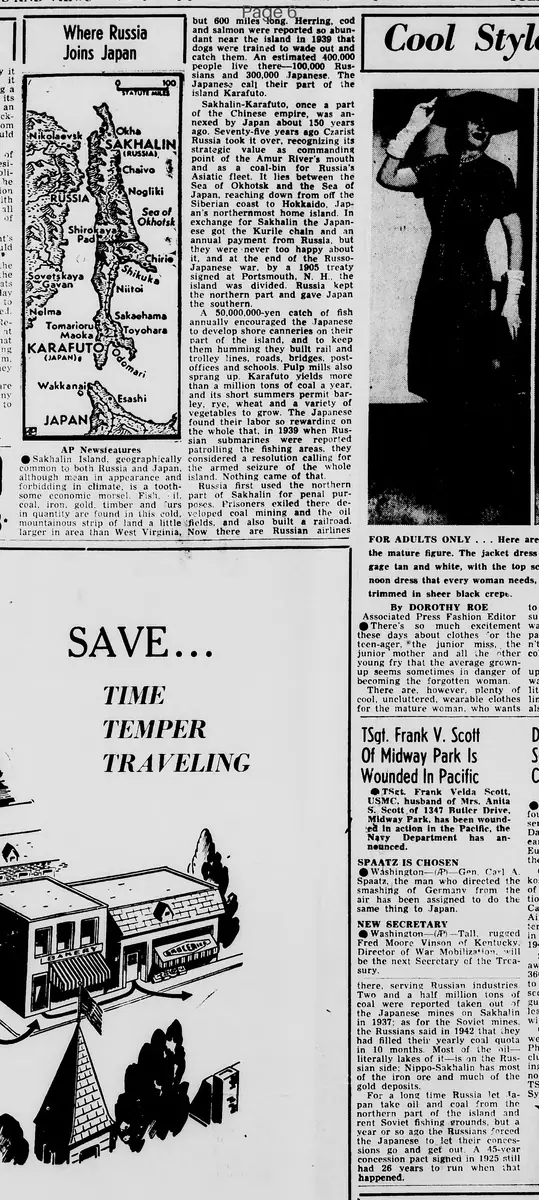
Sakhalin Island, geographically common to both Russia and Japan although mean in appearance and forbidding in climate, is a toothsome economic morsel. Fish, oil, coal, iron, gold, timber and furs in quantity are found in this cold, mountainous strip of land a little larger in area than West Virginia,
but 600 miles long. Herring, cod and salmon were reported so abundant near the island in 1939 that dogs were trained to wade out and catch them. An estimated 400,000 people live there--100,000 Russians and 300,000 Japanese. The Japanese call their part of the island Karafuto.
Sakhalin-Karafuto, once a part of the Chinese empire, was annexed by Japan about 150 years ago. Seventy-five years ago Czarist Russia took it over, recognizing its strategic value as commanding point of the Amur River's mouth and as a coal-bin for Russia's Asiatic fleet. It lies between the Sea of Okhotsk and the Sea of Japan, reaching down from off the Siberian coast to Hokkaido, Japan's northernmost home island. In exchange for Sakhalin the Japanese got the Kurile chain and an annual payment from Russia, but they were never too happy about it, and at the end of the Russo-Japanese war, by a 1905 treaty signed at Portsmouth, N. H. the island was divided. Russia kept the northern part and gave Japan the southern.
A 50,000,000-yen catch of fish annually encouraged the Japanese to develop shore canneries on their part of the island, and to keep them humming they built rail and trolley lines, roads, bridges, post-offices and schools. Pulp mills also sprang up. Karafuto yields more than a million tons of coal a year, and its short summers permit barley, rye, wheat and a variety of vegetables to grow. The Japanese found their labor so rewarding on the whole that, in 1939 when Russian submarines were reported patrolling the fishing areas, they considered a resolution calling for the armed seizure of the whole island. Nothing came of that.
Russia first used the northern part of Sakhalin for penal purposes. Prisoners exiled there developed coal mining and the oil fields, and also built a railroad. Now there are Russian airlines there, serving Russian industries. Two and a half million tons of coal were reported taken out of the Japanese mines on Sakhalin in 1937; as for the Soviet mines, the Russians said in 1942 that they had filled their yearly coal quota in 10 months. Most of the oil--literally lakes of it--is on the Russian side; Nippo-Sakhalin has most of the iron ore and much of the gold deposits.
For a long time Russia let Japan take oil and coal from the northern part of the island and rent Soviet fishing grounds, but a year or so ago the Russians forced the Japanese to let their concessions go and get out. A 45-year concession pact signed in 1925 still had 26 years to run when that happened.
What sub-type of article is it?
What keywords are associated?
Where did it happen?
Foreign News Details
Primary Location
Sakhalin Island
Outcome
island divided by 1905 treaty; russia terminates japanese concessions around 1942 despite 1925 pact having 26 years left.
Event Details
Sakhalin Island, shared by Russia and Japan, rich in fish, oil, coal, iron, gold, timber, and furs. Historically annexed from China, taken by Russia 75 years ago, divided after 1905 Russo-Japanese War. Japan developed southern Karafuto with fisheries, infrastructure, and agriculture. Russia used northern part for penal labor, mining, and oil. Recent Russian action ended Japanese concessions for northern resources.