Thank you for visiting SNEWPapers!
Sign up free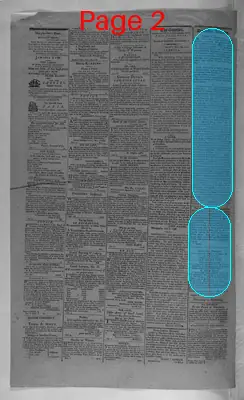
Gazette Of The United States, & Philadelphia Daily Advertiser
Philadelphia, Philadelphia County, Pennsylvania
What is this article about?
Boston political commentary criticizing Democrats for misleading followers and referencing publications by General Marshall, Lyon to Mason letter, and General Clark's expulsion. Includes Roxbury town meeting critique and 1747 Scottish captain anecdote. Ends with ad for Josiah Quincy's July 4, 1798 oration on independence.
Merged-components note: Merged sequential components reporting domestic news from Boston on political remarks and events.
Clipping

OCR Quality
Full Text
BOSTON, December 10.
Mr. Cobb. It has just published General Marshal's answers to the questions of his Richmond friend; upon which he makes the following remarks: "The questions, with the answers thereto, are said to have been published at Richmond in a pamphlet. I first saw them when I was in the country. It was at the time when the woods began to exchange their lively green for the sickly yellow: apt emblem of the versatility of man."
Lyon, in his letter to Mason, speaks of a General Clark, a brother-in-law of his, and member of the Legislature. A correspondent wishes to know, if this is not the villain who has since been expelled the house of Representatives of Vermont, for fraudulent practices.
The Democrats say, they have honest men of their party. They have unquestionably a notorious set among the most active and leading members, who do not pass for honest. But if, however, any really well meaning persons have been deceived and misled, as to the integrity and wisdom of our present rulers, and who yet from pride stick to the wrong side, they are bound to think maturely, once more, of their conduct and principles, as also of the bad company they have fallen into. Conscience, if party has not seared it with a red-hot iron, ought to whisper sometimes in their ears. If we Democrats are not right, and it is at least possible we are not, we are very wrong indeed. We are then of all men the most criminal, the most pestilent; we are helping the French we are hindering, as far as in us lies, the political salvation of our country, and conscience will whisper more last words. We may be wrong now, as we have been heretofore. Almost every thing we desired formerly, we no longer dare avow. Our censures of government have been so clearly disproved, that even Gallatin, Frenchman as he is, gives up the point, and justifies the conduct he had so much hand in rendering obnoxious. O Roxbury, who art rich from industry, and growing richer, and yet believest that our nation is oppressed and like to be enslaved; thou abounds with inhabitants of sense and merit, and yet bowest thy head before leaders who are a laughing stock. Verily it would be better for Sodom and Gomorrah, than for thee, if the days of tribulation, that thy rash town-meeting was called to hasten, should actually come to pass. Thou didst say, when the General * who is guiltless of shedding human blood, full of the terrors of war breathed into your bosoms his own heroic spirit; then when swelled with all his valor, you resolved, and resolving didst say, it is better to be smitten than to smite again with the fist of wickedness; better to sneak and say our prayers to the French than to arm, better to lose our ships than to fire their guns against pirates, and better to turn quakers than become soldiers. were armed they go nearly free and safe. Thus the wisdom of the conspicuous as its heroism did on the town-meeting day.
The event reminds us of a tongue valiant Scotch captain of militia, in 1747, who being sadly afraid to go into battle, called his soldiers to hear an harangue fit for the town meeting and its orator, and he so effectually painted the horrors of a battle, and the certainty of their going instantly to hell, if they were killed, as he believed the most of them would, that he found when he had finished, every brave fellow had run off, leaving the captain the excuse he wanted, to follow them. And thus the Democrats would leave ADAMS and WASHINGTON, Liberty and Property, a prey to the French.
* Heath.
This Day Published,
And for sale at the Office of the Editor, No. 119 Chestnut-street,
(Price 1-8th of a Dollar,)
AN ORATION,
Pronounced July 4, 1798,
At the request of the Inhabitants of the Town of BOSTON, in commemoration of the anniversary of American Independence.
By JOSIAH QUINCY.
"The inroads upon our public liberty, call for reparation—The wrongs we have sustained, call for Justice. That Reparation and that Justice, may yet be obtained, by Union, Spirit, and Firmness. But to divide and conquer was the maxim of the Devil in the garden of Eden, and to disunite and enslave hath been the principle of all his votaries from that period to the present."
Observations on the Boston Port-Bill, &c. p. 78 by the late J. Quincy, jun.
August 11
What sub-type of article is it?
What themes does it cover?
What keywords are associated?
What entities or persons were involved?
Where did it happen?
Story Details
Key Persons
Location
Boston, Roxbury, Richmond, Vermont
Event Date
December 10, 1798
Story Details
Commentary on political publications and Democratic deceptions, criticizing Roxbury town meeting resolutions against arming, with anecdote of 1747 Scottish captain; advertisement for Josiah Quincy's 1798 independence oration.