Thank you for visiting SNEWPapers!
Sign up free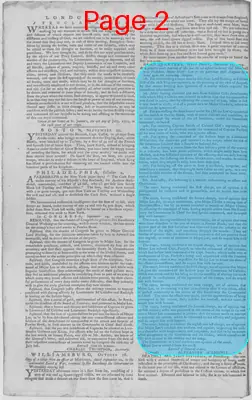
The Virginia Gazette
Richmond, Williamsburg, Richmond County, Virginia
What is this article about?
At West Point on September 2, 1779, a general court-martial presided by Col. Marshall acquitted Major Henry Lee of the partisan light dragoons on eight charges related to his command of a detachment in the August 18-19 Powles Hook expedition, including withholding information, assuming command, march disorders, and retreat decisions. Confirmed by Commander in Chief on September 11, 1779; Lee released from arrest.
Clipping
OCR Quality
Full Text
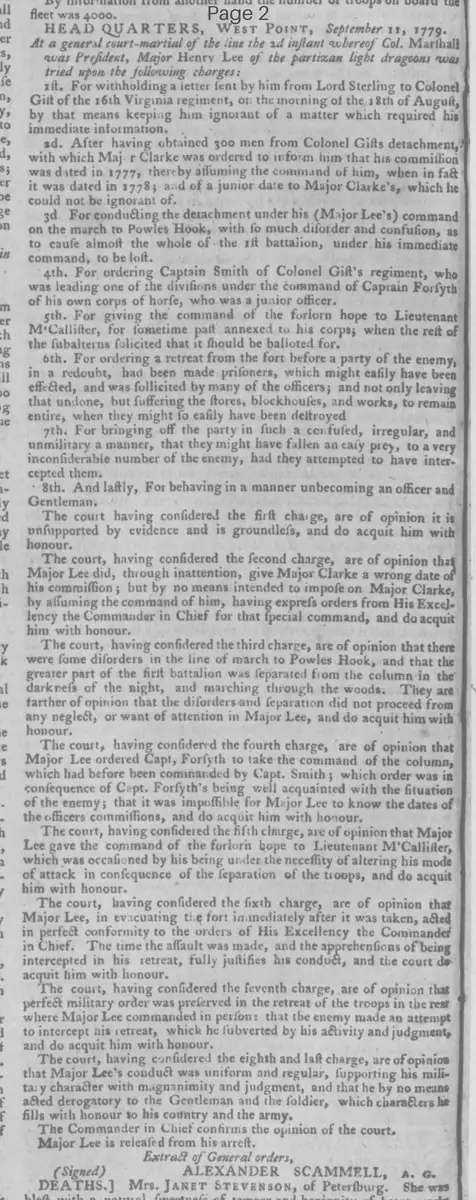
At a general court-martial of the line the 2d instant whereof Col. Marshall was President, Major Henry Lee of the partizan light dragoons was tried upon the following charges:
1st. For withholding a letter sent by him from Lord Sterling to Colonel Giles of the 16th Virginia regiment, on the morning of the 18th of August, by that means keeping him ignorant of a matter which required his immediate information.
2d. After having obtained 300 men from Colonel Giles detachment, with which Maj. Clarke was ordered to inform him that his commission was dated in 1777, thereby assuming the command of him, when in fact it was dated in 1778; and of a junior date to Major Clarke's, which he could not be ignorant of.
3d. For conducting the detachment under his (Major Lee's) command on the march to Powles Hook, with so much disorder and confusion, as to cause almost the whole of the 1st battalion, under his immediate command, to be lost.
4th. For ordering Captain Smith of Colonel Giles regiment, who was leading one of the divisions under the command of Captain Forsyth of his own corps of horse, who was a junior officer.
5th. For giving the command of the forlorn hope to Lieutenant M'Callister, for sometime past annexed to his corps; when the rest of the subalterns solicited that it should be balloted for.
6th. For ordering a retreat from the fort before a party of the enemy, in a redoubt, had been made prisoners, which might easily have been effected, and was solicited by many of the officers; and not only leaving that undone, but suffering the stores, blockhouses, and works, to remain entire, when they might so easily have been destroyed.
7th. For bringing off the party in such a confused, irregular, and unmilitary a manner, that they might have fallen an easy prey, to a very inconsiderable number of the enemy, had they attempted to have intercepted them.
8th. And lastly, For behaving in a manner unbecoming an officer and Gentleman.
The court having considered the first charge, are of opinion it is unsupported by evidence and is groundless, and do acquit him with honour.
The court, having considered the second charge, are of opinion that Major Lee did, through inattention, give Major Clarke a wrong date of his commission; but by no means intended to impose on Major Clarke, by assuming the command of him, having express orders from His Excellency the Commander in Chief for that special command, and do acquit him with honour.
The court, having considered the third charge, are of opinion that there were some disorders in the line of march to Powles Hook, and that the greater part of the first battalion was separated from the column in the darkness of the night, and marching through the woods. They are farther of opinion that the disorders and separation did not proceed from any neglect, or want of attention in Major Lee, and do acquit him with honour.
The court, having considered the fourth charge, are of opinion that Major Lee ordered Capt. Forsyth to take the command of the column, which had before been commanded by Capt. Smith; which order was in consequence of Capt. Forsyth's being well acquainted with the situation of the enemy; that it was impossible for Major Lee to know the dates of the officers commissions, and do acquit him with honour.
The court, having considered the fifth charge, are of opinion that Major Lee gave the command of the forlorn hope to Lieutenant M'Callister, which was occasioned by his being under the necessity of altering his mode of attack in consequence of the separation of the troops, and do acquit him with honour.
The court, having considered the sixth charge, are of opinion that Major Lee, in evacuating the fort immediately after it was taken, acted in perfect conformity to the orders of His Excellency the Commander in Chief. The time the assault was made, and the apprehensions of being intercepted in his retreat, fully justifies his conduct, and the court do acquit him with honour.
The court, having considered the seventh charge, are of opinion that perfect military order was preserved in the retreat of the troops in the rear where Major Lee commanded in person: that the enemy made an attempt to intercept his retreat, which he subverted by his activity and judgment, and do acquit him with honour.
The court, having considered the eighth and last charge, are of opinion that Major Lee's conduct was uniform and regular, supporting his military character with magnanimity and judgment, and that he by no means acted derogatory to the Gentleman and the soldier, which characters he fills with honour to his country and the army.
The Commander in Chief confirms the opinion of the court.
Major Lee is released from his arrest.
Extract of General orders,
(Signed)
ALEXANDER SCAMMELL, A. G.
What sub-type of article is it?
What keywords are associated?
What entities or persons were involved?
Where did it happen?
Domestic News Details
Primary Location
West Point
Event Date
September 11, 1779
Key Persons
Outcome
acquitted with honor on all eight charges; released from arrest.
Event Details
General court-martial tried Major Henry Lee on charges related to withholding a letter, assuming command via misinformation, disordered march to Powles Hook, improper orders to officers, assigning forlorn hope command, premature retreat from fort leaving enemy and structures intact, irregular retreat, and unbecoming conduct. Court found charges unsupported or justified, acquitting him on each.