Thank you for visiting SNEWPapers!
Sign up free
Foreign News
July 2, 1845
Republican Herald
Providence, Providence County, Rhode Island
What is this article about?
Detailed overview of the British royal family, including Queen Victoria and her children; key government officials like Sir Robert Peel; nobility structure; parliamentary composition; bishops' revenues; and naval forces, compared to the United States.
Clipping
OCR Quality
95%
Excellent
Full Text
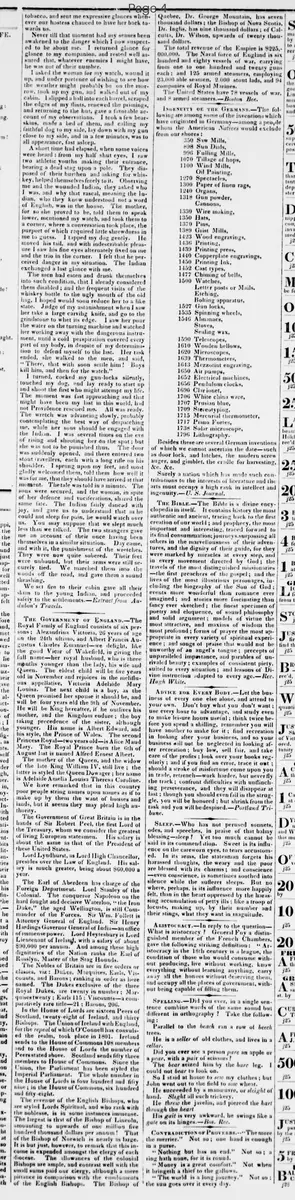
The Government of England.—The Royal Family of England consists of six persons; Alexandrina Victoria, 26 years of age on the 24th ultimo, and Albert Francis Augustus Charles Emanuel—we delight, like the good Vicar of Wakefield, in giving the full name—her royal husband, who is three months younger than the lady, his wife and queen. "The eldest child will be five years old in November and rejoices in the multitudinous appellative, Victoria Adelaide Mary Louisa." The next child is a boy, as the queen promised her spouse it should be, and will be four years old the 9th of November. He will be King hereafter, if he outlives his mother, and the Kingdom endure; the boy having precedence of the sister, although younger. His name is Albert Edward, and his style, the Prince of Wales. The second Princess Royal—two years old—is Alice Maud Mary. The Royal Prince born the 6th of August last is named Alfred Ernest Albert. The mother of the Queen, and the widow of the late King William IV, still live; the latter is styled the Queen Dowager; her name is Adelaide Amelia Louisa Theresa Caroline. We have remarked that in this country poor people string names upon names as if to make up by them the want of houses and lands, but it seems they may plead high authority.
The Government of Great Britain is in the hands of Sir Robert Peel, the first Lord of the Treasury, whom we consider the greatest of living European statesmen. His salary is about the same as that of the President of these United States.
Lord Lyndhurst, as Lord High Chancellor, presides over the Law of England. His salary is much greater, being about $60,000 a year.
The Earl of Aberdeen has charge of the Foreign Department. Lord Stanley of the Colonial. The conqueror Napoleon on the hard fought and decisive Waterloo, "the Iron Duke," the aged Wellington, is still Commander of the Forces. Sir Wm. Follett is Attorney General of England. Sir Henry Hardinge Governor General of India—an office of immense power. Lord Heytesbury is Lord Lieutenant of Ireland, with a salary of about $90,000 per annum. And among these high dignitaries of the Nation ranks the Earl of Rosslyn, Master of the Stag Hounds.
The Nobles of Britain are in five orders or classes, viz: Dukes, Marquises, Earls, Viscounts, and Barons; ranking in order as here named. The Dukes exclusive of the three Royal Dukes, are twenty in number: Marquises twenty; Earls 115; Viscounts—a comparatively rare title—21: Barons, 206.
In the House of Lords are sixteen Peers of Scotland, twenty-eight of Ireland, and thirty Bishops. The Union of Ireland with England, for the repeal of which O'Connell has convulsed the realm, took place in 1801. Ireland sends to the House of Commons 108 members and to the House of Lords the number of Peers stated above. Scotland sends fifty three members to House of Commons. Since the Union, the Parliament has been styled the Imperial Parliament. The whole number in the House of Lords is four hundred and fifty nine; in the House of Commons, six hundred and fifty-eight.
The revenue of the English Bishops, who are styled Lords Spiritual, and who rank with the noblesse, is in some instances immense. The largest is that of the Bishop of Lincoln, amounting to upwards of one million five hundred thousand dollars per annum! That of the Bishop of Norwich is nearly as large. It is but just, however, to remark that this income is expended amongst the clergy of each diocese.
The allowances of the colonial Bishops are ample, and contrast well with the small sums paid our clergy, although a mere pittance in comparison with the emoluments of the English Bishops. The Bishop of Quebec, Dr. George Mountain, has seven thousand dollars; the Bishop of Nova Scotia, Dr. Inglis, has nine thousand dollars; of Calcutta, Dr. Wilson, upwards of twenty thousand dollars.
The total revenue of the Empire is $225,000,000. The Naval force of England is six hundred and eighty vessels of war, carrying from one to one hundred and twenty guns each: and 125 armed steamers, employing 23,000 able seamen, 2,000 stout lads, and 94 companies of Royal Marines.
The United States have 78 vessels of war. and 8 armed steamers.—Boston Bee.
The Government of Great Britain is in the hands of Sir Robert Peel, the first Lord of the Treasury, whom we consider the greatest of living European statesmen. His salary is about the same as that of the President of these United States.
Lord Lyndhurst, as Lord High Chancellor, presides over the Law of England. His salary is much greater, being about $60,000 a year.
The Earl of Aberdeen has charge of the Foreign Department. Lord Stanley of the Colonial. The conqueror Napoleon on the hard fought and decisive Waterloo, "the Iron Duke," the aged Wellington, is still Commander of the Forces. Sir Wm. Follett is Attorney General of England. Sir Henry Hardinge Governor General of India—an office of immense power. Lord Heytesbury is Lord Lieutenant of Ireland, with a salary of about $90,000 per annum. And among these high dignitaries of the Nation ranks the Earl of Rosslyn, Master of the Stag Hounds.
The Nobles of Britain are in five orders or classes, viz: Dukes, Marquises, Earls, Viscounts, and Barons; ranking in order as here named. The Dukes exclusive of the three Royal Dukes, are twenty in number: Marquises twenty; Earls 115; Viscounts—a comparatively rare title—21: Barons, 206.
In the House of Lords are sixteen Peers of Scotland, twenty-eight of Ireland, and thirty Bishops. The Union of Ireland with England, for the repeal of which O'Connell has convulsed the realm, took place in 1801. Ireland sends to the House of Commons 108 members and to the House of Lords the number of Peers stated above. Scotland sends fifty three members to House of Commons. Since the Union, the Parliament has been styled the Imperial Parliament. The whole number in the House of Lords is four hundred and fifty nine; in the House of Commons, six hundred and fifty-eight.
The revenue of the English Bishops, who are styled Lords Spiritual, and who rank with the noblesse, is in some instances immense. The largest is that of the Bishop of Lincoln, amounting to upwards of one million five hundred thousand dollars per annum! That of the Bishop of Norwich is nearly as large. It is but just, however, to remark that this income is expended amongst the clergy of each diocese.
The allowances of the colonial Bishops are ample, and contrast well with the small sums paid our clergy, although a mere pittance in comparison with the emoluments of the English Bishops. The Bishop of Quebec, Dr. George Mountain, has seven thousand dollars; the Bishop of Nova Scotia, Dr. Inglis, has nine thousand dollars; of Calcutta, Dr. Wilson, upwards of twenty thousand dollars.
The total revenue of the Empire is $225,000,000. The Naval force of England is six hundred and eighty vessels of war, carrying from one to one hundred and twenty guns each: and 125 armed steamers, employing 23,000 able seamen, 2,000 stout lads, and 94 companies of Royal Marines.
The United States have 78 vessels of war. and 8 armed steamers.—Boston Bee.
What sub-type of article is it?
Court News
Political
What keywords are associated?
British Royal Family
Queen Victoria
Government Officials
Nobility Structure
Parliament Composition
Bishops Revenues
Naval Forces
What entities or persons were involved?
Alexandrina Victoria
Albert Francis Augustus Charles Emanuel
Victoria Adelaide Mary Louisa
Albert Edward
Alice Maud Mary
Alfred Ernest Albert
Adelaide Amelia Louisa Theresa Caroline
Sir Robert Peel
Lord Lyndhurst
Earl Of Aberdeen
Lord Stanley
Wellington
Sir Wm. Follett
Sir Henry Hardinge
Lord Heytesbury
Earl Of Rosslyn
O'connell
Dr. George Mountain
Dr. Inglis
Dr. Wilson
Where did it happen?
England
Foreign News Details
Primary Location
England
Key Persons
Alexandrina Victoria
Albert Francis Augustus Charles Emanuel
Victoria Adelaide Mary Louisa
Albert Edward
Alice Maud Mary
Alfred Ernest Albert
Adelaide Amelia Louisa Theresa Caroline
Sir Robert Peel
Lord Lyndhurst
Earl Of Aberdeen
Lord Stanley
Wellington
Sir Wm. Follett
Sir Henry Hardinge
Lord Heytesbury
Earl Of Rosslyn
O'connell
Dr. George Mountain
Dr. Inglis
Dr. Wilson
Event Details
Overview of the British royal family composition and ages; current government officials and their roles and salaries; structure of nobility and parliament including numbers of peers and members; revenues of bishops in England and colonies; total empire revenue; and naval forces compared to the United States.