Thank you for visiting SNEWPapers!
Sign up free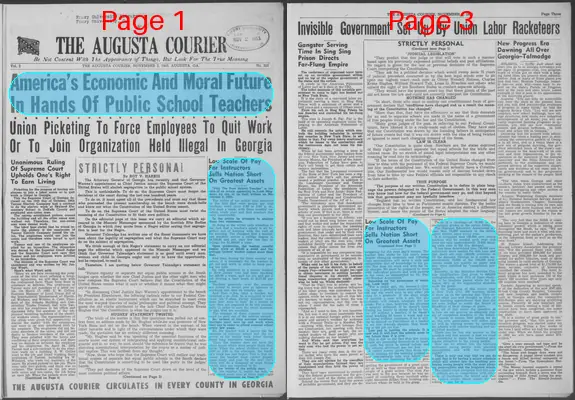
The Augusta Courier
Augusta, Richmond County, Georgia
What is this article about?
An article from Look Magazine, summarized in this piece, highlights the low pay for public school teachers, which discourages qualified candidates, leads to shortages, and threatens the quality of education and America's future. It details teachers' workloads, financial struggles, and the need for better salaries to attract talent.
Merged-components note: Continuation of the story on teachers' pay from page 1 to page 3.
Clippings
1 of 2
OCR Quality
Full Text
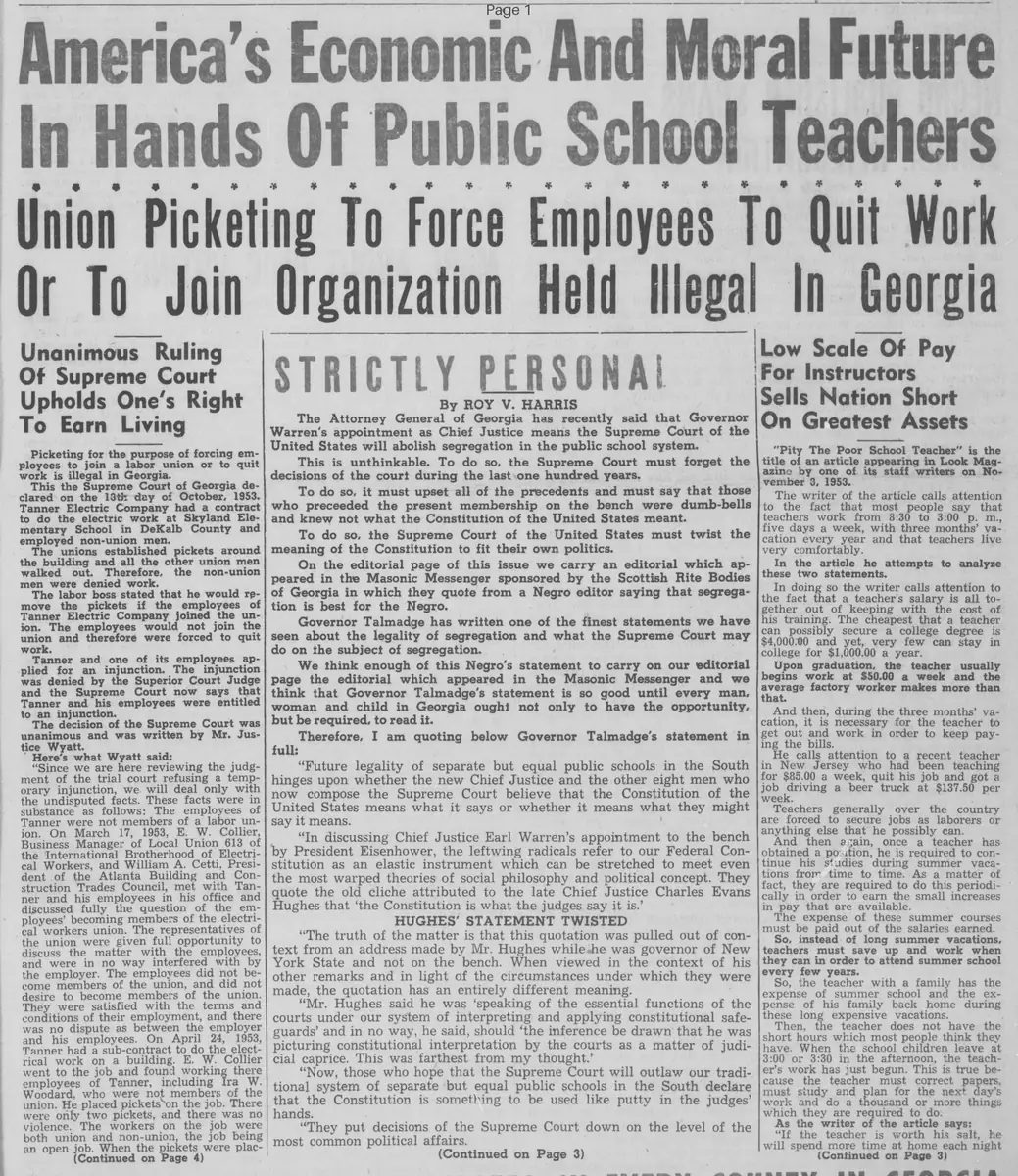
In Hands Of Public School Teachers
Low Scale Of Pay For Instructors Sells Nation Short On Greatest Assets
"Pity The Poor School Teacher" is the title of an article appearing in Look Magazine by one of its staff writers on November 3, 1953.
The writer of the article calls attention to the fact that most people say that teachers work from 8:30 to 3:00 p. m., five days a week, with three months' vacation every year and that teachers live very comfortably.
In the article he attempts to analyze these two statements.
In doing so the writer calls attention to the fact that a teacher's salary is altogether out of keeping with the cost of his training. The cheapest that a teacher can possibly secure a college degree is $4,000.00 and yet, very few can stay in college for $1,000.00 a year.
Upon graduation, the teacher usually begins work at $50.00 a week and the average factory worker makes more than that.
And then, during the three months' vacation, it is necessary for the teacher to get out and work in order to keep paying the bills.
He calls attention to a recent teacher in New Jersey who had been teaching for $85.00 a week, quit his job and got a job driving a beer truck at $137.50 per week.
Teachers generally over the country are forced to secure jobs as laborers or anything else that he possibly can.
And then again, once a teacher has obtained a position, he is required to continue his studies during summer vacations from time to time. As a matter of fact, they are required to do this periodically in order to earn the small increases in pay that are available.
The expense of these summer courses must be paid out of the salaries earned.
So, instead of long summer vacations, teachers must save up and work when they can in order to attend summer school every few years.
So, the teacher with a family has the expense of summer school and the expense of his family back home during these long expensive vacations.
Then, the teacher does not have the short hours which most people think they have. When the school children leave at 3:00 or 3:30 in the afternoon, the teacher's work has just begun. This is true because the teacher must correct papers, must study and plan for the next day's work and do a thousand or more things which they are required to do.
As the writer of the article says:
"If the teacher is worth his salt, he will spend more time at home each night (Continued on Page 3)
Low Scale Of Pay For Instructors Sells Nation Short On Greatest Assets
(Continued from Page 1)
preparing for the next day's lessons. The teacher who sticks by last year's notes despite changing materials and differing class personalities will serve a stale and indigestible diet of knowledge to his pupils. Nor does his work end with his little charges. He must be prepared to meet with individual parents and with parents in the mass, as represented by the Parent-Teacher Association. Summing up the advantages of teaching, Look says: "For a single girl, the teacher's starting wage is probably more attractive than the pay she could earn in any other job open to a graduate. If she stays single or marries a man with a job, the pay probably will remain adequate for her needs. For a man, however, the situation is entirely different. If he doesn't mind forcing his family to skimp (he'd be better off without a family), if he doesn't mind working 50 hours a week and can get along without vacations, if he is willing to depend on Providence or a banker to see him through disaster, then teaching is the job for him. Low pay is hurting the schools. It is now and it will hurt the schools more in the future than it is now. This is due to the fact that few young people are preparing themselves to teach. It costs too much to attend college and the returns afterward are too low. A recent survey shows that those who are in training for the teaching profession now intellectually rate way below than those who are preparing for other professions. There is a shortage of 70,000 in the elementary grades in the nation today. The National Education Association advises that 75,000 teachers in the public school system leave every year. It is estimated that 150,000 new school teachers will be needed each year and there are only approximately 75,000 training each year to fill this demand. It has been determined that 150,000 new instructors were needed for this year and that there are only 100,000 available to fill the demand. Strange as it seems, approximately 70,000 of the 100,000 newcomers could not qualify on paper and they were certified by exceptional processes. Recently, in the Selective Service College Qualification Test given to 400,000 undergraduates, only 27% of those studying to be teachers passed while for instance, 68% of the engineering students made the grade. At the beginning of this school year in New York City, 200 teachers failed to show up on the opening day. They secured other jobs and thought so little of their teaching appointment that they did not even bother to notify the Board of Education of their change of plans. So, all of this raises the question as to how we can provide an adequate supply of competent teachers in the future. It stands to reason that unless we do so, the new generations will suffer and we will be wasting money by operating the schools with inferior teaching and unqualified teachers. There can be but one answer to the question and that answer is that we must do something to make the teaching profession attractive to the young people. How can we attract into the teaching profession young people with pleasing personalities and with the brightest minds? There is only one way that we can do it and that is by having a salary schedule which will attract into the teaching profession young people with the most pleasing personalities and the brightest minds. The people must recognize that the public schools are in competition with other kinds of businesses for talent and that we cannot secure talent unless we are willing to pay for it.
What sub-type of article is it?
What themes does it cover?
What keywords are associated?
Where did it happen?
Story Details
Location
United States
Event Date
1953
Story Details
The article critiques low teacher salaries, highlighting training costs, additional work requirements, summer jobs, extended hours, teacher shortages, declining quality of candidates, and the urgent need for higher pay to attract talented individuals to education.