Thank you for visiting SNEWPapers!
Sign up free
Editorial
February 25, 1806
The Enquirer
Richmond, Henrico County, Virginia
What is this article about?
Editorial introduces and publishes essay by 'A Virginian Farmer' critiquing Virginia House of Delegates' 1805-1806 revenue estimate as inaccurate, claiming it double-counts September payments and includes future taxes, resulting in overstated surplus; actual resources show $35,536 deficit against appropriations.
Merged-components note: Essay on Virginia state finances merged with embedded estimate tables.
Clipping
OCR Quality
75%
Good
Full Text
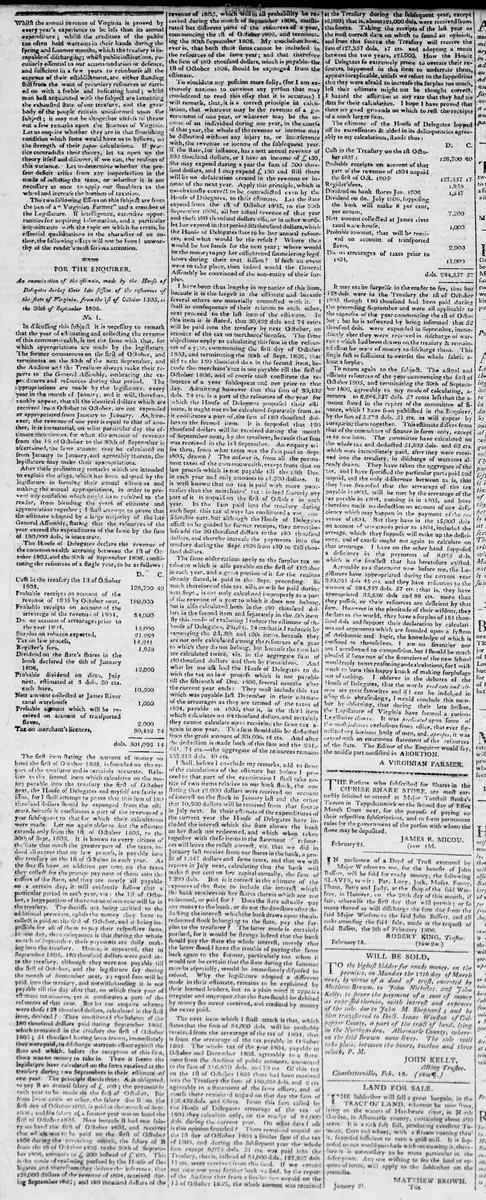
While the annual revenue of Virginia is proved by every year's experience to be less than its annual expenditure; whilst the creditors of the public too often hold warrants in their hands during the spring and summer months, which the treasury is incapable of discharging; whilst public institutions, peculiarly essential to our accommodation or defence, and sufficient in a few years to reimburse all the expense of their establishment, are either standing still from the want of pecuniary resources or carried on with a feeble and hesitating hand; whilst men best acquainted with the subject are lamenting the exhausted state of our treasury, and the great body of the people remain uninformed upon the subject; it may not be altogether useless to throw out a few remarks upon the finances of Virginia.
Let us enquire whether they are in that flourishing condition which some would have us to believe, on the strength of their paper calculations. If practice contradicts their theory, let us open up the theory itself and discover, if we can, the reasons of this variance. Let us determine whether the present deficit arises from any imperfection in the mode of collecting the taxes, or whether it is not necessary at once to apply our shoulders to the wheel and increase the burthen of taxation.
The two following Essays on this subject are from the pen of a 'Virginian Farmer' and a member of the Legislature. If intelligence, extensive opportunities for acquiring information, and a particular acquaintance with the topic on which he treats, be essential qualifications in the character of an author, the following essays will not be found unworthy of the reader's most serious attention.
FOR THE ENQUIRER.
An examination of the estimate, made by the House of Delegates during their late session, of the resources of the state of Virginia, from the 1st of October 1805, to the 30th of September 1806.
No. I.
In discussing this subject it is necessary to remark that the year of estimating and collecting the revenue of this commonwealth, is not the same with that, for which appropriations are made by the legislature. The former commences on the 1st of October, and terminates on the 30th of the next September, and the Auditor and the Treasurer always make their reports to the General Assembly, embracing the expenditures and resources during that period. The appropriations are made by the legislature, every year in the month of January, and it will, therefore, readily appear, that all the identical dollars which are received from October to October, are not expended or appropriated from January to January. As, however, the revenue of one year is equal to that of another, it is immaterial, on what particular day the estimate commences, for when the amount of revenue from the 1st of October to the 30th of September is ascertained, the same amount may be calculated on from January to January, and agreeably thereto, the legislature may make their appropriations.
After these preliminary remarks which are intended to explain the usage, which has been adopted by the legislature in forming their annual estimates and making the annual appropriations, in order to prevent any confusion which might have resulted to the reader, from blending the years of estimate and appropriation together; I shall attempt to prove that the estimate adopted by a large majority of the late General Assembly, stating that the resources of the year exceed the expenditures of the same by the sum of 180,000 dols, is inaccurate.
The House of Delegates declare the revenue of the commonwealth accruing between the 1st of October 1805, and the 30th of September 1806, constituting the resources of a single year, to be as follows:
dols. 501,095 14
The first item stating the amount of money on hand the first of October 1805, is founded on the report of the treasurer and is certainly accurate. Relative to the second item which calculates on the money payable into the treasury the first of October next, the House of Delegates and myself are fairly at issue, for I shall attempt to prove that this sum of 180 thousand dollars should be expunged from the estimate, because it constitutes a part of the revenue of a year subsequent to that for which their calculations were made. Let me again observe that the estimate extends only from the 1st of October 1805, to the 30th of Sept. 1806. It is known to every citizen of the state that much the greater part of the taxes, indeed all except that on law process, is payable into the treasury on the 1st of October in each year. As the sheriffs have an additional per cent. on the taxes they collect for the prompt payment of them into the coffers of the state, and they are nearly all payable on a certain day, it will evidently follow that a particular period in each year, viz: the 1st of October, a large portion of the revenue of one year will be in the treasury. The sheriffs not being entitled to the additional premium, unless the money they have to collect is paid on the first of October, and it being impossible for all of them to pay their respective sums, in one day, the consequence is that during the whole month of September, these payments are daily making into the treasury. Hence, it appeared, that in September 1805, 180 thousand dollars were paid into the treasury, although they were not payable till the first of October, and the legislature may during the month of September next, an equal sum will be paid into the treasury, and notwithstanding it is not payable till the day after that, on which their year of estimate terminates, yet it constitutes a part of the resources of that year. But let me enquire whence were those 128 thousand dollars, calculated in the first item, derived? They constituted the balance of the 180 thousand dollars paid during September 1805, which remained in the treasury the first of October 1805; 51 thousand having been drawn, immediately they were paid, to discharge warrants afloat against the state and which, before the reception of this sum, there was no money to take in. Then it seems the legislature have calculated on the sums received at the treasury during two Septembers in their estimate of one year. The principle stands thus: A is obligated to pay B an annual salary of £100: the payment in each year to be made on the first of October. But from some cause or other, the salary due B on the first day of October 1805, is paid in the month of Sept. 1806; and his salary of a former year was on hand the first of October 1805. Now because B had one salary on hand the first of October 1805, and receives that which was to be paid on the first of October 1806 during the preceding month, the salary of B from the 1st of October 1805 to the 30th of September 1806, amounts to £200 instead of £100. This is the mode of reasoning pursued by the House of Delegates, and therefrom they deduce the inference, that 128,000 dollars of the revenue of 1804, received during September 1805; and 180 thousand dollars of the revenue of 1805, which will in all probability be received during the month of September 1806, constituted but different parts of the resources of a year, commencing the 1st of October 1805, and terminating the 30th September 1806. My conclusion however is, that both these sums cannot be included in the resources of the same year; and that therefore the sum of 180 thousand dollars, which is payable the 1st of October 1806, should be expunged from the estimate.
To elucidate my position more fully, (for I am extremely anxious to convince any person that may condescend to read this essay that it is accurate) I will remark, that, it is a correct principle in calculation, that whatever may be the revenue of a government of one year, or whatever may be the income of an individual during one year, in the course of that year, the whole of the revenue or income may be disbursed without any injury to, or interference with, the revenue or income of the subsequent year. If the state, for instance, has a nett annual revenue of 500 thousand dollars, or I have an income of £150, she may expend during a year the sum of 500 thousand dollars, and I may expend £150 and still there will be no defalcation created in the revenue or income of the next year. Apply this principle, which is too obviously correct to be contradicted even by the House of Delegates, to their estimate. Let the state expend from the 1st of October 1805, to the 30th September 1806, all her actual revenue of that year and these 180 thousand dollars also, or in other words, let her expend in that period 680 thousand dollars, which the House of Delegates state to be her annual resources, and what would be the result? Where then would be her funds for the next year: where would be the money to pay her enlightened financiering legislators during their next session? If such an event were to take place, then indeed would the General Assembly be convinced of the non-entity of their surplus.
I have been thus lengthy in my notice of this item, because it is the largest in the estimate and because several others are materially connected with it. I shall in consequence of their relation to each other, next proceed to the last item of the estimate. In this item it is stated, that 30,439 dols. and 74 cents will be paid into the treasury by next October, on account of the tax on merchants' licenses. The same objections apply to calculating this sum in the resources of a year, commencing the first day of October 1805, and terminating the 30th of Sept. 1806, that did to the 180 thousand dols. in the second item, because the merchant's tax is not payable till the 1st of October 1806, and of course must constitute the resources of a year subsequent and not prior to that day. Admitting however that this sum of 30,439 dols. 74 cts. is a part of the resources of the year for which the House of Delegates proposed their estimate, it ought not to be calculated separately from, as it constitutes a part of, the sum of 180 thousand dollars in the second item: It is supposed that 180 thousand dollars will be received during the month of September next, by the treasurer, because that sum was received in the last September. An enquiry arises then, from what taxes was the sum paid in Sept. 1805, drawn? The answer is, from all the permanent taxes of the commonwealth, except from that on law process which is not payable till the 15th Dec. in each year and only amounts to 14,500 dollars. It is well known that no tax is paid with more punctuality than the merchants' tax: indeed scarcely any part of it is unpaid on the first of October in each year. In the sum paid into the treasury during each Sept. this tax always has constituted a very considerable part, but although the House of Delegates affect to be guided by former receipts, they nevertheless add the 30 thousand dollars to the 180 thousand dollars, and thereby increase the payments into the treasury during the Sept. 1806 from 180 to 210 thousand dollars.
The same observations apply to the surplus tax on tobacco which is also payable on the first of October in each year, and a great portion of it for the reasons already stated, is paid in the Sept. preceding. So much therefore of this tax also, as will be paid during next Sept., is not only calculated improperly as a part of the revenue of a year to which it does not belong, but is also calculated both in the 180 thousand dollars in the second item and separately in the 5th item. By this mode of reasoning I reduce the estimate of the house of Delegates, 231,641. 74 cts. that is, I reduce it by expunging the 2d, 5th and 12th items, because they are not only calculated among the resources of a year to which they do not belong, but because the two last are calculated twice, viz. in the aggregate sum of 180 thousand dollars and then by themselves. And what let me ask had the House of Delegates to do with the tax on law process which is not payable till the fifteenth of Dec. 1806, several months after the current year ends: They must include this tax which was payable last December in their estimate of the arrearages as they are termed of the taxes of 1804, payable in 1805, that is, in the third item which calculates on 84 thousand dollars, and certainly they cannot calculate upon receiving the same tax again in one year. This sum should also be deducted from the gross amount of 501,095. 14 cts. And after the deduction is made both of this sum and the 231,641. 74 cts.—the aggregate of the resources remains 255,218 dols. 40 cts.
I shall, before I conclude my remarks, add to some of the calculations of the estimate but before I proceed to that part of the examination I shall take notice of two items relative to our bank stock, the one stating that 12,000 dollars were received on account of interest on the stock in January last and the other that 10,500 dollars will be received from that source in July next. In their estimate of the expenditures of the current year the House of Delegates have included the interest which the state allows the bank on her stock not redeemed, and which when taken together with these items in the statement resources will leave the result correct, viz. that we did in January last receive from our shares in the bank, a profit of 1,347 dollars and some cents, and that we will receive in July next, calculating that the bank will make 8 per cent on her capital annually, the sum of 7,200 dols. But is it correct in the estimate of the expenses of the state to include the interest which the bank receives on her shares therein which are not redeemed, or paid for? Does the state actually pay any money to the bank, or do not the directors after deducting the interest which the bank draws upon the unredeemed stock belonging to the state, pay the surplus to the treasurer? The latter mode is certainly pursued, for it would be strange indeed that the bank should pay the state the whole interest, merely that the latter should have the trouble of paying the same back again to the former, particularly too when it would not be certain that the state during the summer months especially, would be immediately disposed to refund. Why the legislature adopted a different mode in their estimate, remains to be explained by their learned leaders, but to a plain mind it appears irregular and improper, that the state should be debited by money she never received, and credited by money she never paid.
The next item which I shall attack is that, which states that the sum of 84,000 dols. will be probably received from the arrearage of the tax of 1804, that is from the arrearage of the tax payable in October 1805. The whole tax of the year 1804, payable in October and December 1805, agreeably to a statement from the Auditor of public accounts, amounted to the sum of 316,970 dols. and 70 cts. Of this tax on the 1st of October 1805 there had been received into the Treasury the sum of 180,558 dols. and 2 cts agreeably to a statement of the same officer, and of course there remained unpaid on that day the sum of 136,412 dols. and 68 cts. From this sum called by the House of Delegates arrearage of the tax of 1804 they calculate only, on the receipt of 84,000 dols. during the current year. On what data I ask is this opinion founded? There remained unpaid on the 1st day of October 1804 a similar sum of the tax of 1803, and during the subsequent year the whole sum except 9,075 dols. 51 cts. was paid into the Treasury, that is, instead of 94,000 dols., 127,367 dols 17 cts. were received from this fund. If we extend our view one year farther back we find, by the report of the Auditor that from a similar sum unpaid on the 1st of October 1803, the whole amount was received at the Treasury during the subsequent year, except 16,000; that is, about 125,000 dols. were received from this source. Taking the receipts of the last year as the most correct data on which to found an opinion, and from this source the Treasury will receive the sum of 127,357 dols. 17 cts. and adopting a mean between the two years, 125,000. How the House of Delegates so extremely prone to overrate their resources, happened in this item to underrate them, appears inexplicable, unless we resort to the supposition that they were afraid to increase the surplus too much, lest their estimate might not be thought correct. I hazard the assertion at any rate that they had no data for their calculation. I hope I have proved that there are good grounds on which to rest the receipts of a much larger sum.
The estimate of the House of Delegates lopped off its excrescences & aided in its delinquencies agreeably to my calculations, stands thus:
Cash in the Treasury on the 1st October 1805:
Probable receipts on account of that part of the revenue of 1804 unpaid the 1st of Oct. 1805
Register's fees,
Dividend on bank stock Jan. 1806
Dividend on do. July 1806, supposing the bank will make 8 per cent, per annum,
Nett amount collected at James river canal warehouse,
Probable amount, that will be received on account of transported slaves,
Do. on arrearages of taxes prior to 1804,
dols. 294,557 57
It may excite surprise in the reader to see, that but 128 dols. were in the Treasury the 1st of October 1805, though 180 thousand had been paid during the preceding September and were all applicable to the expenses of the year commencing the 1st of October; but he is answered by being informed that 52 thousand dols. were expended in September, immediately after they were received in discharge of warrants which had been drawn on the treasury & remained afloat for want of money to discharge them. This single act is sufficient to overturn the whole fabric about a surplus.
To return again to the subject. The actual and efficient resources of the year commencing the 1st of October 1805, and terminating the 30th of September 1806, agreeably to my mode of calculating, amounts to 284,557 dols. 57 cents less than the amount stated in the report of the committee of finance, which I have seen published in the Enquirer, by the sum of 5,579 dols. 51 cts. as will appear by comparing them together. This estimate differs from that of the committee of finance in form only, except as to one item. The committee have calculated on the whole tax and deducted 51,559 dols. and 62 cts. which were immediately paid, after they were received into the treasury, in discharge of warrants already drawn. They have taken the aggregate of the tax, and I have specified the particular parts paid and unpaid, and the only difference between us is, that they have supposed that the arrearage of the tax payable in 1805, will be met by the arrearage of the tax payable in 1804, coming in in 1805, and have therefore made no deduction on account of any deficiency which may happen in the payment of the revenue of 1804. But they have in the 15,000 dols on account of arrearages prior to 1804, included the arrearage, which they suppose will make up the deficiency, and of course ought not again to calculate on that arrearage. I have on the other hand supposed a deficiency in the payments of 9,075 dols. which is the smallest that has heretofore existed. Agreeably to a statement now before me, the Legislature have appropriated during the current year 320,091 dols 45 cts. and they have resources to the amount of 284,557 dols. 57 cts.; that is, they have appropriated 35,536 dols and 88 cts. more than they possess, or their resources are deficient by that sum. However in the plenitude of their wisdom, they declare to the world, they have a surplus of 180 thousand dols. and support their declaration by calculations and arguments which are founded upon a system of Arithmetic and logic, the knowledge of which is confined to themselves. I am no financier nor am I accustomed to composition, but I should be much pleased if some one of the financiers of the new school would reply to my reasoning and calculations, for I wish much to learn this happy knack of making surplus out of nothing. I observe in the debates of the House of Delegates, that the words predicate and climax are great favorites and if I can be indulged in using their phraseology, I would conclude this number by observing, that during their late Session the Legislature of Virginia have formed a curious Legislative climax. It was predicated upon some of the most judicious exclusions from office, that ever signalized any luminous body of men, and, apropos, it was capped with an enormous statement of the resources of the state. The Editor of the Enquirer would say, the middle part consisted in ABORTION.
A VIRGINIAN FARMER.
Let us enquire whether they are in that flourishing condition which some would have us to believe, on the strength of their paper calculations. If practice contradicts their theory, let us open up the theory itself and discover, if we can, the reasons of this variance. Let us determine whether the present deficit arises from any imperfection in the mode of collecting the taxes, or whether it is not necessary at once to apply our shoulders to the wheel and increase the burthen of taxation.
The two following Essays on this subject are from the pen of a 'Virginian Farmer' and a member of the Legislature. If intelligence, extensive opportunities for acquiring information, and a particular acquaintance with the topic on which he treats, be essential qualifications in the character of an author, the following essays will not be found unworthy of the reader's most serious attention.
FOR THE ENQUIRER.
An examination of the estimate, made by the House of Delegates during their late session, of the resources of the state of Virginia, from the 1st of October 1805, to the 30th of September 1806.
No. I.
In discussing this subject it is necessary to remark that the year of estimating and collecting the revenue of this commonwealth, is not the same with that, for which appropriations are made by the legislature. The former commences on the 1st of October, and terminates on the 30th of the next September, and the Auditor and the Treasurer always make their reports to the General Assembly, embracing the expenditures and resources during that period. The appropriations are made by the legislature, every year in the month of January, and it will, therefore, readily appear, that all the identical dollars which are received from October to October, are not expended or appropriated from January to January. As, however, the revenue of one year is equal to that of another, it is immaterial, on what particular day the estimate commences, for when the amount of revenue from the 1st of October to the 30th of September is ascertained, the same amount may be calculated on from January to January, and agreeably thereto, the legislature may make their appropriations.
After these preliminary remarks which are intended to explain the usage, which has been adopted by the legislature in forming their annual estimates and making the annual appropriations, in order to prevent any confusion which might have resulted to the reader, from blending the years of estimate and appropriation together; I shall attempt to prove that the estimate adopted by a large majority of the late General Assembly, stating that the resources of the year exceed the expenditures of the same by the sum of 180,000 dols, is inaccurate.
The House of Delegates declare the revenue of the commonwealth accruing between the 1st of October 1805, and the 30th of September 1806, constituting the resources of a single year, to be as follows:
dols. 501,095 14
The first item stating the amount of money on hand the first of October 1805, is founded on the report of the treasurer and is certainly accurate. Relative to the second item which calculates on the money payable into the treasury the first of October next, the House of Delegates and myself are fairly at issue, for I shall attempt to prove that this sum of 180 thousand dollars should be expunged from the estimate, because it constitutes a part of the revenue of a year subsequent to that for which their calculations were made. Let me again observe that the estimate extends only from the 1st of October 1805, to the 30th of Sept. 1806. It is known to every citizen of the state that much the greater part of the taxes, indeed all except that on law process, is payable into the treasury on the 1st of October in each year. As the sheriffs have an additional per cent. on the taxes they collect for the prompt payment of them into the coffers of the state, and they are nearly all payable on a certain day, it will evidently follow that a particular period in each year, viz: the 1st of October, a large portion of the revenue of one year will be in the treasury. The sheriffs not being entitled to the additional premium, unless the money they have to collect is paid on the first of October, and it being impossible for all of them to pay their respective sums, in one day, the consequence is that during the whole month of September, these payments are daily making into the treasury. Hence, it appeared, that in September 1805, 180 thousand dollars were paid into the treasury, although they were not payable till the first of October, and the legislature may during the month of September next, an equal sum will be paid into the treasury, and notwithstanding it is not payable till the day after that, on which their year of estimate terminates, yet it constitutes a part of the resources of that year. But let me enquire whence were those 128 thousand dollars, calculated in the first item, derived? They constituted the balance of the 180 thousand dollars paid during September 1805, which remained in the treasury the first of October 1805; 51 thousand having been drawn, immediately they were paid, to discharge warrants afloat against the state and which, before the reception of this sum, there was no money to take in. Then it seems the legislature have calculated on the sums received at the treasury during two Septembers in their estimate of one year. The principle stands thus: A is obligated to pay B an annual salary of £100: the payment in each year to be made on the first of October. But from some cause or other, the salary due B on the first day of October 1805, is paid in the month of Sept. 1806; and his salary of a former year was on hand the first of October 1805. Now because B had one salary on hand the first of October 1805, and receives that which was to be paid on the first of October 1806 during the preceding month, the salary of B from the 1st of October 1805 to the 30th of September 1806, amounts to £200 instead of £100. This is the mode of reasoning pursued by the House of Delegates, and therefrom they deduce the inference, that 128,000 dollars of the revenue of 1804, received during September 1805; and 180 thousand dollars of the revenue of 1805, which will in all probability be received during the month of September 1806, constituted but different parts of the resources of a year, commencing the 1st of October 1805, and terminating the 30th September 1806. My conclusion however is, that both these sums cannot be included in the resources of the same year; and that therefore the sum of 180 thousand dollars, which is payable the 1st of October 1806, should be expunged from the estimate.
To elucidate my position more fully, (for I am extremely anxious to convince any person that may condescend to read this essay that it is accurate) I will remark, that, it is a correct principle in calculation, that whatever may be the revenue of a government of one year, or whatever may be the income of an individual during one year, in the course of that year, the whole of the revenue or income may be disbursed without any injury to, or interference with, the revenue or income of the subsequent year. If the state, for instance, has a nett annual revenue of 500 thousand dollars, or I have an income of £150, she may expend during a year the sum of 500 thousand dollars, and I may expend £150 and still there will be no defalcation created in the revenue or income of the next year. Apply this principle, which is too obviously correct to be contradicted even by the House of Delegates, to their estimate. Let the state expend from the 1st of October 1805, to the 30th September 1806, all her actual revenue of that year and these 180 thousand dollars also, or in other words, let her expend in that period 680 thousand dollars, which the House of Delegates state to be her annual resources, and what would be the result? Where then would be her funds for the next year: where would be the money to pay her enlightened financiering legislators during their next session? If such an event were to take place, then indeed would the General Assembly be convinced of the non-entity of their surplus.
I have been thus lengthy in my notice of this item, because it is the largest in the estimate and because several others are materially connected with it. I shall in consequence of their relation to each other, next proceed to the last item of the estimate. In this item it is stated, that 30,439 dols. and 74 cents will be paid into the treasury by next October, on account of the tax on merchants' licenses. The same objections apply to calculating this sum in the resources of a year, commencing the first day of October 1805, and terminating the 30th of Sept. 1806, that did to the 180 thousand dols. in the second item, because the merchant's tax is not payable till the 1st of October 1806, and of course must constitute the resources of a year subsequent and not prior to that day. Admitting however that this sum of 30,439 dols. 74 cts. is a part of the resources of the year for which the House of Delegates proposed their estimate, it ought not to be calculated separately from, as it constitutes a part of, the sum of 180 thousand dollars in the second item: It is supposed that 180 thousand dollars will be received during the month of September next, by the treasurer, because that sum was received in the last September. An enquiry arises then, from what taxes was the sum paid in Sept. 1805, drawn? The answer is, from all the permanent taxes of the commonwealth, except from that on law process which is not payable till the 15th Dec. in each year and only amounts to 14,500 dollars. It is well known that no tax is paid with more punctuality than the merchants' tax: indeed scarcely any part of it is unpaid on the first of October in each year. In the sum paid into the treasury during each Sept. this tax always has constituted a very considerable part, but although the House of Delegates affect to be guided by former receipts, they nevertheless add the 30 thousand dollars to the 180 thousand dollars, and thereby increase the payments into the treasury during the Sept. 1806 from 180 to 210 thousand dollars.
The same observations apply to the surplus tax on tobacco which is also payable on the first of October in each year, and a great portion of it for the reasons already stated, is paid in the Sept. preceding. So much therefore of this tax also, as will be paid during next Sept., is not only calculated improperly as a part of the revenue of a year to which it does not belong, but is also calculated both in the 180 thousand dollars in the second item and separately in the 5th item. By this mode of reasoning I reduce the estimate of the house of Delegates, 231,641. 74 cts. that is, I reduce it by expunging the 2d, 5th and 12th items, because they are not only calculated among the resources of a year to which they do not belong, but because the two last are calculated twice, viz. in the aggregate sum of 180 thousand dollars and then by themselves. And what let me ask had the House of Delegates to do with the tax on law process which is not payable till the fifteenth of Dec. 1806, several months after the current year ends: They must include this tax which was payable last December in their estimate of the arrearages as they are termed of the taxes of 1804, payable in 1805, that is, in the third item which calculates on 84 thousand dollars, and certainly they cannot calculate upon receiving the same tax again in one year. This sum should also be deducted from the gross amount of 501,095. 14 cts. And after the deduction is made both of this sum and the 231,641. 74 cts.—the aggregate of the resources remains 255,218 dols. 40 cts.
I shall, before I conclude my remarks, add to some of the calculations of the estimate but before I proceed to that part of the examination I shall take notice of two items relative to our bank stock, the one stating that 12,000 dollars were received on account of interest on the stock in January last and the other that 10,500 dollars will be received from that source in July next. In their estimate of the expenditures of the current year the House of Delegates have included the interest which the state allows the bank on her stock not redeemed, and which when taken together with these items in the statement resources will leave the result correct, viz. that we did in January last receive from our shares in the bank, a profit of 1,347 dollars and some cents, and that we will receive in July next, calculating that the bank will make 8 per cent on her capital annually, the sum of 7,200 dols. But is it correct in the estimate of the expenses of the state to include the interest which the bank receives on her shares therein which are not redeemed, or paid for? Does the state actually pay any money to the bank, or do not the directors after deducting the interest which the bank draws upon the unredeemed stock belonging to the state, pay the surplus to the treasurer? The latter mode is certainly pursued, for it would be strange indeed that the bank should pay the state the whole interest, merely that the latter should have the trouble of paying the same back again to the former, particularly too when it would not be certain that the state during the summer months especially, would be immediately disposed to refund. Why the legislature adopted a different mode in their estimate, remains to be explained by their learned leaders, but to a plain mind it appears irregular and improper, that the state should be debited by money she never received, and credited by money she never paid.
The next item which I shall attack is that, which states that the sum of 84,000 dols. will be probably received from the arrearage of the tax of 1804, that is from the arrearage of the tax payable in October 1805. The whole tax of the year 1804, payable in October and December 1805, agreeably to a statement from the Auditor of public accounts, amounted to the sum of 316,970 dols. and 70 cts. Of this tax on the 1st of October 1805 there had been received into the Treasury the sum of 180,558 dols. and 2 cts agreeably to a statement of the same officer, and of course there remained unpaid on that day the sum of 136,412 dols. and 68 cts. From this sum called by the House of Delegates arrearage of the tax of 1804 they calculate only, on the receipt of 84,000 dols. during the current year. On what data I ask is this opinion founded? There remained unpaid on the 1st day of October 1804 a similar sum of the tax of 1803, and during the subsequent year the whole sum except 9,075 dols. 51 cts. was paid into the Treasury, that is, instead of 94,000 dols., 127,367 dols 17 cts. were received from this fund. If we extend our view one year farther back we find, by the report of the Auditor that from a similar sum unpaid on the 1st of October 1803, the whole amount was received at the Treasury during the subsequent year, except 16,000; that is, about 125,000 dols. were received from this source. Taking the receipts of the last year as the most correct data on which to found an opinion, and from this source the Treasury will receive the sum of 127,357 dols. 17 cts. and adopting a mean between the two years, 125,000. How the House of Delegates so extremely prone to overrate their resources, happened in this item to underrate them, appears inexplicable, unless we resort to the supposition that they were afraid to increase the surplus too much, lest their estimate might not be thought correct. I hazard the assertion at any rate that they had no data for their calculation. I hope I have proved that there are good grounds on which to rest the receipts of a much larger sum.
The estimate of the House of Delegates lopped off its excrescences & aided in its delinquencies agreeably to my calculations, stands thus:
Cash in the Treasury on the 1st October 1805:
Probable receipts on account of that part of the revenue of 1804 unpaid the 1st of Oct. 1805
Register's fees,
Dividend on bank stock Jan. 1806
Dividend on do. July 1806, supposing the bank will make 8 per cent, per annum,
Nett amount collected at James river canal warehouse,
Probable amount, that will be received on account of transported slaves,
Do. on arrearages of taxes prior to 1804,
dols. 294,557 57
It may excite surprise in the reader to see, that but 128 dols. were in the Treasury the 1st of October 1805, though 180 thousand had been paid during the preceding September and were all applicable to the expenses of the year commencing the 1st of October; but he is answered by being informed that 52 thousand dols. were expended in September, immediately after they were received in discharge of warrants which had been drawn on the treasury & remained afloat for want of money to discharge them. This single act is sufficient to overturn the whole fabric about a surplus.
To return again to the subject. The actual and efficient resources of the year commencing the 1st of October 1805, and terminating the 30th of September 1806, agreeably to my mode of calculating, amounts to 284,557 dols. 57 cents less than the amount stated in the report of the committee of finance, which I have seen published in the Enquirer, by the sum of 5,579 dols. 51 cts. as will appear by comparing them together. This estimate differs from that of the committee of finance in form only, except as to one item. The committee have calculated on the whole tax and deducted 51,559 dols. and 62 cts. which were immediately paid, after they were received into the treasury, in discharge of warrants already drawn. They have taken the aggregate of the tax, and I have specified the particular parts paid and unpaid, and the only difference between us is, that they have supposed that the arrearage of the tax payable in 1805, will be met by the arrearage of the tax payable in 1804, coming in in 1805, and have therefore made no deduction on account of any deficiency which may happen in the payment of the revenue of 1804. But they have in the 15,000 dols on account of arrearages prior to 1804, included the arrearage, which they suppose will make up the deficiency, and of course ought not again to calculate on that arrearage. I have on the other hand supposed a deficiency in the payments of 9,075 dols. which is the smallest that has heretofore existed. Agreeably to a statement now before me, the Legislature have appropriated during the current year 320,091 dols 45 cts. and they have resources to the amount of 284,557 dols. 57 cts.; that is, they have appropriated 35,536 dols and 88 cts. more than they possess, or their resources are deficient by that sum. However in the plenitude of their wisdom, they declare to the world, they have a surplus of 180 thousand dols. and support their declaration by calculations and arguments which are founded upon a system of Arithmetic and logic, the knowledge of which is confined to themselves. I am no financier nor am I accustomed to composition, but I should be much pleased if some one of the financiers of the new school would reply to my reasoning and calculations, for I wish much to learn this happy knack of making surplus out of nothing. I observe in the debates of the House of Delegates, that the words predicate and climax are great favorites and if I can be indulged in using their phraseology, I would conclude this number by observing, that during their late Session the Legislature of Virginia have formed a curious Legislative climax. It was predicated upon some of the most judicious exclusions from office, that ever signalized any luminous body of men, and, apropos, it was capped with an enormous statement of the resources of the state. The Editor of the Enquirer would say, the middle part consisted in ABORTION.
A VIRGINIAN FARMER.
| D. | C. | |
| Cash in the treasury the 1st of October 1805, | 128,700 | 40 |
| Probable receipts on account of the revenue of 1805 by October next, | 180,000 | |
| Probable receipts on account of the arrearage of the revenue of 1804, | 84,000 | |
| Do. on account of arrearages prior to the year 1804, | 15,000 | |
| Surplus on tobacco exported, | 21,260 | |
| Tax on law process, | 14,241 | |
| Register's fees, | 1,953 | |
| Dividend on the state's shares in the bank declared the 6th of January 1806, | 12,000 | |
| Probable dividend on ditto, July next, estimated at 3 dolls. 50 cts. each share, | 10,500 | |
| Nett amount collected at James River canal warehouse | 1,000 | |
| Probable amount which will be received on account of transported slaves, | 2,000 | |
| Tax on merchant's licences, | 30,482 | 74 |
| D. | C. |
| 128,700 | 40 |
| 127,357 | 17 |
| 1,953 | |
| 7,200 | |
| 1,000 | |
| 2,000 | |
| 15,000 |
What sub-type of article is it?
Economic Policy
Taxation
What keywords are associated?
Virginia Finances
Revenue Estimate
House Of Delegates
Taxation
Deficit
Arrearages
Bank Stock
What entities or persons were involved?
House Of Delegates
General Assembly
Virginian Farmer
Treasurer
Auditor
Virginia State
Editorial Details
Primary Topic
Critique Of Virginia House Of Delegates' Revenue Estimate For 1805 1806
Stance / Tone
Critical Of Legislative Financial Calculations, Arguing For Actual Deficit
Key Figures
House Of Delegates
General Assembly
Virginian Farmer
Treasurer
Auditor
Virginia State
Key Arguments
Estimate Double Counts September Tax Payments From Two Years
Includes Future Taxes Payable After September 1806
Overstates Resources By $231,641 Including Merchants' Licenses And Tobacco Tax
Arrearages From 1804 Likely Higher Than Estimated $84,000
Actual Resources $284,557 Vs. Appropriations $320,091, Deficit $35,536
Bank Stock Dividends Miscalculated By Including Unredeemed Interest