Thank you for visiting SNEWPapers!
Sign up free
Editorial
October 31, 1875
The New Orleans Bulletin
New Orleans, Orleans County, Louisiana
What is this article about?
An 1875 New Orleans editorial urges unemployed city dwellers to relocate to rural areas for farming and self-sufficiency, noting a positive trend of families migrating and predicting economic benefits for the state.
Clipping
OCR Quality
98%
Excellent
Full Text
NEW ORLEANS, OCTOBER 31, 1875.
A BRIGHTENING PROSPECT.
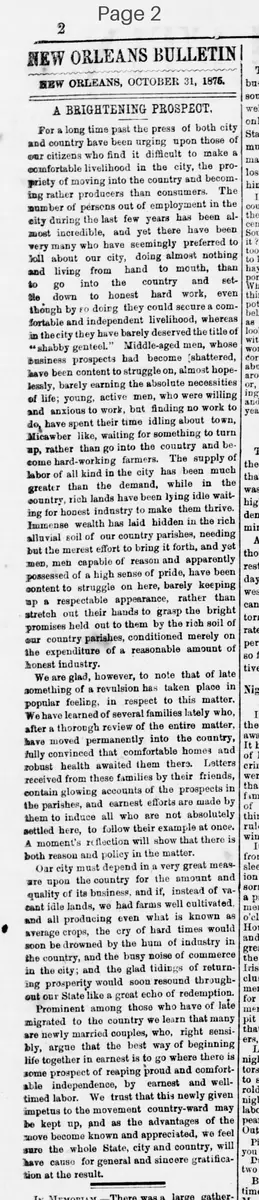
For a long time past the press of both city and country have been urging upon those of our citizens who find it difficult to make a comfortable livelihood in the city, the propriety of moving into the country and becoming rather producers than consumers. The number of persons out of employment in the city during the last few years has been almost incredible, and yet there have been very many who have seemingly preferred to roll about our city, doing almost nothing and living from hand to mouth, than to go into the country and set down to honest hard work, even though by so doing they could secure a comfortable and independent livelihood, whereas in the city they have barely deserved the title of "shabby genteel." Middle-aged men, whose business prospects had become shattered, have been content to struggle on, almost hopelessly, barely earning the absolute necessities of life; young, active men, who were willing and anxious to work, but finding no work to do, have spent their time idling about town, Micawber like, waiting for something to turn up, rather than go into the country and become hard-working farmers. The supply of labor of all kind in the city has been much greater than the demand, while in the country, rich lands have been lying idle waiting for honest industry to make them thrive. Immense wealth has laid hidden in the rich alluvial soil of our country parishes, needing but the merest effort to bring it forth, and yet men, men capable of reason and apparently possessed of a high sense of pride, have been content to struggle on here, barely keeping up a respectable appearance, rather than stretch out their hands to grasp the bright promises held out to them by the rich soil of our country parishes, conditioned merely on the expenditure of a reasonable amount of honest industry.
We are glad, however, to note that of late something of a revulsion has taken place in popular feeling, in respect to this matter. We have learned of several families lately who, after a thorough review of the entire matter, have moved permanently into the country, fully convinced that comfortable homes and robust health awaited them there. Letters received from these families by their friends contain glowing accounts of the prospects in the parishes, and earnest efforts are made by them to induce all who are not absolutely settled here, to follow their example at once. A moment's reflection will show that there is both reason and policy in the matter. Our city must depend in a very great measure upon the country for the amount and quality of its business, and if, instead of vacant idle lands, we had farms well cultivated and all producing even what is known as average crops, the cry of hard times would soon be drowned by the hum of industry in the country, and the busy noise of commerce in the city; and the glad tidings of returning prosperity would soon resound throughout our State like a great echo of redemption. Prominent among those who have of late migrated to the country we learn that many are newly married couples, who, right sensibly, argue that the best way of beginning life together in earnest is to go where there is some prospect of reaping proud and comfortable independence, by earnest and well-timed labor. We trust that this newly given impetus to the movement country-ward may be kept up, and as the advantages of the move become known and appreciated, we feel sure the whole State, city and country, will have cause for general and sincere gratification at the result.
A BRIGHTENING PROSPECT.
For a long time past the press of both city and country have been urging upon those of our citizens who find it difficult to make a comfortable livelihood in the city, the propriety of moving into the country and becoming rather producers than consumers. The number of persons out of employment in the city during the last few years has been almost incredible, and yet there have been very many who have seemingly preferred to roll about our city, doing almost nothing and living from hand to mouth, than to go into the country and set down to honest hard work, even though by so doing they could secure a comfortable and independent livelihood, whereas in the city they have barely deserved the title of "shabby genteel." Middle-aged men, whose business prospects had become shattered, have been content to struggle on, almost hopelessly, barely earning the absolute necessities of life; young, active men, who were willing and anxious to work, but finding no work to do, have spent their time idling about town, Micawber like, waiting for something to turn up, rather than go into the country and become hard-working farmers. The supply of labor of all kind in the city has been much greater than the demand, while in the country, rich lands have been lying idle waiting for honest industry to make them thrive. Immense wealth has laid hidden in the rich alluvial soil of our country parishes, needing but the merest effort to bring it forth, and yet men, men capable of reason and apparently possessed of a high sense of pride, have been content to struggle on here, barely keeping up a respectable appearance, rather than stretch out their hands to grasp the bright promises held out to them by the rich soil of our country parishes, conditioned merely on the expenditure of a reasonable amount of honest industry.
We are glad, however, to note that of late something of a revulsion has taken place in popular feeling, in respect to this matter. We have learned of several families lately who, after a thorough review of the entire matter, have moved permanently into the country, fully convinced that comfortable homes and robust health awaited them there. Letters received from these families by their friends contain glowing accounts of the prospects in the parishes, and earnest efforts are made by them to induce all who are not absolutely settled here, to follow their example at once. A moment's reflection will show that there is both reason and policy in the matter. Our city must depend in a very great measure upon the country for the amount and quality of its business, and if, instead of vacant idle lands, we had farms well cultivated and all producing even what is known as average crops, the cry of hard times would soon be drowned by the hum of industry in the country, and the busy noise of commerce in the city; and the glad tidings of returning prosperity would soon resound throughout our State like a great echo of redemption. Prominent among those who have of late migrated to the country we learn that many are newly married couples, who, right sensibly, argue that the best way of beginning life together in earnest is to go where there is some prospect of reaping proud and comfortable independence, by earnest and well-timed labor. We trust that this newly given impetus to the movement country-ward may be kept up, and as the advantages of the move become known and appreciated, we feel sure the whole State, city and country, will have cause for general and sincere gratification at the result.
What sub-type of article is it?
Agriculture
Labor
Economic Policy
What keywords are associated?
Rural Migration
Urban Unemployment
Farming Prospects
Economic Revival
Honest Industry
Editorial Details
Primary Topic
Encouraging Migration From City To Rural Farming Areas
Stance / Tone
Optimistic Encouragement For Rural Relocation
Key Arguments
City Unemployment Is High While Rural Lands Lie Idle
Relocating To Country Offers Comfortable Livelihood Through Honest Work
Recent Families Report Positive Experiences And Urge Others To Follow
Rural Productivity Would Boost City Commerce And State Prosperity
Newly Married Couples Wisely Choose Farming For Independence