Thank you for visiting SNEWPapers!
Sign up free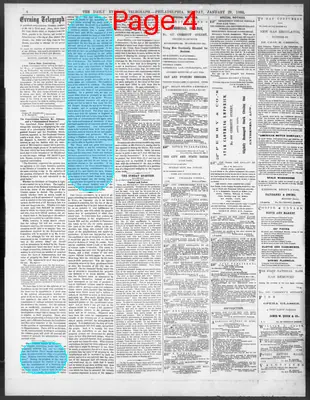
Story
January 29, 1866
The Evening Telegraph
Philadelphia, Philadelphia County, Pennsylvania
What is this article about?
A commentary criticizing the London Times for its persistent negativity toward America, defending U.S. national unity, creditworthiness, and post-Civil War prosperity, highlighting how ordinary citizens share in government responsibilities and debts.
Clipping
OCR Quality
98%
Excellent
Full Text
The "London Times" in Trouble.
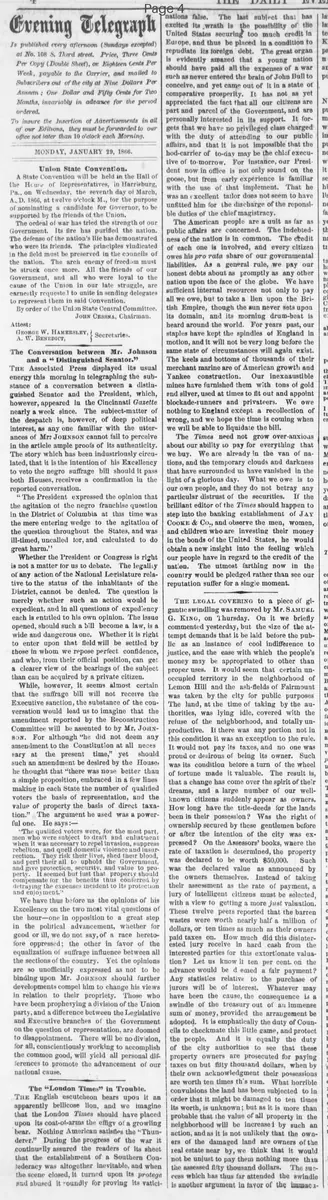
The English escutcheon bears upon it an apparently bellicose lion, and we imagine that the London Times should have placed upon its coat-of-arms the effigy of a growling bear. Nothing American satisfies the "Thunderer." During the progress of the war it continually assured the readers of its sheet that the establishment of a Southern Confederacy was altogether inevitable, and when the scene closed, it turned upon its protege and abused it roundly for proving its validations false. The last subject that has excited its wrath is the possibility of the United States securing too much credit in Europe, and thus be placed in a condition to repudiate its foreign debt. The great organ is evidently amazed that a young nation should have paid all the expenses of a war such as never entered the brain of John Bull to conceive, and yet came out of it in a state of comparative prosperity. It has not as yet appreciated the fact that all our citizens are part and parcel of the Government, and are personally interested in its support. It forgets that we have no privileged class charged with the duty of attending to our public affairs, and that it is not impossible that the hod-carrier of to-day may be the chief executive of to-morrow. For instance, our President now in office is not only sound on the goose, but from early experience is familiar with the use of that implement. That he was an excellent tailor does not seem to have unfitted him for the discharge of the responsible duties of the chief magistracy.
The American people are a unit as far as public affairs are concerned. The indebtedness of the nation is in common. The credit of each one is involved, and every citizen owes his pro rata share of our governmental liabilities. As a general rule, we pay our honest debts about as promptly as any other nation upon the face of the globe. We have sufficient internal resources not only to pay all we owe, but to take a lien upon the British Empire, though the sun never sets upon its domain, and its morning drum-beat is heard around the world. For years past, our staples have kept the spindles of England in motion, and it will not be very long before the same state of circumstances will again exist. The keels and bottoms of thousands of their merchant marine are of American growth and Yankee construction. Our inexhaustible mines have furnished them with tons of gold and silver, used at times to fit out and appoint blockade-runners and privateers. We owe nothing to England except a recollection of wrong, and we hope the time is coming when we will be able to liquidate the bill.
The Times need not grow over-anxious about our ability to pay for everything that we buy. We are already in the van of nations, and the temporary clouds and darkness that have surrounded us have vanished in the light of a glorious day. What we owe is to our own people, and they do not betray any particular distrust of the securities. If the brilliant editor of the Times should happen to step into the banking establishment of Jay Cooke & Co., and observe the men, women, and children who are investing their money in the bonds of the United States, he would obtain a new insight into the feeling which our people have in regard to the credit of the nation. The utmost farthing now in the country would be pledged rather than see our reputation suffer for a single moment.
The English escutcheon bears upon it an apparently bellicose lion, and we imagine that the London Times should have placed upon its coat-of-arms the effigy of a growling bear. Nothing American satisfies the "Thunderer." During the progress of the war it continually assured the readers of its sheet that the establishment of a Southern Confederacy was altogether inevitable, and when the scene closed, it turned upon its protege and abused it roundly for proving its validations false. The last subject that has excited its wrath is the possibility of the United States securing too much credit in Europe, and thus be placed in a condition to repudiate its foreign debt. The great organ is evidently amazed that a young nation should have paid all the expenses of a war such as never entered the brain of John Bull to conceive, and yet came out of it in a state of comparative prosperity. It has not as yet appreciated the fact that all our citizens are part and parcel of the Government, and are personally interested in its support. It forgets that we have no privileged class charged with the duty of attending to our public affairs, and that it is not impossible that the hod-carrier of to-day may be the chief executive of to-morrow. For instance, our President now in office is not only sound on the goose, but from early experience is familiar with the use of that implement. That he was an excellent tailor does not seem to have unfitted him for the discharge of the responsible duties of the chief magistracy.
The American people are a unit as far as public affairs are concerned. The indebtedness of the nation is in common. The credit of each one is involved, and every citizen owes his pro rata share of our governmental liabilities. As a general rule, we pay our honest debts about as promptly as any other nation upon the face of the globe. We have sufficient internal resources not only to pay all we owe, but to take a lien upon the British Empire, though the sun never sets upon its domain, and its morning drum-beat is heard around the world. For years past, our staples have kept the spindles of England in motion, and it will not be very long before the same state of circumstances will again exist. The keels and bottoms of thousands of their merchant marine are of American growth and Yankee construction. Our inexhaustible mines have furnished them with tons of gold and silver, used at times to fit out and appoint blockade-runners and privateers. We owe nothing to England except a recollection of wrong, and we hope the time is coming when we will be able to liquidate the bill.
The Times need not grow over-anxious about our ability to pay for everything that we buy. We are already in the van of nations, and the temporary clouds and darkness that have surrounded us have vanished in the light of a glorious day. What we owe is to our own people, and they do not betray any particular distrust of the securities. If the brilliant editor of the Times should happen to step into the banking establishment of Jay Cooke & Co., and observe the men, women, and children who are investing their money in the bonds of the United States, he would obtain a new insight into the feeling which our people have in regard to the credit of the nation. The utmost farthing now in the country would be pledged rather than see our reputation suffer for a single moment.
What sub-type of article is it?
Historical Event
Personal Triumph
What themes does it cover?
Triumph
Moral Virtue
Fortune Reversal
What keywords are associated?
London Times Criticism
American Credit
Civil War Prosperity
National Debt
Post War Recovery
Jay Cooke
Andrew Johnson
What entities or persons were involved?
London Times
Andrew Johnson
Where did it happen?
United States, England
Story Details
Key Persons
London Times
Andrew Johnson
Location
United States, England
Event Date
Post Civil War
Story Details
The article rebukes the London Times for doubting American credit after the Civil War, emphasizing national unity, prompt debt payment, resource abundance, and the President's humble origins as symbols of egalitarian strength and prosperity.