Thank you for visiting SNEWPapers!
Sign up free
Story
July 21, 1851
American Telegraph
Washington, District Of Columbia
What is this article about?
Editorial warns of efforts to reinstate flogging in the US Navy after its abolition, criticizes naval officers' support, and urges public pressure on Congress to maintain the ban and also eliminate spirit rations.
Clipping
OCR Quality
98%
Excellent
Full Text
FLOGGING IN THE NAVY.
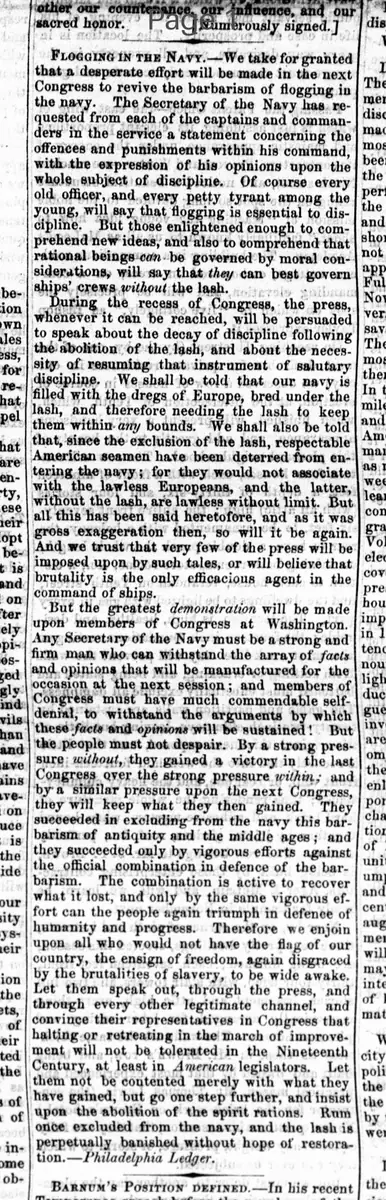
We take for granted that a desperate effort will be made in the next Congress to revive the barbarism of flogging in the navy. The Secretary of the Navy has requested from each of the captains and commanders in the service a statement concerning the offences and punishments within his command, with the expression of his opinions upon the whole subject of discipline. Of course every old officer, and every petty tyrant among the young, will say that flogging is essential to discipline. But those enlightened enough to comprehend new ideas, and also to comprehend that rational beings can be governed by moral considerations, will say that they can best govern ships' crews without the lash.
During the recess of Congress, the press, whenever it can be reached, will be persuaded to speak about the decay of discipline following the abolition of the lash, and about the necessity of resuming that instrument of salutary discipline. We shall be told that our navy is filled with the dregs of Europe, bred under the lash, and therefore needing the lash to keep them within any bounds. We shall also be told that, since the exclusion of the lash, respectable American seamen have been deterred from entering the navy; for they would not associate with the lawless Europeans, and the latter, without the lash, are lawless without limit. But all this has been said heretofore, and as it was gross exaggeration then, so will it be again. And we trust that very few of the press will be imposed upon by such tales, or will believe that brutality is the only efficacious agent in the command of ships.
But the greatest demonstration will be made upon members of Congress at Washington. Any Secretary of the Navy must be a strong and firm man who can withstand the array of facts and opinions that will be manufactured for the occasion at the next session; and members of Congress must have much commendable self-denial, to withstand the arguments by which these facts and opinions will be sustained! But the people must not despair. By a strong pressure without, they gained a victory in the last Congress over the strong pressure within; and by a similar pressure upon the next Congress, they will keep what they then gained. They succeeded in excluding from the navy this barbarism of antiquity and the middle ages; and they succeeded only by vigorous efforts against the official combination in defence of the barbarism. The combination is active to recover what it lost, and only by the same vigorous effort can the people again triumph in defence of humanity and progress. Therefore we enjoin upon all who would not have the flag of our country, the ensign of freedom, again disgraced by the brutalities of slavery, to be wide awake. Let them speak out, through the press, and through every other legitimate channel, and convince their representatives in Congress that halting or retreating in the march of improvement will not be tolerated in the Nineteenth Century, at least in American legislators. Let them not be contented merely with what they have gained, but go one step further, and insist upon the abolition of the spirit rations. Rum once excluded from the navy, and the lash is perpetually banished without hope of restoration.—Philadelphia Ledger
We take for granted that a desperate effort will be made in the next Congress to revive the barbarism of flogging in the navy. The Secretary of the Navy has requested from each of the captains and commanders in the service a statement concerning the offences and punishments within his command, with the expression of his opinions upon the whole subject of discipline. Of course every old officer, and every petty tyrant among the young, will say that flogging is essential to discipline. But those enlightened enough to comprehend new ideas, and also to comprehend that rational beings can be governed by moral considerations, will say that they can best govern ships' crews without the lash.
During the recess of Congress, the press, whenever it can be reached, will be persuaded to speak about the decay of discipline following the abolition of the lash, and about the necessity of resuming that instrument of salutary discipline. We shall be told that our navy is filled with the dregs of Europe, bred under the lash, and therefore needing the lash to keep them within any bounds. We shall also be told that, since the exclusion of the lash, respectable American seamen have been deterred from entering the navy; for they would not associate with the lawless Europeans, and the latter, without the lash, are lawless without limit. But all this has been said heretofore, and as it was gross exaggeration then, so will it be again. And we trust that very few of the press will be imposed upon by such tales, or will believe that brutality is the only efficacious agent in the command of ships.
But the greatest demonstration will be made upon members of Congress at Washington. Any Secretary of the Navy must be a strong and firm man who can withstand the array of facts and opinions that will be manufactured for the occasion at the next session; and members of Congress must have much commendable self-denial, to withstand the arguments by which these facts and opinions will be sustained! But the people must not despair. By a strong pressure without, they gained a victory in the last Congress over the strong pressure within; and by a similar pressure upon the next Congress, they will keep what they then gained. They succeeded in excluding from the navy this barbarism of antiquity and the middle ages; and they succeeded only by vigorous efforts against the official combination in defence of the barbarism. The combination is active to recover what it lost, and only by the same vigorous effort can the people again triumph in defence of humanity and progress. Therefore we enjoin upon all who would not have the flag of our country, the ensign of freedom, again disgraced by the brutalities of slavery, to be wide awake. Let them speak out, through the press, and through every other legitimate channel, and convince their representatives in Congress that halting or retreating in the march of improvement will not be tolerated in the Nineteenth Century, at least in American legislators. Let them not be contented merely with what they have gained, but go one step further, and insist upon the abolition of the spirit rations. Rum once excluded from the navy, and the lash is perpetually banished without hope of restoration.—Philadelphia Ledger
What sub-type of article is it?
Historical Event
What themes does it cover?
Moral Virtue
Justice
What keywords are associated?
Navy Flogging
Abolition Of Lash
Naval Discipline
Spirit Rations
Congressional Pressure
Where did it happen?
Us Navy
Story Details
Location
Us Navy
Event Date
Nineteenth Century
Story Details
An editorial anticipates attempts to revive flogging in the US Navy and calls for public and press opposition to preserve its recent abolition, while advocating for the additional elimination of spirit rations to ensure lasting reform.