Thank you for visiting SNEWPapers!
Sign up free
Literary
March 18, 1785
Fowle's New Hampshire Gazette And General Advertiser
Portsmouth, Rockingham County, New Hampshire
What is this article about?
This philosophical essay critiques faith as dependent on ignorance, warns against over-disputing religious matters, contrasts destructive Jewish miracles with Christ's benevolent ones, emphasizes Christian practice and charity over mere opinions, and laments religious quarrels arising from doctrinal punctilios.
Clipping
OCR Quality
95%
Excellent
Full Text
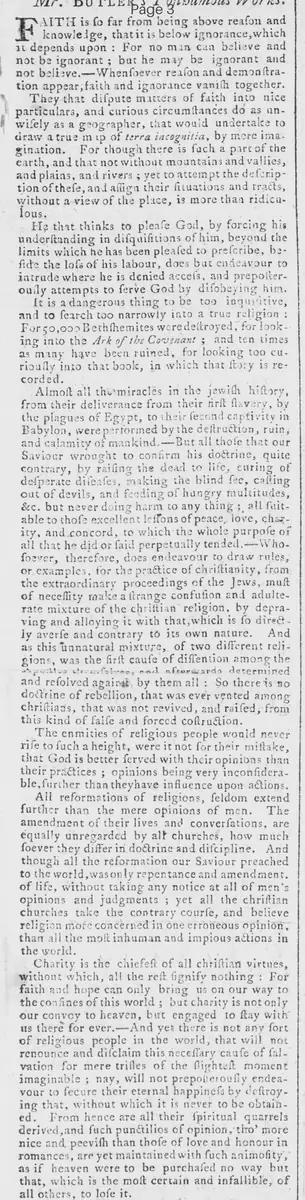
FAITH is so far from being above reason and
knowledge, that it is below ignorance, which
it depends upon: For no man can believe and
not be ignorant; but he may be ignorant and
not believe.--Whenever reason and
demonstration appear, faith and ignorance
vanish together.
They that dispute matters of faith into nice
particulars, and curious circumstances do as
unwisely as a geographer, that would undertake to
draw a true map of terra incognita, by mere imagination.
For though there is such a part of the
earth, and that not without mountains and valleys,
and plains, and rivers; yet to attempt the description
of these, and assign their situations and tracts,
without a view of the place, is more than ridiculous.
He that thinks to please God, by forcing his
understanding in disquisitions of him, beyond the
limits which he has been pleased to prescribe, besides
the loss of his labour, does but endeavour to
intrude where he is denied access, and preposterously
attempts to serve God by disobeying him.
It is a dangerous thing to be too inquisitive,
and to search too narrowly into a true religion:
For 20,000 Bethshemites were destroyed, for looking
into the Ark of the Covenant; and ten times
as many have been ruined, for looking too curiously
into that book, in which that story is recorded.
Almost all the miracles in the Jewish history,
from their deliverance from their first slavery, by
the plagues of Egypt, to their second captivity in
Babylon, were performed by the destruction, ruin,
and calamity of mankind.--But all those that our
Saviour wrought to confirm his doctrine, quite
contrary, by raising the dead to life, curing of
desperate diseases, making the blind see, casting
out of devils, and feeding of hungry multitudes,
etc. but never doing harm to any thing; all suitable
to those excellent lessons of peace, love, charity,
and concord, to which the whole purpose of
all that he did or said perpetually tended.--Whosoever,
therefore, does endeavour to draw rules,
or examples, for the practice of christianity, from
the extraordinary proceedings of the Jews, must
of necessity make a strange confusion and adulterate
mixture of the christian religion, by depraving
and alloying it with that, which is so directly
averse and contrary to its own nature. And
as this unnatural mixture, of two different religions,
was the first cause of dissension among the
Jews themselves, and afterwards determined
and resolved against, by them all: So there is no
doctrine of rebellion, that was ever vented among
christians, that was not revived, and raised; from
this kind of false and forced construction.
The enmities of religious people would never
rise to such a height, were it not for their mistake,
that God is better served with their opinions than
their practices; opinions being very inconsiderable,
further than they have influence upon actions.
All reformations of religions, seldom extend
further than the mere opinions of men. The
amendment of their lives and conversations, are
equally unregarded by all churches, how much
soever they differ in doctrine and discipline. And
though all the reformation our Saviour preached
to the world, was only repentance and amendment
of life, without taking any notice at all of men's
opinions and judgments; yet all the christian
churches take the contrary course, and believe
religion more concerned in one erroneous opinion,
than all the most inhuman and impious actions in
the world.
Charity is the chiefest of all christian virtues,
without which, all the rest signify nothing: For
faith and hope can only bring us on our way to
the confines of this world; but charity is not only
our convoy to heaven, but engaged to stay with
us there for ever.--And yet there is not any sort
of religious people in the world, that will not
renounce and disclaim this necessary cause of salvation
for mere trifles of the slightest moment
imaginable; nay, will not preposterously endeavour
to secure their eternal happiness by destroying
that, without which it is never to be obtained.
From hence are all their spiritual quarrels
derived, and such punctilios of opinion, through more
nice and peevish than those of love and honour in
romances, are yet maintained with such animosity,
as if heaven were to be purchased no way but
that, which is the most certain and infallible, of
all others, to lose it.
knowledge, that it is below ignorance, which
it depends upon: For no man can believe and
not be ignorant; but he may be ignorant and
not believe.--Whenever reason and
demonstration appear, faith and ignorance
vanish together.
They that dispute matters of faith into nice
particulars, and curious circumstances do as
unwisely as a geographer, that would undertake to
draw a true map of terra incognita, by mere imagination.
For though there is such a part of the
earth, and that not without mountains and valleys,
and plains, and rivers; yet to attempt the description
of these, and assign their situations and tracts,
without a view of the place, is more than ridiculous.
He that thinks to please God, by forcing his
understanding in disquisitions of him, beyond the
limits which he has been pleased to prescribe, besides
the loss of his labour, does but endeavour to
intrude where he is denied access, and preposterously
attempts to serve God by disobeying him.
It is a dangerous thing to be too inquisitive,
and to search too narrowly into a true religion:
For 20,000 Bethshemites were destroyed, for looking
into the Ark of the Covenant; and ten times
as many have been ruined, for looking too curiously
into that book, in which that story is recorded.
Almost all the miracles in the Jewish history,
from their deliverance from their first slavery, by
the plagues of Egypt, to their second captivity in
Babylon, were performed by the destruction, ruin,
and calamity of mankind.--But all those that our
Saviour wrought to confirm his doctrine, quite
contrary, by raising the dead to life, curing of
desperate diseases, making the blind see, casting
out of devils, and feeding of hungry multitudes,
etc. but never doing harm to any thing; all suitable
to those excellent lessons of peace, love, charity,
and concord, to which the whole purpose of
all that he did or said perpetually tended.--Whosoever,
therefore, does endeavour to draw rules,
or examples, for the practice of christianity, from
the extraordinary proceedings of the Jews, must
of necessity make a strange confusion and adulterate
mixture of the christian religion, by depraving
and alloying it with that, which is so directly
averse and contrary to its own nature. And
as this unnatural mixture, of two different religions,
was the first cause of dissension among the
Jews themselves, and afterwards determined
and resolved against, by them all: So there is no
doctrine of rebellion, that was ever vented among
christians, that was not revived, and raised; from
this kind of false and forced construction.
The enmities of religious people would never
rise to such a height, were it not for their mistake,
that God is better served with their opinions than
their practices; opinions being very inconsiderable,
further than they have influence upon actions.
All reformations of religions, seldom extend
further than the mere opinions of men. The
amendment of their lives and conversations, are
equally unregarded by all churches, how much
soever they differ in doctrine and discipline. And
though all the reformation our Saviour preached
to the world, was only repentance and amendment
of life, without taking any notice at all of men's
opinions and judgments; yet all the christian
churches take the contrary course, and believe
religion more concerned in one erroneous opinion,
than all the most inhuman and impious actions in
the world.
Charity is the chiefest of all christian virtues,
without which, all the rest signify nothing: For
faith and hope can only bring us on our way to
the confines of this world; but charity is not only
our convoy to heaven, but engaged to stay with
us there for ever.--And yet there is not any sort
of religious people in the world, that will not
renounce and disclaim this necessary cause of salvation
for mere trifles of the slightest moment
imaginable; nay, will not preposterously endeavour
to secure their eternal happiness by destroying
that, without which it is never to be obtained.
From hence are all their spiritual quarrels
derived, and such punctilios of opinion, through more
nice and peevish than those of love and honour in
romances, are yet maintained with such animosity,
as if heaven were to be purchased no way but
that, which is the most certain and infallible, of
all others, to lose it.
What sub-type of article is it?
Essay
What themes does it cover?
Religious
Moral Virtue
What keywords are associated?
Faith Reason
Religious Dispute
Christian Charity
Jewish Miracles
Opinion Vs Practice
Religious Reformation
Literary Details
Key Lines
Faith Is So Far From Being Above Reason And Knowledge, That It Is Below Ignorance, Which It Depends Upon: For No Man Can Believe And Not Be Ignorant; But He May Be Ignorant And Not Believe.
Charity Is The Chiefest Of All Christian Virtues, Without Which, All The Rest Signify Nothing: For Faith And Hope Can Only Bring Us On Our Way To The Confines Of This World; But Charity Is Not Only Our Convoy To Heaven, But Engaged To Stay With Us There For Ever.