Thank you for visiting SNEWPapers!
Sign up free
Story
October 9, 1895
The Hawaiian Star
Honolulu, Honolulu County, Hawaii
What is this article about?
Scientific explanation debunking the myth of horses' physiological susceptibility to electricity, attributing vulnerability to hoof shoes and nails creating conductive paths; advises careful farriery.
Clipping
OCR Quality
98%
Excellent
Full Text
The Horse and Electricity.
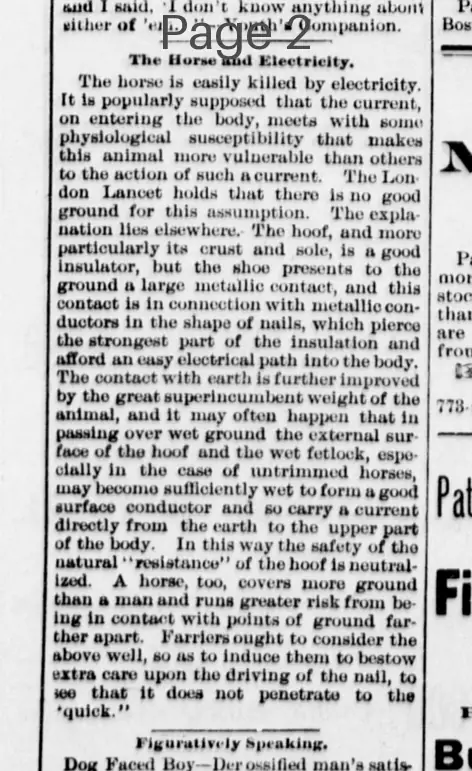
The horse is easily killed by electricity. It is popularly supposed that the current, on entering the body, meets with some physiological susceptibility that makes this animal more vulnerable than others to the action of such a current. The London Lancet holds that there is no good ground for this assumption. The explanation lies elsewhere. The hoof, and more particularly its crust and sole, is a good insulator, but the shoe presents to the ground a large metallic contact, and this contact is in connection with metallic conductors in the shape of nails, which pierce the strongest part of the insulation and afford an easy electrical path into the body. The contact with earth is further improved by the great superincumbent weight of the animal, and it may often happen that in passing over wet ground the external surface of the hoof and the wet fetlock, especially in the case of untrimmed horses, may become sufficiently wet to form a good surface conductor and so carry a current directly from the earth to the upper part of the body. In this way the safety of the natural "resistance" of the hoof is neutralized. A horse, too, covers more ground than a man and runs greater risk from being in contact with points of ground farther apart. Farriers ought to consider the above well, so as to induce them to bestow extra care upon the driving of the nail, to see that it does not penetrate to the "quick."
The horse is easily killed by electricity. It is popularly supposed that the current, on entering the body, meets with some physiological susceptibility that makes this animal more vulnerable than others to the action of such a current. The London Lancet holds that there is no good ground for this assumption. The explanation lies elsewhere. The hoof, and more particularly its crust and sole, is a good insulator, but the shoe presents to the ground a large metallic contact, and this contact is in connection with metallic conductors in the shape of nails, which pierce the strongest part of the insulation and afford an easy electrical path into the body. The contact with earth is further improved by the great superincumbent weight of the animal, and it may often happen that in passing over wet ground the external surface of the hoof and the wet fetlock, especially in the case of untrimmed horses, may become sufficiently wet to form a good surface conductor and so carry a current directly from the earth to the upper part of the body. In this way the safety of the natural "resistance" of the hoof is neutralized. A horse, too, covers more ground than a man and runs greater risk from being in contact with points of ground farther apart. Farriers ought to consider the above well, so as to induce them to bestow extra care upon the driving of the nail, to see that it does not penetrate to the "quick."
What sub-type of article is it?
Curiosity
Medical Curiosity
What themes does it cover?
Nature
Misfortune
What keywords are associated?
Horse Electricity
Hoof Insulation
Electric Vulnerability
Farrier Advice
Nail Penetration
Story Details
Story Details
Horses are easily killed by electricity due to their metal shoes and nails providing a conductive path through the insulating hoof, enhanced by weight and wet ground; farriers should drive nails carefully to avoid penetrating the quick.