Thank you for visiting SNEWPapers!
Sign up free
Daily National Intelligencer
Washington, District Of Columbia
What is this article about?
Kentucky physician Anthony Hunn publishes observations on a recent epidemic malignant disease, detailing its symptoms from mild catarrh to fatal attacks, causes via miasma, and treatments including warm baths, stimulants, and warnings against bleeding in severe cases. He urges prompt medical aid and calls on fellow doctors to share knowledge.
Clipping
OCR Quality
Full Text
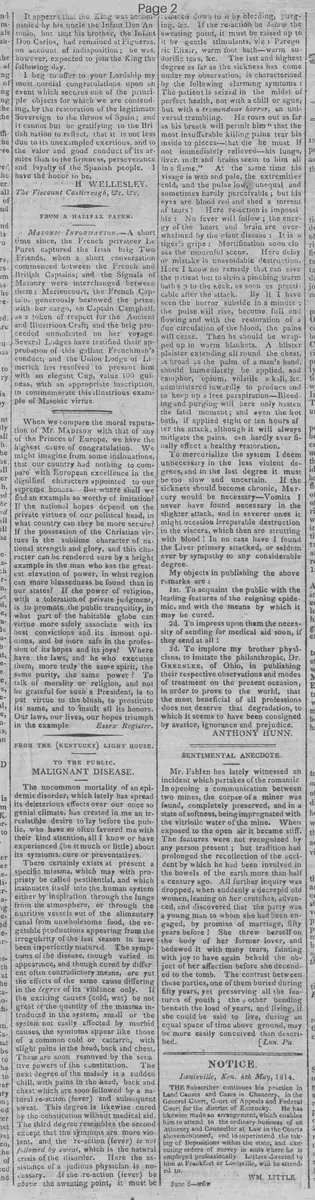
TO THE PUBLIC.
MALIGNANT DISEASE.
The uncommon mortality of an epidemic disorder, which lately has spread its deleterious effects over our once so genial climate, has created in me an irresistible desire to lay before the public, who have so often favored me with their kind attention, all I know or have experienced (be it much or little) about its symptoms, cure or preventatives.
There certainly exists at present a specific miasma, which may with propriety be called pestilential, and which insinuates itself into the human system either by inspiration through the lungs from the atmosphere, or through the nutritive vessels out of the alimentary canal from unwholesome food, the vegetable productions appearing from the irregularity of the last season to have been imperfectly matured. The symptoms of the disease, though varied in appearance, and though cured by different often contradictory means, are yet the effects of the same cause differing in the degree of its violence only. If the exciting causes (cold, wet) be not great or the quantity of the miasma introduced in the system, small or the system not easily affected by morbid causes, the symptoms appear like those of a common cold or catarrh, with slight pains in the head, back and chest. These are soon removed by the sensitive powers of the constitution. The next degree of the malady is a sudden chill, with pains in the head, back and chest which are soon followed by a natural re-action (fever) and subsequent sweat. This degree is likewise cured by the constitution without medical aid. The third degree resembles the second except that the symptoms are more violent, and the re-action (fever) is not followed by sweat, which is the natural crisis of the disorder. Here the assistance of a judicious physician is necessary. If the re-action (fever) be above the sweating point, it must be reduced down to it by bleeding, purging, &c. If the re-action be below the sweating point, it must be raised up to it by gentle stimulants, viz: Paregoric Elixir, warm foot bath--warm sudorific teas, &c. The last and highest degree as far as the sickness has come under my observation, is characterised by the following alarming symptoms:
The patient is seized in the midst of perfect health, not with a chill or ague, but with a tremendous horror, an universal trembling. He roars out as far as his breath will permit him "that the most insufferable killing pains tear his inside to pieces--that die he must if not immediately relieved--his lungs, liver, melt and brains seem to him all in a flame." At the same time his visage is wan and pale, the extremities cold, and the pulse low, unequal and sometimes hardly perceivable; but his eyes are blood red and shed a torrent of tears! Here re-action is impossible: No fever will follow; the energy of the heart and brain are overwhelmed by the giant disease: It is a tiger's gripe: Mortification soon closes the mournful scene. Here delay or mistake is unavoidable destruction. Here I know no remedy that can save the patient but to sit in a pinching warm bath up to the neck, as soon as practicable after the attack. By it I have seen the horror subside in a minute; the pulse will rise, become full and flowing and with the restoration of a due circulation of the blood, the pains will cease. Then he should be wrapped up in warm blankets. A blister plaister extending all round the chest, as broad as the palm of a man's hand, should immediately be applied, and camphor, opium, volatile alkali, &c. administered inwardly to produce and to keep up a free perspiration--Bleeding and purging will here only hasten the fatal moment; and even the hot bath, if applied eight or ten hours after the attack, although it will always mitigate the pains, can hardly ever finally effect a healthy restoration.
To mercurialize the system I deem unnecessary in the less violent degrees, and in the last degree it must be too slow and uncertain. If the sickness should become chronic, Mercury would be necessary--Vomits I never have found necessary in the slighter attack, and in severer ones it might occasion irreparable destruction in the viscera, which then are strutting with blood! In no case have I found the Liver primary attacked, or seldom ever by sympathy to any considerable degree.
My objects in publishing the above remarks are:
1st. To acquaint the public with the leading features of the reigning epidemic, and with the means by which it may be cured.
2d. To impress upon them the necessity of sending for medical aid soon, if they send at all!
3d. To implore my brother physicians, to imitate the philanthropic, Dr. GREENLEE, of Ohio, in publishing their respective observations and modes of treatment on the present occasion, in order to prove to the world, that the most beneficial of all professions does not deserve that degradation, to which it seems to have been consigned by avarice, ignorance and prejudice.
ANTHONY HUNN.
What sub-type of article is it?
What keywords are associated?
What entities or persons were involved?
Where did it happen?
Domestic News Details
Primary Location
Kentucky
Key Persons
Outcome
uncommon mortality from the epidemic; severe cases lead to mortification and death without prompt intervention like warm baths.
Event Details
Description of a pestilential miasma causing an epidemic with symptoms ranging from mild colds to fatal attacks involving horror, trembling, severe pains, and no fever reaction; treatments vary by severity, emphasizing immediate warm baths for critical cases and stimulants or reductions for milder ones.