Thank you for visiting SNEWPapers!
Sign up free
Story
March 31, 1920
The Chattanooga News
Chattanooga, Hamilton County, Tennessee
What is this article about?
J. E. Edgerton of the Tennessee Manufacturers' Association defends the 1919 tax assessment laws, clarifying they enhance enforcement of constitutional provisions for equitable taxation without major changes, urging manufacturers to comply with information requests.
Clipping
OCR Quality
98%
Excellent
Full Text
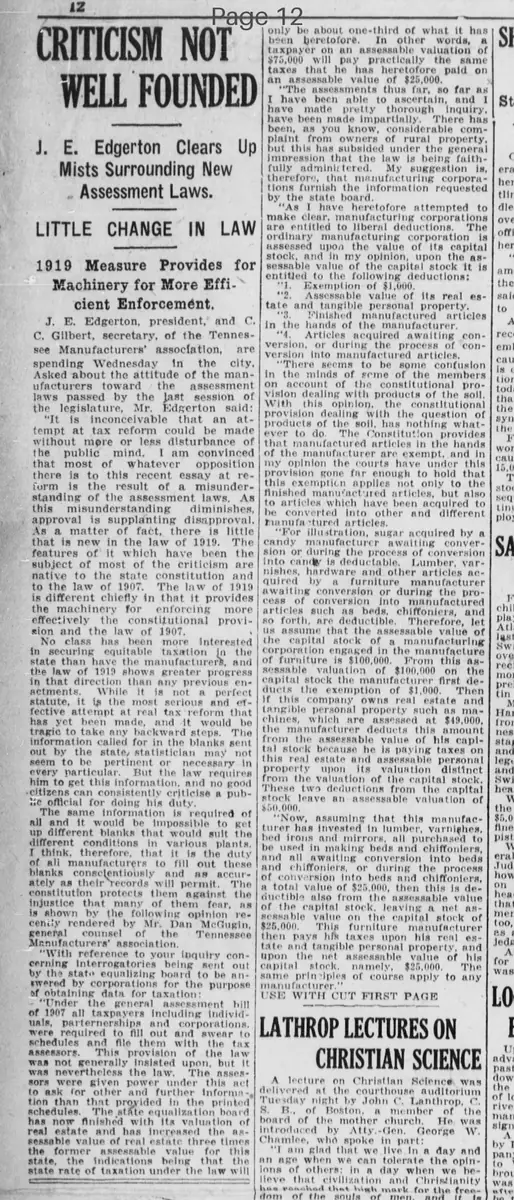
CRITICISM NOT WELL FOUNDED
J. E. Edgerton Clears Up Mists Surrounding New Assessment Laws.
LITTLE CHANGE IN LAW
1919 Measure Provides for Machinery for More Efficient Enforcement.
J. E. Edgerton, president, and C. C. Gilbert, secretary, of the Tennessee Manufacturers' association, are spending Wednesday in the city.
Asked about the attitude of the manufacturers toward the assessment laws passed by the last session of the legislature, Mr. Edgerton said:
"It is inconceivable that an attempt at tax reform could be made without more or less disturbance of the public mind. I am convinced that most of whatever opposition there is to this recent essay at reform is the result of a misunderstanding of the assessment laws. As this misunderstanding diminishes, approval is supplanting disapproval.
As a matter of fact, there is little that is new in the law of 1919. The features of it which have been the subject of most of the criticism are native to the state constitution and to the law of 1907. The law of 1919 is different chiefly in that it provides the machinery for enforcing more effectively the constitutional provision and the law of 1907.
No class has been more interested in securing equitable taxation in the state than have the manufacturers, and the law of 1919 shows greater progress in that direction than any previous enactments. While it is not a perfect statute, it is the most serious and effective attempt at real tax reform that has yet been made, and it would be tragic to take any backward steps. The information called for in the blanks sent out by the state statistician may not seem to be pertinent or necessary in every particular. But the law requires him to get this information, and no good citizens can consistently criticise a public official for doing his duty.
The same information is required of all and it would be impossible to get up different blanks that would suit the different conditions in various plants. I think, therefore, that it is the duty of all manufacturers to fill out these blanks conscientiously and as accurately as their records will permit. The constitution protects them against the injustice that many of them fear, as is shown by the following opinion recently rendered by Mr. Dan McGugin, general counsel of the Tennessee Manufacturers' association.
"With reference to your inquiry concerning interrogatories being sent out by the state equalizing board to be answered by corporations for the purpose of obtaining data for taxation:
"Under the general assessment bill of 1907 all taxpayers including individuals, partnerships and corporations, were required to fill out and swear to schedules and file them with the tax assessors. This provision of the law was not generally insisted upon, but it was nevertheless the law. The assessors were given power under this act to ask for other and further information than that provided in the printed schedules. The state equalization board has now finished with its valuation of real estate and has increased the assessable value of real estate three times the former assessable value for this state, the indications being that the state rate of taxation under the law will only be about one-third of what it has been heretofore.
In other words, a taxpayer on an assessable valuation of $75,000 will pay practically the same taxes that he has heretofore paid on an assessable value of $25,000.
The assessments thus far, so far as I have been able to ascertain, and I have made pretty thorough inquiry, have been made impartially. There has been, as you know, considerable complaint from owners of rural property, but this has subsided under the general impression that the law is being faithfully administered. My suggestion is, therefore, that manufacturing corporations furnish the information requested by the state board.
"As I have heretofore attempted to make clear, manufacturing corporations are entitled to liberal deductions. The ordinary manufacturing corporation is assessed upon the value of its capital stock, and in my opinion, upon the assessable value of the capital stock it is entitled to the following deductions:
"1. Exemption of $1,000.
"2. Assessable value of its real estate and tangible personal property.
"3. Finished manufactured articles in the hands of the manufacturer.
"4. Articles acquired awaiting conversion, or during the process of conversion into manufactured articles.
"There seems to be some confusion in the minds of some of the members on account of the constitutional provision dealing with products of the soil. With this opinion, the constitutional provision dealing with the question of products of the soil, has nothing whatever to do. The Constitution provides that manufactured articles in the hands of the manufacturer are exempt, and in my opinion the courts have under this provision gone far enough to hold that this exemption applies not only to the finished manufactured articles, but also to articles which have been acquired to be converted into other and different manufactured articles.
"For illustration, sugar acquired by a candy manufacturer awaiting conversion or during the process of conversion into candy is deductible. Lumber, varnishes, hardware and other articles acquired by a furniture manufacturer awaiting conversion or during the process of conversion into manufactured articles such as beds, chiffoniers, and so forth, are deductible. Therefore, let us assume that the assessable value of the capital stock of a manufacturing corporation engaged in the manufacture of furniture is $100,000. From this assessable valuation of $100,000 on the capital stock the manufacturer first deducts the exemption of $1,000. Then if this company owns real estate and tangible personal property such as machines, which are assessed at $49,000, the manufacturer deducts this amount from the assessable value of his capital stock because he is paying taxes on this real estate and assessable personal property upon its valuation distinct from the valuation of the capital stock. These two deductions from the capital stock leave an assessable valuation of $50,000.
"Now, assuming that this manufacturer has invested in lumber, varnishes, bed irons and mirrors, all purchased to be used in making beds and chiffoniers, and all awaiting conversion into beds and chiffoniers, or during the process of conversion into beds and chiffoniers, a total value of $25,000, then this is deductible also from the assessable value of the capital stock, leaving a net assessable value on the capital stock of $25,000. This furniture manufacturer then pays his taxes upon his real estate and tangible personal property, and upon the net assessable value of his capital stock, namely, $25,000. The same principles of course apply to any manufacturer.""
J. E. Edgerton Clears Up Mists Surrounding New Assessment Laws.
LITTLE CHANGE IN LAW
1919 Measure Provides for Machinery for More Efficient Enforcement.
J. E. Edgerton, president, and C. C. Gilbert, secretary, of the Tennessee Manufacturers' association, are spending Wednesday in the city.
Asked about the attitude of the manufacturers toward the assessment laws passed by the last session of the legislature, Mr. Edgerton said:
"It is inconceivable that an attempt at tax reform could be made without more or less disturbance of the public mind. I am convinced that most of whatever opposition there is to this recent essay at reform is the result of a misunderstanding of the assessment laws. As this misunderstanding diminishes, approval is supplanting disapproval.
As a matter of fact, there is little that is new in the law of 1919. The features of it which have been the subject of most of the criticism are native to the state constitution and to the law of 1907. The law of 1919 is different chiefly in that it provides the machinery for enforcing more effectively the constitutional provision and the law of 1907.
No class has been more interested in securing equitable taxation in the state than have the manufacturers, and the law of 1919 shows greater progress in that direction than any previous enactments. While it is not a perfect statute, it is the most serious and effective attempt at real tax reform that has yet been made, and it would be tragic to take any backward steps. The information called for in the blanks sent out by the state statistician may not seem to be pertinent or necessary in every particular. But the law requires him to get this information, and no good citizens can consistently criticise a public official for doing his duty.
The same information is required of all and it would be impossible to get up different blanks that would suit the different conditions in various plants. I think, therefore, that it is the duty of all manufacturers to fill out these blanks conscientiously and as accurately as their records will permit. The constitution protects them against the injustice that many of them fear, as is shown by the following opinion recently rendered by Mr. Dan McGugin, general counsel of the Tennessee Manufacturers' association.
"With reference to your inquiry concerning interrogatories being sent out by the state equalizing board to be answered by corporations for the purpose of obtaining data for taxation:
"Under the general assessment bill of 1907 all taxpayers including individuals, partnerships and corporations, were required to fill out and swear to schedules and file them with the tax assessors. This provision of the law was not generally insisted upon, but it was nevertheless the law. The assessors were given power under this act to ask for other and further information than that provided in the printed schedules. The state equalization board has now finished with its valuation of real estate and has increased the assessable value of real estate three times the former assessable value for this state, the indications being that the state rate of taxation under the law will only be about one-third of what it has been heretofore.
In other words, a taxpayer on an assessable valuation of $75,000 will pay practically the same taxes that he has heretofore paid on an assessable value of $25,000.
The assessments thus far, so far as I have been able to ascertain, and I have made pretty thorough inquiry, have been made impartially. There has been, as you know, considerable complaint from owners of rural property, but this has subsided under the general impression that the law is being faithfully administered. My suggestion is, therefore, that manufacturing corporations furnish the information requested by the state board.
"As I have heretofore attempted to make clear, manufacturing corporations are entitled to liberal deductions. The ordinary manufacturing corporation is assessed upon the value of its capital stock, and in my opinion, upon the assessable value of the capital stock it is entitled to the following deductions:
"1. Exemption of $1,000.
"2. Assessable value of its real estate and tangible personal property.
"3. Finished manufactured articles in the hands of the manufacturer.
"4. Articles acquired awaiting conversion, or during the process of conversion into manufactured articles.
"There seems to be some confusion in the minds of some of the members on account of the constitutional provision dealing with products of the soil. With this opinion, the constitutional provision dealing with the question of products of the soil, has nothing whatever to do. The Constitution provides that manufactured articles in the hands of the manufacturer are exempt, and in my opinion the courts have under this provision gone far enough to hold that this exemption applies not only to the finished manufactured articles, but also to articles which have been acquired to be converted into other and different manufactured articles.
"For illustration, sugar acquired by a candy manufacturer awaiting conversion or during the process of conversion into candy is deductible. Lumber, varnishes, hardware and other articles acquired by a furniture manufacturer awaiting conversion or during the process of conversion into manufactured articles such as beds, chiffoniers, and so forth, are deductible. Therefore, let us assume that the assessable value of the capital stock of a manufacturing corporation engaged in the manufacture of furniture is $100,000. From this assessable valuation of $100,000 on the capital stock the manufacturer first deducts the exemption of $1,000. Then if this company owns real estate and tangible personal property such as machines, which are assessed at $49,000, the manufacturer deducts this amount from the assessable value of his capital stock because he is paying taxes on this real estate and assessable personal property upon its valuation distinct from the valuation of the capital stock. These two deductions from the capital stock leave an assessable valuation of $50,000.
"Now, assuming that this manufacturer has invested in lumber, varnishes, bed irons and mirrors, all purchased to be used in making beds and chiffoniers, and all awaiting conversion into beds and chiffoniers, or during the process of conversion into beds and chiffoniers, a total value of $25,000, then this is deductible also from the assessable value of the capital stock, leaving a net assessable value on the capital stock of $25,000. This furniture manufacturer then pays his taxes upon his real estate and tangible personal property, and upon the net assessable value of his capital stock, namely, $25,000. The same principles of course apply to any manufacturer.""
What sub-type of article is it?
Historical Event
What themes does it cover?
Justice
Moral Virtue
What keywords are associated?
Tax Reform
Assessment Laws
Tennessee Manufacturers
Equitable Taxation
Legal Deductions
What entities or persons were involved?
J. E. Edgerton
C. C. Gilbert
Dan Mcgugin
Where did it happen?
Tennessee
Story Details
Key Persons
J. E. Edgerton
C. C. Gilbert
Dan Mcgugin
Location
Tennessee
Event Date
1919
Story Details
J. E. Edgerton explains that the 1919 tax law improves enforcement of prior constitutional and 1907 provisions for equitable taxation, addresses misunderstandings causing criticism, and urges manufacturers to provide required information, citing legal protections and deductions as outlined by Dan McGugin.