Thank you for visiting SNEWPapers!
Sign up free
The Virginia Gazette
Richmond, Williamsburg, Richmond County, Virginia
What is this article about?
In the British House of Lords, Marquis of Rockingham proposed an amendment criticizing measures against colonial discontents and calling for review to restore order without foreign forces. A London petition was presented, countered by a Nova Scotian one detailing grievances. In the Commons, John Wilkes denounced the American war as unjust and ruinous, urging negotiation for peace.
Clipping
OCR Quality
Full Text
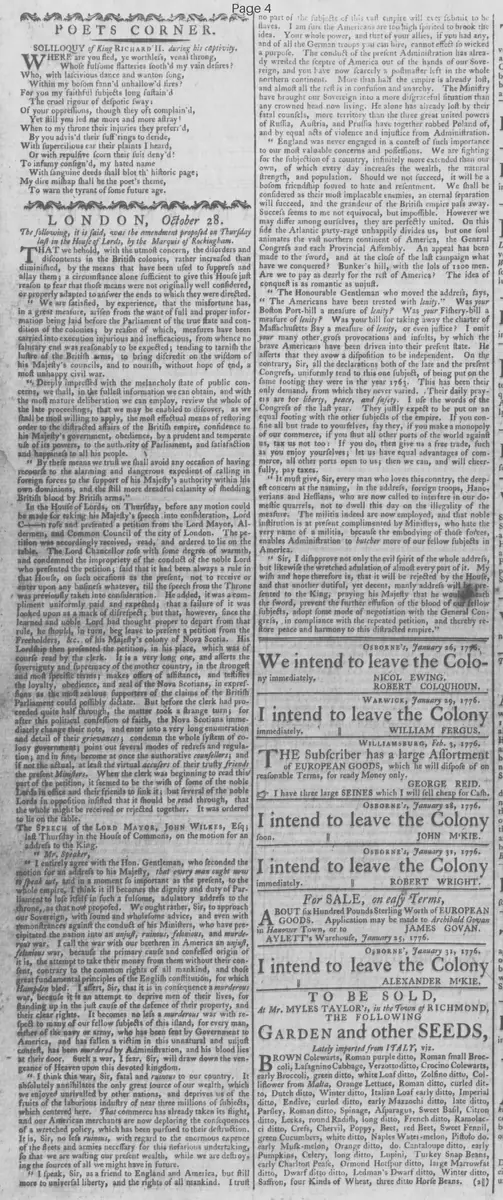
The following, it is said, was the amendment proposed on Thursday last in the House of Lords, by the Marquis of Rockingham.
"That the discontents in the British colonies, rather increased than diminished, by the means that have been used to suppress and allay them; a circumstance alone sufficient to give this House just reason to fear that those means were not originally well considered, or properly adapted to answer the ends to which they were directed.
We are satisfied, by experience, that the misfortune has, in a great measure, arisen from the want of full and proper information being laid before the Parliament of the true state and condition of the colonies; by reason of which, measures have been carried into execution injurious and inefficacious, from whence no salutary end was reasonably to be expected; tending to tarnish the lustre of the British arms, to bring discredit on the wisdom of his Majesty's councils, and to nourish, without hope of end, a most unhappy civil war.
Deeply impressed with the melancholy state of public concerns, we shall, in the fullest information we can obtain, and with the most mature deliberation we can employ, review the whole of the late proceedings, that we may be enabled to discover, as we shall be most willing to apply, the most effectual means of restoring order to the distracted affairs of the British empire, confidence to his Majesty's government, obedience, by a prudent and temperate use of its powers, to the authority of Parliament, and satisfaction and happiness to all his people.
By these means we trust we shall avoid any occasion of having recourse to the alarming and dangerous expedient of calling in foreign forces to the support of his Majesty's authority within his own dominions, and this still more dreadful calamity of shedding British blood by British arms."
In the House of Lords, on Thursday, before any motion could be made for taking his Majesty's speech into consideration, Lord C-n rose and presented a petition from the Lord Mayor, Aldermen, and Common Council of the city of London. The petition was accordingly received, read, and ordered to lie on the table. The Lord Chancellor rose with some degree of warmth, and condemned the impropriety of the conduct of the noble Lord who presented the petition; said that it had been always a rule in that House, on such occasions as the present, not to receive or enter upon any business whatever, till the speech from the Throne was previously taken into consideration. He added, it was a compliment uniformly paid and expected; that a failure of it was looked upon as a mark of disrespect; but that, however, since the learned and noble Lord had thought proper to depart from that rule, he should, in turn, beg leave to present a petition from the Freeholders, &c. of his Majesty's colony of Nova Scotia. His Lordship then presented the petition, in his place, which was of course read by the clerk. It is a very long one, and asserts the sovereignty and supremacy of the mother country, in the strongest and most specific terms; makes offers of assistance, and testifies the loyalty, obedience, and zeal of the Nova Scotians, in expressions as the most zealous supporters of the claims of the British Parliament could possibly dictate. But before the clerk had proceeded quite half through, the matter took a strange turn; for after this political confession of faith, the Nova Scotians immediately change their note, and enter into a very long enumeration and detail of their grievances; condemn the whole system of colony government; point out several modes of redress and regulation; and in fine, become at once the authoritative counsellors; and if not the actual, at least the virtual accusers of their trusty friends the present Ministers. When the clerk was beginning to read this part of the petition, it seemed to be the wish of some of the noble Lords in office and their friends to sink it; but several of the noble Lords in opposition insisted that it should be read through, that the whole might be received or rejected together. It was ordered to lie on the table.
The Speech of the Lord Mayor, John Wilkes, Esq; last Thursday in the House of Commons, on the motion for an address to the King.
"Mr. Speaker,
I entirely agree with the Hon. Gentleman, who seconded the motion for an address to his Majesty, that every man ought now to speak out, and in a moment so important as the present, to the whole empire, I think it ill becomes the dignity and duty of Parliament to lose itself in such a fulsome, adulatory address to the throne, as that now proposed. We ought rather, Sir, to approach our Sovereign, with sound and wholesome advice, and even with remonstrances against the conduct of his Ministers, who have precipitated the nation into an unjust, ruinous, felonious, and murderous war. I call the war with our brethren in America an unjust, felonious war, because the primary cause and confessed origin of it is, the attempt to take their money from them without their consent, contrary to the common rights of all mankind, and those great fundamental principles of the English constitution, for which Hampden bled. I assert, Sir, that it is in consequence a murderous war, because it is an attempt to deprive men of their lives, for standing up in the just cause of the defence of their property, and their clear rights. It becomes no less a murderous war with respect to many of our fellow subjects of this island, for every man, either of the navy or army, who has been sent by Government to America, and has fallen a victim in this unnatural and unjust contest, has been murdered by Administration, and his blood lies at their door. Such a war, I fear, Sir, will draw down the vengeance of Heaven upon this devoted kingdom.
I think this war, Sir, fatal and ruinous to our country. It absolutely annihilates the only great source of our wealth, which we enjoyed unrivalled by other nations, and deprives us of the fruits of the laborious industry of near three millions of subjects, which centered here. That commerce has already taken its flight, and our American merchants are now deploring the consequences of a wretched policy, which has been pursued to their destruction. It is, Sir, no less ruinous, with regard to the enormous expense of the fleets and armies necessary for this nefarious undertaking, so that we are wasting our present wealth, while we are destroying the sources of all we might have in future.
I speak, Sir, as a friend to England and America, but still more to universal liberty, and the rights of all mankind. I trust no part of the subjects of this vast empire will ever submit to be slaves. I am sure the Americans are too high spirited to brook the idea. Your whole power, and that of your allies, if you had any, and of all the German troops you can hire, cannot effect so wicked a purpose. The conduct of the present Administration has already wrested the sceptre of America out of the hands of our Sovereign, and you have now scarcely a postmaster left in the whole northern continent. More than half the empire is already lost, and almost all the rest is in confusion and anarchy. The Ministry have brought our Sovereign into a more disgraceful situation than any crowned head now living. He alone has already lost by their fatal counsels, more territory than the three great united powers of Russia, Austria, and Prussia have together robbed Poland of, and by equal acts of violence and injustice from Administration.
England was never engaged in a contest of such importance to our most valuable concerns and possessions. We are fighting for the subjection of a country, infinitely more extended than our own, of which every day increases the wealth, the natural strength, and population. Should we not succeed, it will be a bosom friendship soured to hate and resentment. We shall be considered as their most implacable enemies, an eternal separation will succeed, and the grandeur of the British empire pass away. Success seems to me not equivocal, but impossible. However we may differ among ourselves, they are perfectly united. On this side the Atlantic party-rage unhappily divides us, but one soul animates the vast northern continent of America, the General Congress and each Provincial Assembly. An appeal has been made to the sword, and at the close of the last campaign what have we conquered? Bunker's hill, with the loss of 1200 men. Are we to pay as dearly for the rest of America? The idea of conquest is as romantic as unjust.
The Honourable Gentleman who moved the address, says, "The Americans have been treated with lenity." Was your Boston Port-bill a measure of lenity? Was your Fishery-bill a measure of lenity? Was your bill for taking away the charter of Massachusetts Bay a measure of lenity, or even justice? I omit your many other gross provocations and insults, by which the brave Americans have been driven into their present state. He asserts that they avow a disposition to be independent. On the contrary, Sir, all the declarations both of the late and the present Congress, uniformly tend to this one subject, of being put on the same footing they were in the year 1763. This has been their only demand, from which they never varied. Their daily prayers are for liberty, peace, and safety. I use the words of the Congress of the last year. They justly expect to be put on an equal footing with the other subjects of the empire. If you confine all but trade to yourselves, say they, if you make a monopoly of our commerce, if you shut all other ports of the world against us, tax us not too: If you do, then give us a free trade, such as you enjoy yourselves; let us have equal advantages of commerce, all other ports open to us; then we can, and will cheerfully, pay taxes.
It must give, Sir, every man who loves this country, the deepest concern at the naming, in the address, foreign troops, Hanoverians and Hessians, who are now called to interfere in our domestic quarrels, not to dwell this day on the illegality of the measure. The militia indeed are now employed, and that noble institution is at present complimented by Ministers, who hate the very name of a militia, because the embodying of those forces, enables Administration to butcher more of our fellow subjects in America.
Sir, I disapprove not only the evil spirit of the whole address, but likewise the wretched adulation of almost every part of it. My wish and hope therefore is, that it will be rejected by the House, and that another dutiful, yet decent, manly address will be presented to the King, praying his Majesty that he would sheathe the sword, prevent the further effusion of the blood of our fellow subjects, adopt some mode of negotiation with the General Congress, in compliance with the repeated petition, and thereby restore peace and harmony to this distracted empire."
What sub-type of article is it?
What keywords are associated?
What entities or persons were involved?
Where did it happen?
Foreign News Details
Primary Location
British Colonies
Event Date
Thursday Last
Key Persons
Outcome
loss of 1200 men at bunker's hill; more than half the empire already lost
Event Details
Amendment proposed in House of Lords criticizing suppression of colonial discontents and calling for review to avoid foreign forces and civil war. Petition from London presented, countered by Nova Scotian petition asserting loyalty but detailing grievances. John Wilkes' speech in Commons denouncing the American war as unjust, ruinous, and murderous, urging rejection of address and negotiation with Congress for peace on 1763 footing.