Thank you for visiting SNEWPapers!
Sign up free
The Caledonian
Saint Johnsbury, Caledonia County, Vermont
What is this article about?
Historical anecdote praising General Francis Marion's guerrilla warfare and sacrifices during the American Revolution in South Carolina swamps, where his simple life and dedication to liberty impress a visiting British officer, leading the officer to question the British cause.
Clipping
OCR Quality
Full Text
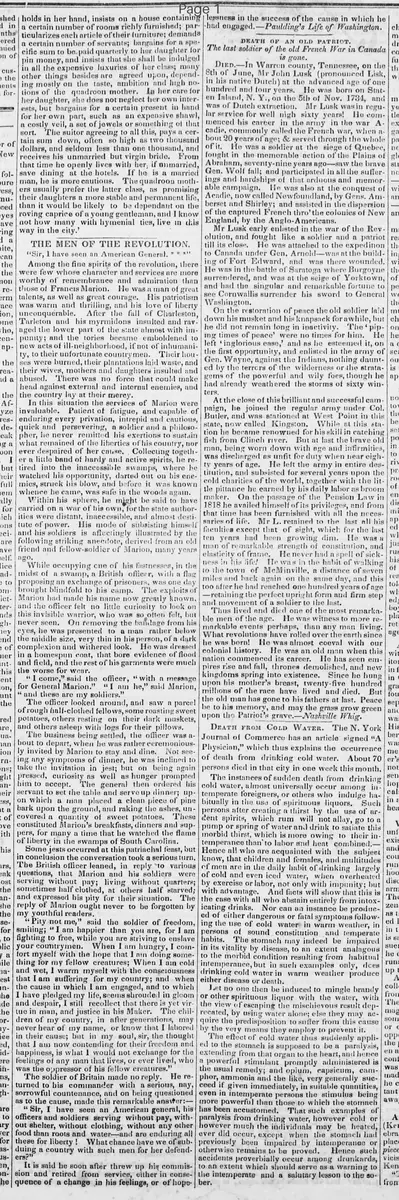
"Sir, I have seen an American General."
Among the fine spirits of the revolution, there were few whose character and services are more worthy of remembrance and admiration than those of Francis Marion. He was a man of great talents, as well as great courage. His patriotism was warm and thrilling, and his love of liberty unconquerable. After the fall of Charleston, Tarleton and his myrmidons insulted and ravaged the lower part of the state almost with impunity; and the tories became emboldened to new acts of ill-neighborhood, if not of inhumanity, to their unfortunate countrymen.
Their houses were burned, their plantations laid waste, and their wives, mothers and daughters insulted and abused. There was no force that could make head against external and internal enemies, and the country lay at their mercy.
In this situation the services of Marion were invaluable. Patient of fatigue, and capable of enduring every privation, intrepid and cautious, quick and persevering, a soldier and a philosopher, he never remitted his exertions to sustain what remained of the liberties of his country, nor ever despaired of her cause. Collecting together a little band of hardy and active spirits, he retired into the inaccessible swamps, where he watched his opportunity, darted out on his enemies, struck his blow, and before it was known whence he came, was safe in the woods again.
Within his sphere, he might be said to have carried on a war of his own, for the state authorities were distant, inaccessible, and almost destitute of power. His mode of subsisting himself and his soldiers is affectingly illustrated by the following striking anecdote, derived from an old friend and fellow-soldier of Marion, many years ago.
While occupying one of his fastnesses, in the midst of a swamp, a British officer, with a flag proposing an exchange of prisoners, was one day brought blindfold to his camp. The exploits of Marion had made his name now greatly known, and the officer felt no little curiosity to look on this invisible warrior, who was so often felt, but never seen. On removing the bandage from his eyes, he was presented to a man rather below the middle size, very thin in his person, of a dark complexion and withered look. He was dressed in a homespun coat, that bore evidence of flood and field, and the rest of his garments were much the worse for wear.
"I come," said the officer, "with a message for General Marion."
"I am he," said Marion, "and these are my soldiers."
The officer looked around, and saw a parcel of rough half-clothed fellows, some roasting sweet potatoes, others resting on their dark muskets, and others asleep with logs for their pillows.
The business being settled, the officer was about to depart, when he was rather ceremoniously invited by Marion to stay and dine. Not seeing any symptoms of dinner, he was inclined to take the invitation in jest; but on being again pressed, curiosity as well as hunger prompted him to accept. The general then ordered his servant to set the table and serve up dinner; upon which a man placed a clean piece of pine bark upon the ground, and raking the ashes, uncovered a quantity of sweet potatoes. These constituted Marion's breakfasts, dinners and suppers, for many a time that he watched the flame of liberty in the swamps of South Carolina.
Some jests occurred at this patriarchal feast, but in conclusion the conversation took a serious turn. The British officer learned, in reply to various questions, that Marion and his soldiers were serving without pay; living without quarters; sometimes half clothed, at others half starved; and expressed his pity for their situation. The reply of Marion ought never to be forgotten by my youthful readers.
"Pity not me," said the soldier of freedom, smiling; "I am happier than you are, for I am fighting to free, while you are striving to enslave your countrymen. When I am hungry, I comfort myself with the hope that I am doing something for my fellow creatures; When I am cold and wet, I warm myself with the consciousness that I am suffering for my country; and when the cause in which I am engaged, and to which I have pledged my life, seems shrouded in gloom and despair, I still recollect that there is yet virtue in man, and justice in his Maker. The children of my country, in after generations, may never hear of my name, or know that I labored in their cause; but in my soul, sir, the thought that I am now contending for their freedom and happiness, is what I would not exchange for the feelings of any man that lives, or ever lived, who was the oppressor of his fellow creatures."
The soldier of Britain made no reply. He returned to his commander with a serious, nay, sorrowful countenance, and on being questioned as to the cause, made this remarkable answer:—
"Sir, I have seen an American general, his officers and soldiers serving without pay, without shelter, without clothing, without any other food than roots and water—and are enduring all these for liberty! What chance have we of subduing a country with such men for her defenders?"
It is said he soon after threw up his commission and retired from service, either in consequence of a change in his feelings, or of hopelessness in the success of the cause in which he had engaged.—Paulding's Life of Washington.
What sub-type of article is it?
What themes does it cover?
What keywords are associated?
What entities or persons were involved?
Where did it happen?
Story Details
Key Persons
Location
Swamps Of South Carolina
Event Date
After The Fall Of Charleston
Story Details
After Charleston's fall, Francis Marion leads partisan fighters in guerrilla raids from South Carolina swamps, enduring hardships on sweet potatoes. A British officer, visiting for prisoner exchange, witnesses their sacrifices and is inspired by Marion's words on liberty, later resigning his commission.