Thank you for visiting SNEWPapers!
Sign up free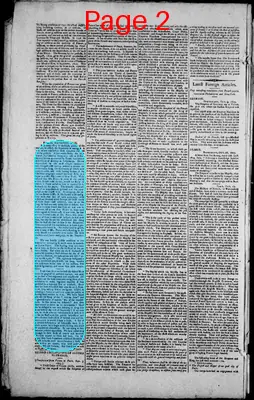
Editorial
December 19, 1805
Rhode Island Republican
Newport, Newport County, Rhode Island
What is this article about?
An editorial from the National Aegis defends poet Joel Barlow against slanderous accusations in the Repertory newspaper, accusing Federalist John Parks of vulgar attacks on Barlow's character and religion. It warns Federalists to cease personal assaults on Republicans or face exposure of their own vices.
Clipping
OCR Quality
95%
Excellent
Full Text
From the NATIONAL AEGIS.
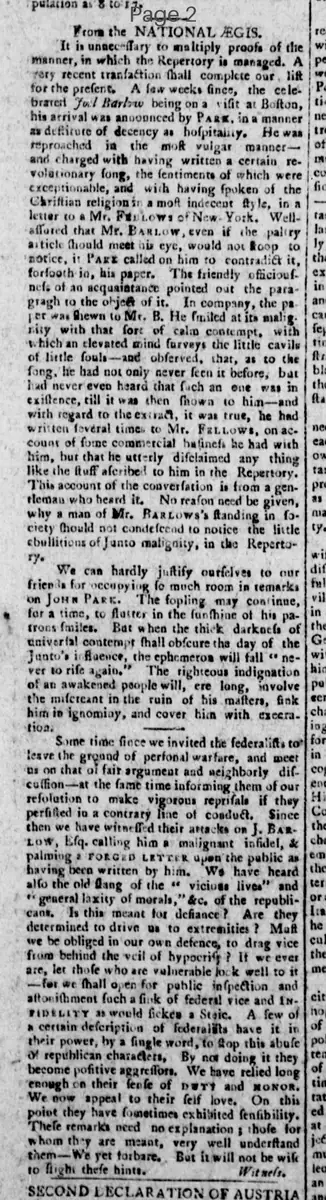
It is unnecessary to multiply proofs of the manner, in which the Repertory is managed. A very recent transaction shall complete our list for the present. A few weeks since, the celebrated Joel Barlow being on a visit at Boston, his arrival was announced by Parks, in a manner as destitute of decency as hospitality. He was reproached in the most vulgar manner—and charged with having written a certain revolutionary song, the sentiments of which were exceptionable, and with having spoken of the Christian religion in a most indecent style, in a letter to a Mr. Fellows of New-York. Well-assured that Mr. Barlow, even if the paltry article should meet his eye, would not stoop to notice, it Parks called on him to contradict it, forsooth, in his paper. The friendly officiousness of an acquaintance pointed out the paragraph to the object of it. In company, the paper was shewn to Mr. B. He smiled at its malignity with that sort of calm contempt, with which an elevated mind surveys the little cavils of little souls—and observed, that, as to the song, he had not only never seen it before, but had never even heard that such an one was in existence, till it was then shewn to him—and with regard to the extract, it was true, he had written several times to Mr. Fellows, on account of some commercial business he had with him, but that he utterly disclaimed any thing like the stuff ascribed to him in the Repertory.
This account of the conversation is from a gentleman who heard it. No reason need be given, why a man of Mr. Barlow's standing in society should not condescend to notice the little ebullitions of Junto malignity, in the Repertory.
We can hardly justify ourselves to our friends for occupying so much room in remarks on John Parks. The fopling may continue, for a time, to flutter in the sunshine of his patrons smiles. But when the thick darkness of universal contempt shall obscure the day of the Junto's influence, the ephemeron will fall, never to rise again. The righteous indignation of an awakened people will, ere long, involve the miscreant in the ruin of his masters, sink him in ignominy, and cover him with execration.
Some time since we invited the federalists to leave the ground of personal warfare, and meet us on that of fair argument and neighborly discussion—at the same time informing them of our resolution to make vigorous reprisals if they persisted in a contrary line of conduct. Since then we have witnessed their attacks on J. Barlow, Esq. calling him a malignant infidel, & palming a FORGED LETTER upon the public as having been written by him. We have heard also the old slang of the "vicious lives" and "general laxity of morals," &c. of the republicans. Is this meant for defiance? Are they determined to drive us to extremities? Must we be obliged in our own defence, to drag vice from behind the veil of hypocrisy? If we ever are, let those who are vulnerable look well to it—for we shall open for public inspection and astonishment such a sink of federal vice and iniquity as would sicken a Stoic. A few of a certain description of federalists have it in their power, by a single word, to stop this abuse of republican characters. By not doing it they become positive aggressors. We have relied long enough on their sense of duty and honor. We now appeal to their self love. On this point they have sometimes exhibited sensibility. These remarks need no explanation: those for whom they are meant, very well understand them—We yet forbear. But it will not be wise to slight these hints.
With res.
It is unnecessary to multiply proofs of the manner, in which the Repertory is managed. A very recent transaction shall complete our list for the present. A few weeks since, the celebrated Joel Barlow being on a visit at Boston, his arrival was announced by Parks, in a manner as destitute of decency as hospitality. He was reproached in the most vulgar manner—and charged with having written a certain revolutionary song, the sentiments of which were exceptionable, and with having spoken of the Christian religion in a most indecent style, in a letter to a Mr. Fellows of New-York. Well-assured that Mr. Barlow, even if the paltry article should meet his eye, would not stoop to notice, it Parks called on him to contradict it, forsooth, in his paper. The friendly officiousness of an acquaintance pointed out the paragraph to the object of it. In company, the paper was shewn to Mr. B. He smiled at its malignity with that sort of calm contempt, with which an elevated mind surveys the little cavils of little souls—and observed, that, as to the song, he had not only never seen it before, but had never even heard that such an one was in existence, till it was then shewn to him—and with regard to the extract, it was true, he had written several times to Mr. Fellows, on account of some commercial business he had with him, but that he utterly disclaimed any thing like the stuff ascribed to him in the Repertory.
This account of the conversation is from a gentleman who heard it. No reason need be given, why a man of Mr. Barlow's standing in society should not condescend to notice the little ebullitions of Junto malignity, in the Repertory.
We can hardly justify ourselves to our friends for occupying so much room in remarks on John Parks. The fopling may continue, for a time, to flutter in the sunshine of his patrons smiles. But when the thick darkness of universal contempt shall obscure the day of the Junto's influence, the ephemeron will fall, never to rise again. The righteous indignation of an awakened people will, ere long, involve the miscreant in the ruin of his masters, sink him in ignominy, and cover him with execration.
Some time since we invited the federalists to leave the ground of personal warfare, and meet us on that of fair argument and neighborly discussion—at the same time informing them of our resolution to make vigorous reprisals if they persisted in a contrary line of conduct. Since then we have witnessed their attacks on J. Barlow, Esq. calling him a malignant infidel, & palming a FORGED LETTER upon the public as having been written by him. We have heard also the old slang of the "vicious lives" and "general laxity of morals," &c. of the republicans. Is this meant for defiance? Are they determined to drive us to extremities? Must we be obliged in our own defence, to drag vice from behind the veil of hypocrisy? If we ever are, let those who are vulnerable look well to it—for we shall open for public inspection and astonishment such a sink of federal vice and iniquity as would sicken a Stoic. A few of a certain description of federalists have it in their power, by a single word, to stop this abuse of republican characters. By not doing it they become positive aggressors. We have relied long enough on their sense of duty and honor. We now appeal to their self love. On this point they have sometimes exhibited sensibility. These remarks need no explanation: those for whom they are meant, very well understand them—We yet forbear. But it will not be wise to slight these hints.
With res.
What sub-type of article is it?
Partisan Politics
Press Freedom
Moral Or Religious
What keywords are associated?
Joel Barlow
Repertory Slander
John Parks
Federalist Attacks
Republican Defense
Forged Letter
Moral Hypocrisy
What entities or persons were involved?
Joel Barlow
John Parks
Repertory
Federalists
Republicans
Junto
Mr. Fellows
Editorial Details
Primary Topic
Defense Of Joel Barlow Against Repertory Slander
Stance / Tone
Strongly Anti Federalist And Defensive Of Republicans
Key Figures
Joel Barlow
John Parks
Repertory
Federalists
Republicans
Junto
Mr. Fellows
Key Arguments
Repertory Falsely Accused Barlow Of Writing An Exceptionable Song And Indecent Remarks On Christianity
Barlow Denies Authorship And Knowledge Of The Song, And Disclaims The Forged Letter
Federalists Persist In Personal Attacks Despite Calls For Fair Argument
Warning That Continued Slander Will Lead To Exposure Of Federalist Vices And Hypocrisy