Thank you for visiting SNEWPapers!
Sign up free
Bloomington Herald
Bloomington, Muscatine, Story County, Muscatine County, Iowa
What is this article about?
A traveler in the Catskill Mountains observes a mismatched couple: a brutish man and his delicate wife carrying their child. He learns she eloped from a wealthy English family to marry the unworthy laborer, now living in poverty at a glass factory.
Clipping
OCR Quality
Full Text
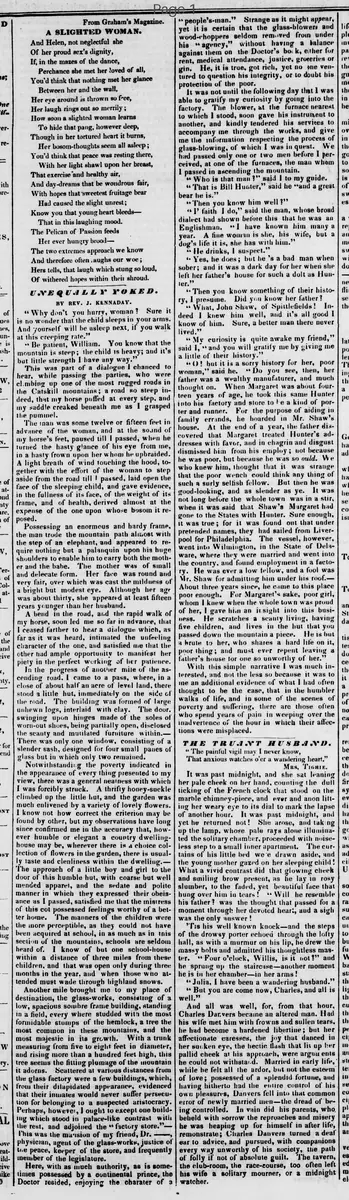
BY REV. J. KENNADAY.
"Why don't you hurry, woman? Sure it is no wonder that the child sleeps in your arms. And yourself will be asleep next, if you walk at this creeping rate."
"Be patient, William. You know that the mountain is steep; the child is heavy; and it's but little strength I have any way."
This was part of a dialogue I chanced to hear, while passing the parties, who were climbing up one of the most rugged roads in the Catskill mountains; a road so steep indeed, that my horse puffed at every step, and my saddle creaked beneath me as I grasped the pommel.
The man was some twelve or fifteen feet in advance of the woman, and at the sound of my horse's feet, paused till I passed, when he turned the hasty glance of his eye from me, in a hasty frown upon her whom he upbraided.
A light breath of wind touching the hood, together with the effort of the woman to step aside from the road till I passed, laid open the face of the sleeping child, and gave evidence, in the fullness of its face, of the weight of its frame, and of health, derived almost at the expense of the one upon whose bosom it reposed.
Possessing an enormous and hardy frame, the man trode the mountain path almost with the step of an elephant, and appeared to require nothing but a palanquin upon his huge shoulders to enable him to carry both the mother and the babe. The mother was of small and delicate form. Her face was round and very fair, over which was cast the mildness of a bright but modest eye. Although her age was about thirty, she appeared at least fifteen years younger than her husband.
A bend in the road, and the rapid walk of my horse, soon led me so far in advance, that I ceased farther to hear a dialogue which, as far as it was heard, intimated the unfeeling character of the one, and satisfied me that the other had ample opportunity to manifest her piety in the perfect working of her patience.
In the progress of another mile of the ascending road, I came to a pass, where, in a close of about half an acre of level land, there stood a little hut, immediately on the side of the road. The building was formed of large unhewn logs, interlaid with clay. The door, swinging upon hinges made of the soles of worn-out shoes, being partially open, disclosed the scanty and mutilated furniture within.
There was only one window, consisting of a slender sash, designed for four small panes of glass but in which only two remained.
Notwithstanding the poverty indicated in the appearance of every thing presented to my view, there was a general neatness with which I was forcibly struck. A thrifty honey-suckle climbed up the little hut, and the garden was much enlivened by a variety of lovely flowers.
I know not how correct the criterion may be found by others, but my observations have long since confirmed me in the accuracy that, however humble or elegant a country dwelling-house may be, wherever there is a choice collection of flowers in the garden, there is usually taste and cleanliness within the dwelling.
The approach of a little boy and girl to the door of this humble hut, with coarse but well mended apparel, and the sedate and polite manner in which they expressed their obeisance as I passed, satisfied me that the mistress of this cot possessed feelings worthy of a better home. The manners of the children were the more perceptible, as they could not have been acquired at school, in as much as in this section of the mountains, schools are seldom heard of. I know of but one school-house within a distance of three miles from these children, and that was open only during three months in the year, and when those who attended must wade through highland snows.
Another mile brought me to my place of destination, the glass-works, consisting of a low, spacious frame building, standing in a field, every where studded with the most formidable stumps of the hemlock, a tree the most common in these mountains, and the most majestic in its growth. With a trunk measuring from five to eight feet in diameter, and rising more than a hundred feet high, this tree seems the fitting plumage of the mountain it adorns. Scattered at various distances from the glass factory were a few buildings, which, from their dilapidated appearance, evidenced that their inmates would never suffer persecution for belonging to a suspected aristocracy.
Perhaps, however, I ought to except one building which stood in palace-like contrast with the rest, and adjoined the factory store. This was the mansion of my friend, Dr. -
physician, agent of the glass-works, justice of the peace, keeper of the store, and frequently member of the legislature.
Here, with as much authority, as is sometimes possessed by a continental prince, the Doctor resided, enjoying the character of a
"people's-man." Strange as it might appear, yet it is certain that the glass-blowers and wood-choppers seldom removed from under his "agency," without having a balance against them on the Doctor's book, either for rent, medical attendance, justice, groceries or gin. He, it is true, got rich, yet no one ventured to question his integrity, or to doubt his protection of the poor.
It was not until the following day that I was able to gratify my curiosity by going into the factory. The blower, at the furnace nearest to which I stood, soon gave his instrument to another, and kindly tendered his services to accompany me through the works, and give me the information respecting the process of glass-blowing, of which I was in quest. We had passed only one or two men before I perceived, at one of the furnaces, the man whom I passed in ascending the mountain.
"Who is that man?" said I to my guide.
"That is Bill Hunter," said he "and a great bear he is."
"Then you know him well?"
"I' faith I do," said the man, whose broad dialect had shown before this that he was an Englishman. "I have known him many a year. A fine woman is she, his wife, but a dog's life it is, she has with him."
He drinks, I suspect."
Yes, he does; but he's a bad man when sober; and it was a dark day for her when she left her father's house for such a dolt as Hunter.
"Then you know something of their history. Did you know her father?"
"What, John Shaw, of Spittlefields! Indeed I knew him well, and it's all good I know of him. Sure, a better man there never lived."
"My curiosity is quite awake my friend," said I, "and you will gratify me by giving me a little of their history."
"O! but it is a sorry history for her, poor woman," said he. "Do you see, then, her father was a wealthy manufacturer, and much thought on. When Margaret was about fourteen years of age, he took this same Hunter into his factory and store to be a kind of porter and runner. For the purpose of aiding in family errands, he boarded in Mr. Shaw's house. At the end of a year, the father discovered that Margaret treated Hunter's addresses with favor, and in chagrin and disgust dismissed him from his employ; not because he was poor, but because he was so dull. We who knew him, thought that it was strange that the poor wench could think any thing of such a surly selfish fellow. But then he was good-looking, and as slender as ye. It was not long before the whole town was in a stir, when it was said that Shaw's Margaret had gone to the States with Hunter. Sure enough, it was true; for it was found out that under pretended names, they had sailed from Liverpool for Philadelphia. The vessel, however, went into Wilmington, in the State of Delaware, where they were married and went into the country, and found employment in a factory. He was ever a low fellow, and a fool was Mr. Shaw for admitting him under his roof.
About three years since, he came to this place poor enough. For Margaret's sake, poor girl, whom I knew when the whole town was proud of her, I gave him an insight into this business. He scratches a scanty living, having five children, and lives in the hut that you passed down the mountain a piece. He is but a brute to her, who shares a hard life on it, poor thing; and must ever repent leaving a father's house for one so unworthy of her."
What sub-type of article is it?
What themes does it cover?
What keywords are associated?
What entities or persons were involved?
Where did it happen?
Story Details
Key Persons
Location
Catskill Mountains
Story Details
A traveler encounters a mismatched couple on a steep mountain road: a large, impatient man named William Hunter and his smaller, patient wife Margaret carrying their child. At the glass factory, a worker reveals Margaret's backstory: daughter of wealthy manufacturer John Shaw from Spittlefields, she eloped at 14 with the dull, brutish Hunter, leading to a life of poverty and hardship in America with five children.