Thank you for visiting SNEWPapers!
Sign up free
Editorial
August 1, 1839
Watchman Of The South
Richmond, Virginia
What is this article about?
Editorial argues that 'New Divinity' is a revival of 18th-century heresy opposed by Thomas Clap in New England churches, quoting his critique of doctrines emphasizing self-interest, universal happiness, and denying original sin and divine sovereignty.
Clipping
OCR Quality
98%
Excellent
Full Text
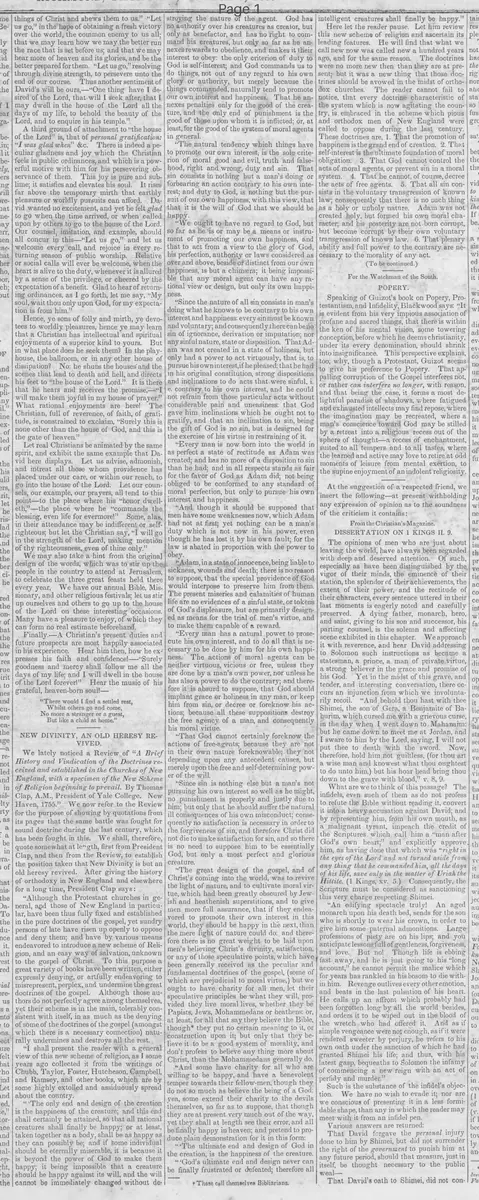
NEW DIVINITY, AN OLD HERESY REVIVED.
We lately noticed a Review of "A Brief History and Vindication of the Doctrines received and established in the Churches of New England, with a specimen of the New Scheme of Religion beginning to prevail. By Thomas Clap, A.M., President of Yale College. New Haven, 1755." We now refer to the Review for the purpose of showing by quotations from its pages that the same battle was fought for sound doctrine during the last century, which has been fought in this. We shall, therefore, quote somewhat at length, first from President Clap, and then from the Review, to establish the position taken that New Divinity is but an old heresy revived. After giving the history of orthodoxy in New England and elsewhere for a long time, President Clap says:
"Although the Protestant churches in general, and those of New England in particular, have been thus fully fixed and established in the pure doctrines of the gospel, yet sundry persons of late have risen up openly to oppose and deny them; and have by various means endeavored to introduce a new scheme of Religion, and an easy way of salvation, unknown to the gospel of Christ. To this purpose a great variety of books have been written, either expressly denying, or artfully endeavoring to misrepresent, perplex, and undermine the great doctrines of the gospel. Although those authors do not perfectly agree among themselves, yet their scheme is in the main, tolerably consistent with itself, in as much as the denying of some of the doctrines of the gospel (amongst which there is a necessary connection) naturally undermines and destroys all the rest.
"I shall present the reader with a general view of this new scheme of religion, as I some years ago collected it from the writings of Chubb, Taylor, Foster, Hutcheson, Campbell and Ramsey, and other books, which are by some highly extolled and assiduously spread about the country.
" 'The only end and design of the creation is the happiness of the creature; and this end shall certainly be attained, so that all rational creatures shall finally be happy; or at least, taken together as a body, shall be as happy as they can possibly be; and if some individual should be eternally miserable, it is because it is beyond the power of God to make them happy; it being impossible that a creature should be happy against its will, and the will cannot be immediately changed without destroying the nature of the agent. God has no authority over his creatures as creator, but only as benefactor, and has no right to command his creatures, but only so far as he annexes rewards to obedience, and makes it their interest to obey: the only criterion of duty to God is self-interest; and God commands us to do things, not out of any regard to his own glory or authority, but merely because the things commanded, naturally tend to promote our own interest and happiness. That he annexes penalties only for the good of the creature, and the only end of punishment is the good of those upon whom it is inflicted; or, at least, for the good of the system of moral agents in general.
"The natural tendency which things have to promote our own interest, is the sole criterion of moral good and evil, truth and falsehood, right and wrong, duty and sin. That sin consists in nothing but a man's doing or forbearing an action contrary to his own interest; and duty to God, is nothing but the pursuit of our own happiness, with this view, that it is the will of God that we should be happy.
"We ought to have no regard to God, but so far as he is or may be a means or instrument of promoting our own happiness, and that to act from a view to the glory of God, his perfection, authority or laws considered as over and above, beside or distinct from our own happiness, is but a chimæra; it being impossible that any moral agent can have any rational view or design, but only its own happiness.
"Since the nature of all sin consists in man's doing what he knows to be contrary to his own interest and happiness: every sin must be known and voluntary; and consequently there can be no sin of ignorance, derivation or imputation; nor any sinful nature, state or disposition. That Adam was not created in a state of holiness, but only had a power to act virtuously, that is, to pursue his own interest, if he pleased: that he had in his original constitution, strong dispositions and inclinations to do acts that were sinful, i.e. contrary to his own interest, and he could not refrain from those particular acts without considerable pain and uneasiness: that God gave him inclinations which he ought not to gratify, and that an inclination to sin, being the gift of God is no sin, but is designed for the exercise of his virtue in restraining of it.
"Every man is now born into the world in as perfect a state of rectitude as Adam was created: and has no more of a disposition to sin than he had; and in all respects stands as fair for the favor of God as Adam did; not being obliged to be conformed to any standard of moral perfection, but only to pursue his own interest and happiness.
"And though it should be supposed that men have some weaknesses now, which Adam had not at first; yet nothing can be a man's duty which is not now in his power, even though he has lost it by his own fault; for the law is abated in proportion with the power to obey.
"Adam, in a state of innocence, being liable to sickness, wounds and death: there is no reason to suppose, that the special providence of God would interpose to preserve him from them. The present miseries and calamities of human life are no evidences of a sinful state, or tokens of God's displeasure, but are primarily designed as means for the trial of men's virtue, and to make them capable of a reward.
"Every man has a natural power to prosecute his own interest, and to do all that is necessary to be done by him for his own happiness. The actions of moral agents can be neither virtuous, vicious or free, unless they are done by a man's own power, nor unless he has also a power to do the contrary; and therefore it is absurd to suppose, that God should implant grace or holiness in any man, or keep him from sin, or decree or foreknow his actions; because all these suppositions destroy the free agency of a man, and consequently his moral virtue.
"That God cannot certainly foreknow the actions of free-agents; because they are not in their own nature foreknowable; they not depending upon any antecedent causes, but merely upon the free and self-determining power of the will.
"Since sin is nothing else but a man's not pursuing his own interest so well as he might no punishment is properly and justly due to him; but only that he should suffer the natural ill consequences of his own misconduct; consequently no satisfaction is necessary in order to the forgiveness of sin, and therefore Christ did not die to make satisfaction for sin, and so there is no need to suppose him to be essentially God, but only a most perfect and glorious creature.
"The great design of the gospel, and of Christ's coming into the world, was to revive the light of nature, and to cultivate moral virtue, which had been greatly obscured by Jewish and heathenish superstitions, and to give men more full assurance, that if they endeavored to promote their own interest in this world, they should be happy in the next, than the mere light of nature could do: and therefore there is no great weight to be laid upon men's believing Christ's divinity, satisfaction, or any of those speculative points, which have been generally received as the peculiar and fundamental doctrines of the gospel, (some of which are prejudicial to moral virtue,) but we ought to have charity for all men, let their speculative principles be what they will, provided they live moral lives, whether they be Papists, Jews, Mohammedans or heathens: or, at least, for all that say they believe the Bible, though they put no certain meaning to it, or construction upon it; but only that they believe it to be a good system of morality, and don't profess to believe any thing more about Christ, than the Mohammedans generally do.
"And some have charity for all who are willing to be happy, and have a benevolent temper towards their fellow-men, though they do not so much as believe the being of a God: yea, some extend their charity to the devils themselves, so far as to suppose, that though they are at present very much out of the way, yet they shall at length see their error, and all be finally happy in heaven; and pretend to produce plain demonstration for it in this form:
"'The ultimate end and design of God in the creation, is the happiness of the creature.
"'God's ultimate end and design never can be finally frustrated or defeated; therefore all intelligent creatures shall finally be happy."
Here let the reader pause. Let him review this new scheme of religion and ascertain its leading features. He will find that what we call new now was called new a hundred years ago, and for the same reason. The doctrines were no more new then than they are at present: but it was a new thing that those doctrines should be avowed in the midst of orthodox churches. The reader cannot fail to notice, that every doctrine characteristic of the system which is now agitating the country, is embraced in the scheme which pious and orthodox men of New England were called to oppose during the last century. These doctrines are, 1. That the promotion of happiness is the grand end of creation. 2. That self-interest is the ultimate foundation of moral obligation. 3. That God cannot control the acts of moral agents, or prevent sin in a moral system. 4. That he cannot, of course, decree the acts of free agents. 5. That all sin consists in the voluntary transgression of known law; consequently that there is no such thing as a holy or unholy nature. Adam was not created holy, but formed his own moral character; and his posterity are not born corrupt, but become corrupt by their own voluntary transgression of known law. 6. That plenary ability and full power to the contrary are necessary to the morality of any act.
(To be continued.)
We lately noticed a Review of "A Brief History and Vindication of the Doctrines received and established in the Churches of New England, with a specimen of the New Scheme of Religion beginning to prevail. By Thomas Clap, A.M., President of Yale College. New Haven, 1755." We now refer to the Review for the purpose of showing by quotations from its pages that the same battle was fought for sound doctrine during the last century, which has been fought in this. We shall, therefore, quote somewhat at length, first from President Clap, and then from the Review, to establish the position taken that New Divinity is but an old heresy revived. After giving the history of orthodoxy in New England and elsewhere for a long time, President Clap says:
"Although the Protestant churches in general, and those of New England in particular, have been thus fully fixed and established in the pure doctrines of the gospel, yet sundry persons of late have risen up openly to oppose and deny them; and have by various means endeavored to introduce a new scheme of Religion, and an easy way of salvation, unknown to the gospel of Christ. To this purpose a great variety of books have been written, either expressly denying, or artfully endeavoring to misrepresent, perplex, and undermine the great doctrines of the gospel. Although those authors do not perfectly agree among themselves, yet their scheme is in the main, tolerably consistent with itself, in as much as the denying of some of the doctrines of the gospel (amongst which there is a necessary connection) naturally undermines and destroys all the rest.
"I shall present the reader with a general view of this new scheme of religion, as I some years ago collected it from the writings of Chubb, Taylor, Foster, Hutcheson, Campbell and Ramsey, and other books, which are by some highly extolled and assiduously spread about the country.
" 'The only end and design of the creation is the happiness of the creature; and this end shall certainly be attained, so that all rational creatures shall finally be happy; or at least, taken together as a body, shall be as happy as they can possibly be; and if some individual should be eternally miserable, it is because it is beyond the power of God to make them happy; it being impossible that a creature should be happy against its will, and the will cannot be immediately changed without destroying the nature of the agent. God has no authority over his creatures as creator, but only as benefactor, and has no right to command his creatures, but only so far as he annexes rewards to obedience, and makes it their interest to obey: the only criterion of duty to God is self-interest; and God commands us to do things, not out of any regard to his own glory or authority, but merely because the things commanded, naturally tend to promote our own interest and happiness. That he annexes penalties only for the good of the creature, and the only end of punishment is the good of those upon whom it is inflicted; or, at least, for the good of the system of moral agents in general.
"The natural tendency which things have to promote our own interest, is the sole criterion of moral good and evil, truth and falsehood, right and wrong, duty and sin. That sin consists in nothing but a man's doing or forbearing an action contrary to his own interest; and duty to God, is nothing but the pursuit of our own happiness, with this view, that it is the will of God that we should be happy.
"We ought to have no regard to God, but so far as he is or may be a means or instrument of promoting our own happiness, and that to act from a view to the glory of God, his perfection, authority or laws considered as over and above, beside or distinct from our own happiness, is but a chimæra; it being impossible that any moral agent can have any rational view or design, but only its own happiness.
"Since the nature of all sin consists in man's doing what he knows to be contrary to his own interest and happiness: every sin must be known and voluntary; and consequently there can be no sin of ignorance, derivation or imputation; nor any sinful nature, state or disposition. That Adam was not created in a state of holiness, but only had a power to act virtuously, that is, to pursue his own interest, if he pleased: that he had in his original constitution, strong dispositions and inclinations to do acts that were sinful, i.e. contrary to his own interest, and he could not refrain from those particular acts without considerable pain and uneasiness: that God gave him inclinations which he ought not to gratify, and that an inclination to sin, being the gift of God is no sin, but is designed for the exercise of his virtue in restraining of it.
"Every man is now born into the world in as perfect a state of rectitude as Adam was created: and has no more of a disposition to sin than he had; and in all respects stands as fair for the favor of God as Adam did; not being obliged to be conformed to any standard of moral perfection, but only to pursue his own interest and happiness.
"And though it should be supposed that men have some weaknesses now, which Adam had not at first; yet nothing can be a man's duty which is not now in his power, even though he has lost it by his own fault; for the law is abated in proportion with the power to obey.
"Adam, in a state of innocence, being liable to sickness, wounds and death: there is no reason to suppose, that the special providence of God would interpose to preserve him from them. The present miseries and calamities of human life are no evidences of a sinful state, or tokens of God's displeasure, but are primarily designed as means for the trial of men's virtue, and to make them capable of a reward.
"Every man has a natural power to prosecute his own interest, and to do all that is necessary to be done by him for his own happiness. The actions of moral agents can be neither virtuous, vicious or free, unless they are done by a man's own power, nor unless he has also a power to do the contrary; and therefore it is absurd to suppose, that God should implant grace or holiness in any man, or keep him from sin, or decree or foreknow his actions; because all these suppositions destroy the free agency of a man, and consequently his moral virtue.
"That God cannot certainly foreknow the actions of free-agents; because they are not in their own nature foreknowable; they not depending upon any antecedent causes, but merely upon the free and self-determining power of the will.
"Since sin is nothing else but a man's not pursuing his own interest so well as he might no punishment is properly and justly due to him; but only that he should suffer the natural ill consequences of his own misconduct; consequently no satisfaction is necessary in order to the forgiveness of sin, and therefore Christ did not die to make satisfaction for sin, and so there is no need to suppose him to be essentially God, but only a most perfect and glorious creature.
"The great design of the gospel, and of Christ's coming into the world, was to revive the light of nature, and to cultivate moral virtue, which had been greatly obscured by Jewish and heathenish superstitions, and to give men more full assurance, that if they endeavored to promote their own interest in this world, they should be happy in the next, than the mere light of nature could do: and therefore there is no great weight to be laid upon men's believing Christ's divinity, satisfaction, or any of those speculative points, which have been generally received as the peculiar and fundamental doctrines of the gospel, (some of which are prejudicial to moral virtue,) but we ought to have charity for all men, let their speculative principles be what they will, provided they live moral lives, whether they be Papists, Jews, Mohammedans or heathens: or, at least, for all that say they believe the Bible, though they put no certain meaning to it, or construction upon it; but only that they believe it to be a good system of morality, and don't profess to believe any thing more about Christ, than the Mohammedans generally do.
"And some have charity for all who are willing to be happy, and have a benevolent temper towards their fellow-men, though they do not so much as believe the being of a God: yea, some extend their charity to the devils themselves, so far as to suppose, that though they are at present very much out of the way, yet they shall at length see their error, and all be finally happy in heaven; and pretend to produce plain demonstration for it in this form:
"'The ultimate end and design of God in the creation, is the happiness of the creature.
"'God's ultimate end and design never can be finally frustrated or defeated; therefore all intelligent creatures shall finally be happy."
Here let the reader pause. Let him review this new scheme of religion and ascertain its leading features. He will find that what we call new now was called new a hundred years ago, and for the same reason. The doctrines were no more new then than they are at present: but it was a new thing that those doctrines should be avowed in the midst of orthodox churches. The reader cannot fail to notice, that every doctrine characteristic of the system which is now agitating the country, is embraced in the scheme which pious and orthodox men of New England were called to oppose during the last century. These doctrines are, 1. That the promotion of happiness is the grand end of creation. 2. That self-interest is the ultimate foundation of moral obligation. 3. That God cannot control the acts of moral agents, or prevent sin in a moral system. 4. That he cannot, of course, decree the acts of free agents. 5. That all sin consists in the voluntary transgression of known law; consequently that there is no such thing as a holy or unholy nature. Adam was not created holy, but formed his own moral character; and his posterity are not born corrupt, but become corrupt by their own voluntary transgression of known law. 6. That plenary ability and full power to the contrary are necessary to the morality of any act.
(To be continued.)
What sub-type of article is it?
Moral Or Religious
What keywords are associated?
New Divinity
Old Heresy
Thomas Clap
New England Orthodoxy
Moral Virtue
Self Interest
Universal Happiness
Original Sin
Divine Authority
What entities or persons were involved?
Thomas Clap
Yale College
Chubb
Taylor
Foster
Hutcheson
Campbell
Ramsey
New England Churches
Editorial Details
Primary Topic
New Divinity As Revived Old Heresy
Stance / Tone
Orthodox Opposition To Heretical Doctrines
Key Figures
Thomas Clap
Yale College
Chubb
Taylor
Foster
Hutcheson
Campbell
Ramsey
New England Churches
Key Arguments
Promotion Of Creature Happiness As Sole End Of Creation
Self Interest As Criterion Of Duty And Morality
Denial Of God's Authority Beyond Benefaction
Sin Only Voluntary And Known, No Original Sin Or Imputation
Adam Not Created Holy, Humans Born In Rectitude
No Need For Divine Foreknowledge Or Decrees To Preserve Free Agency
Christ Not Divine Satisfaction But Promoter Of Moral Virtue
Universal Charity For Moral Livers Regardless Of Beliefs
All Creatures Ultimately Happy As God's End Cannot Fail