Thank you for visiting SNEWPapers!
Sign up free
Letter to Editor
August 6, 1791
Gazette Of The United States
New York, New York County, New York
What is this article about?
Publicola defends his series of papers against attacks misattributing them to the Vice-President and claiming they support monarchy or aristocracy. He clarifies they critique Thomas Paine's pamphlet for principles opposing U.S. constitutions, defending adopted English principles and American government superiority.
Clipping
OCR Quality
98%
Excellent
Full Text
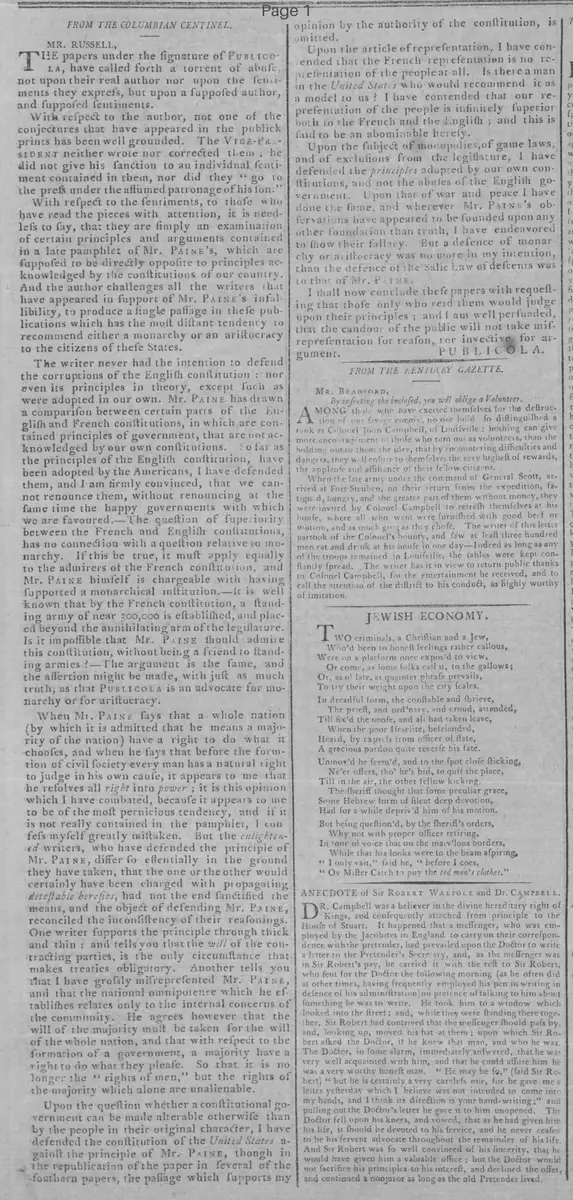
FROM THE COLUMBIAN CENTINEL.
MR. RUSSELL,
THE papers under the signature of PUBLICOLA have called forth a torrent of abuse, not upon their real author nor upon the sentiments they express, but upon a supposed author, and supposed sentiments.
With respect to the author, not one of the conjectures that have appeared in the publick prints has been well grounded. The VICE-PRESIDENT neither wrote nor corrected them; he did not give his sanction to an individual sentiment contained in them, nor did they "go to the press under the assumed patronage of his son."
With respect to the sentiments, to those who have read the pieces with attention, it is needless to say, that they are simply an examination of certain principles and arguments contained in a late pamphlet of Mr. PAINE's, which are supposed to be directly opposite to principles acknowledged by the constitutions of our country.
And the author challenges all the writers that have appeared in support of Mr. PAINE's infallibility, to produce a single passage in these publications which has the most distant tendency to recommend either a monarchy or an aristocracy to the citizens of these States.
The writer never had the intention to defend the corruptions of the English constitution: nor even its principles in theory, except such as were adopted in our own. Mr. PAINE has drawn a comparison between certain parts of the English and French constitutions, in which are contained principles of government, that are not acknowledged by our own constitutions. So far as the principles of the English constitution, have been adopted by the Americans, I have defended them, and I am firmly convinced, that we cannot renounce them, without renouncing at the same time the happy governments with which we are favoured.—The question of superiority between the French and English constitutions, has no connection with a question relative to monarchy. If this be true, it must apply equally to the admirers of the French constitution, and Mr. PAINE himself is chargeable with having supported a monarchical institution.-It is well known that by the French constitution, a standing army of near 300,000 is established, and placed beyond the annihilating arm of the legislature. Is it impossible that Mr. PAINE should admire this constitution, without being a friend to standing armies ?-The argument is the same, and the assertion might be made, with just as much truth, as that PUBLICOLA is an advocate for monarchy or for aristocracy.
When Mr. PAINE says that a whole nation (by which it is admitted that he means a majority of the nation) have a right to do what it chooses, and when he says that before the formation of civil society every man has a natural right to judge in his own cause, it appears to me that he resolves all right into power; it is this opinion which I have combated, because it appears to me to be of the most pernicious tendency, and if it is not really contained in the pamphlet, I confess myself greatly mistaken. But the enlightened writers, who have defended the principle of Mr. PAINE, differ so essentially in the ground they have taken, that the one or the other would certainly have been charged with propagating detestable heresies, had not the end sanctified the means, and the object of defending Mr. PAINE, reconciled the inconsistency of their reasonings.
One writer supports the principle through thick and thin; and tells you that the will of the contracting parties, is the only circumstance that makes treaties obligatory. Another tells you that I have grossly misrepresented Mr. PAINE, and that the national omnipotence which he establishes relates only to the internal concerns of the community. He agrees however that the will of the majority must be taken for the will of the whole nation, and that with respect to the formation of a government, a majority have a right to do what they please. So that it is no longer the "rights of men," but the rights of the majority which alone are unalienable.
Upon the question whether a constitutional government can be made alterable otherwise than by the people in their original character, I have defended the constitution of the United States against the principle of Mr. PAINE, though in the republication of the paper in several of the southern papers, the passage which supports my opinion by the authority of the constitution, is omitted.
Upon the article of representation, I have contended that the French representation is no representation of the people at all. Is there a man in the United States who would recommend it as a model to us? I have contended that our representation of the people is infinitely superior both to the French and the English; and this is said to be an abominable heresy.
Upon the subject of monopolies, of game laws, and of exclusions from the legislature, I have defended the principles adopted by our own constitutions, and not the abuses of the English government. Upon that of war and peace I have done the same, and wherever Mr. PAINE's observations have appeared to be founded upon any other foundation than truth, I have endeavored to show their fallacy. But a defence of monarchy or aristocracy was no more in my intention, than the defence of the Salic Law of descents was to that of Mr. PAINE.
I shall now conclude these papers with requesting that those only who read them would judge upon their principles; and I am well persuaded, that the candour of the public will not take misrepresentation for reason, nor invective for argument.
PUBLICOLA.
MR. RUSSELL,
THE papers under the signature of PUBLICOLA have called forth a torrent of abuse, not upon their real author nor upon the sentiments they express, but upon a supposed author, and supposed sentiments.
With respect to the author, not one of the conjectures that have appeared in the publick prints has been well grounded. The VICE-PRESIDENT neither wrote nor corrected them; he did not give his sanction to an individual sentiment contained in them, nor did they "go to the press under the assumed patronage of his son."
With respect to the sentiments, to those who have read the pieces with attention, it is needless to say, that they are simply an examination of certain principles and arguments contained in a late pamphlet of Mr. PAINE's, which are supposed to be directly opposite to principles acknowledged by the constitutions of our country.
And the author challenges all the writers that have appeared in support of Mr. PAINE's infallibility, to produce a single passage in these publications which has the most distant tendency to recommend either a monarchy or an aristocracy to the citizens of these States.
The writer never had the intention to defend the corruptions of the English constitution: nor even its principles in theory, except such as were adopted in our own. Mr. PAINE has drawn a comparison between certain parts of the English and French constitutions, in which are contained principles of government, that are not acknowledged by our own constitutions. So far as the principles of the English constitution, have been adopted by the Americans, I have defended them, and I am firmly convinced, that we cannot renounce them, without renouncing at the same time the happy governments with which we are favoured.—The question of superiority between the French and English constitutions, has no connection with a question relative to monarchy. If this be true, it must apply equally to the admirers of the French constitution, and Mr. PAINE himself is chargeable with having supported a monarchical institution.-It is well known that by the French constitution, a standing army of near 300,000 is established, and placed beyond the annihilating arm of the legislature. Is it impossible that Mr. PAINE should admire this constitution, without being a friend to standing armies ?-The argument is the same, and the assertion might be made, with just as much truth, as that PUBLICOLA is an advocate for monarchy or for aristocracy.
When Mr. PAINE says that a whole nation (by which it is admitted that he means a majority of the nation) have a right to do what it chooses, and when he says that before the formation of civil society every man has a natural right to judge in his own cause, it appears to me that he resolves all right into power; it is this opinion which I have combated, because it appears to me to be of the most pernicious tendency, and if it is not really contained in the pamphlet, I confess myself greatly mistaken. But the enlightened writers, who have defended the principle of Mr. PAINE, differ so essentially in the ground they have taken, that the one or the other would certainly have been charged with propagating detestable heresies, had not the end sanctified the means, and the object of defending Mr. PAINE, reconciled the inconsistency of their reasonings.
One writer supports the principle through thick and thin; and tells you that the will of the contracting parties, is the only circumstance that makes treaties obligatory. Another tells you that I have grossly misrepresented Mr. PAINE, and that the national omnipotence which he establishes relates only to the internal concerns of the community. He agrees however that the will of the majority must be taken for the will of the whole nation, and that with respect to the formation of a government, a majority have a right to do what they please. So that it is no longer the "rights of men," but the rights of the majority which alone are unalienable.
Upon the question whether a constitutional government can be made alterable otherwise than by the people in their original character, I have defended the constitution of the United States against the principle of Mr. PAINE, though in the republication of the paper in several of the southern papers, the passage which supports my opinion by the authority of the constitution, is omitted.
Upon the article of representation, I have contended that the French representation is no representation of the people at all. Is there a man in the United States who would recommend it as a model to us? I have contended that our representation of the people is infinitely superior both to the French and the English; and this is said to be an abominable heresy.
Upon the subject of monopolies, of game laws, and of exclusions from the legislature, I have defended the principles adopted by our own constitutions, and not the abuses of the English government. Upon that of war and peace I have done the same, and wherever Mr. PAINE's observations have appeared to be founded upon any other foundation than truth, I have endeavored to show their fallacy. But a defence of monarchy or aristocracy was no more in my intention, than the defence of the Salic Law of descents was to that of Mr. PAINE.
I shall now conclude these papers with requesting that those only who read them would judge upon their principles; and I am well persuaded, that the candour of the public will not take misrepresentation for reason, nor invective for argument.
PUBLICOLA.
What sub-type of article is it?
Persuasive
Political
Philosophical
What themes does it cover?
Politics
Constitutional Rights
What keywords are associated?
Publicola Defense
Thomas Paine
Constitutional Principles
French Constitution
American Government
Vice President
Rights Of Man
Majority Rule
Standing Army
What entities or persons were involved?
Publicola
Mr. Russell
Letter to Editor Details
Author
Publicola
Recipient
Mr. Russell
Main Argument
the publicola papers examine and critique principles in thomas paine's pamphlet that oppose u.s. constitutional principles, without advocating monarchy or aristocracy; they defend adopted english principles in american governments against misrepresentations.
Notable Details
Denies Vice President's Involvement
Challenges Defenders Of Paine To Find Pro Monarchy Passages
Critiques French Constitution's Standing Army
Defends U.S. Representation As Superior
Opposes Resolving Rights Into Power Or Majority Rule