Thank you for visiting SNEWPapers!
Sign up free
Literary
August 15, 1816
Daily National Intelligencer
Washington, District Of Columbia
What is this article about?
An essay from the Paris Spectator critiquing egotism through stories of M. d'Argentville, Fontenelle, Marchioness Deffant, Colardeau, and the fictional Saint Chaumont, highlighting self-centered behavior's flaws, ending with M. Arnault's fable likening the egotist to a snail.
Clipping
OCR Quality
98%
Excellent
Full Text
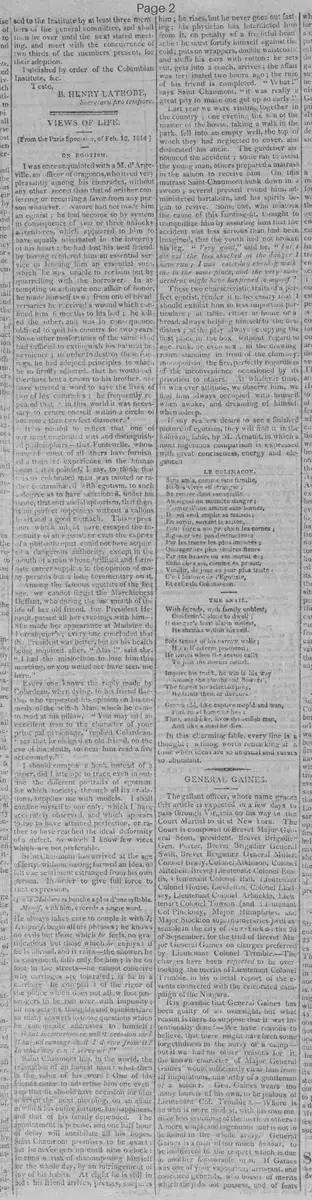
VIEWS OF LIFE.
[From the Paris Spectator, of Feb. 12, 1814]
ON EGOTISM.
I was once acquainted with a M. d'Argentville, an officer of dragoons, who lived very pleasantly among his comrades, without any other secret than that of neither conferring or receiving a favor from any person whatever. Nature had not made him an egotist ; he had become so by system in consequence of two or three unlucky adventures, which appeared to him to have equally originated in the integrity of his heart : he had lost his best friend, by having rendered him an essential service in lending him an essential sum which he was unable to reclaim but by quarrelling with the borrower. In attempting to arbitrate one affair of honor, he made himself two ; from one of his adversaries he received a wound which confined him 6 months to his bed ; he killed the other, and was in consequence. obliged to quit his country for two years Some other misfortunes of the same kind had sufficed to extinguish his natural benevolence ; in order to destroy these feelings, he had adopted principles to which. he so firmly adhered, that he would neither have lent a crown to his brother, nor have uttered a word to save the lives of two of his comrades : he frequently repeated that in this world it was necessary to centre oneself within a circle of not more than two feet diameter.
It is painful to reflect that one of our most celebrated wits and distinguished philosophers-that Fontenelle, whose long life must of all others have furnished a train of experience in the human heart; it is painful, I say, to think that this so celebrated man was tainted or rather contaminated with egotism, to such a degree as to have sanctioned, under his name, that anti social aphorism, that there is no perfect happiness without a callous heart and a good stomach. This expression which might have escaped the insenuity of an egotist, or even the caprice of a philanthropist could not have acquired a dangerous authority, except in the mouth of a man whose brilliant and fortunate career supplies in the opinion of many persons but a long commentary on it.
Among the famous egotists of the last age, we cannot forget the Marchioness Deffant, who during the last month of the life of her old friend, the President Henault, passed all her evenings with him- She made her appearance at Madame de Forcalquier's; every one concluded that the President was better, but on his health being inquired after, "Alas !" said she. " I had the misfortune to lose him this morning, or you would not have seen me here."
Every one knows the reply made by Colardeau, when dying. to his friend Barthélemy, who requested his opinion on his comedy of the Selfish Man, which he came to read at his pillow, " You may add an excellent trait to the character of your principal personage,' replied Colardeau. " say that he obliged an old friend, on the eve of his death, to hear him read a five act comedy."
If I should compose a book, instead of a paper, did I attempt to trace even in outline the different portraits of egotism for which society, through all its gradations, supplies me with models. I shall confine myself to one only, which I have accurately observed, and which appears to me to have attained perfection, or rather to have reached the ideal deformity of a defect, to which I know few vices which are not preferable.
Saint Chaumont has arrived at the age of forty. without having formed an idea, or felt one sentiment estranged from his own person. In order to give full force to that expression,
"De le froidans sa bouche a plus d'une syllable."
Myself, with him, exceeds a single word.
He always takes care to couple it with I; I, myself, begin all his phrases; he knows no evils but those which he feels, no gratifications but those which he enjoys: if he is abroad, and it rains—the shower, he is convinced, falls only for him; is he on foot in the streets—he cannot conceive why carriages are tolerated; is he in a carriage he complains of the rigor of the police which does not allow foot passengers to be run over with impunity; all his actions. thoughts and opinions, are so many answers to those questions which he continually addresses to, himself :
What inconvenience will it occasion me?
What advantage shall I derive from it?
In what way can it serve me?
Saint Chaumont has, in the world, the reputation of an honest man : what then is the value of his word ? One of his friends came to advertise him one evening, that he should have occasion for him at seven the next morning, on an affair in which his entire fortune, his happiness, and that of his family depended. The appointment is precise, and one half hour of delay will annihilate all his hopes.
Saint Chaumont promises to be exact; but he never gets up until nine o'clock : he runs a risk of discomposing himself for the whole day, by an infringement of any of his habits. At eight he is still in bed : his friend arrives, presses, conjures him ; he rises, but he never goes out fasting; his physician has interdicted him from it, on penalty of a frightful head ache : he must fortify himself against the cold; puts on wrappers, double waistcoats and stuffs his ears with cotton: he sets out, gets into a coach, arrives; the affair was terminated two hours ago; the ruin of his friend is completed." What!" says Saint Chaumont, "it was really a great pity to make one get up so early !'
Last year we were visiting together in the country ; one evening the son of the master of the house, taking a walk in the park, fell into an empty well, the top of which they had neglected to cover, and dislocated his ancle. The gardener announced the accident ; some ran to assist the young man, others prepared a matrass in the saloon to receive him On this matrass Saint-Chaumont sunk down in a swoon ; several pressed round him, administered hartshorn, and his spirits began to revive. Some one, who mistook the cause of this fainting-fit, thought to tranquillize him by assuring him that the accident was less serious than had been imagined, that the youth had not broken his leg. " Very good," said he, "but I am not the less shocked at the danger I have run; I was yesterday evening walking in the same place, and the very same accident might have happened to myself"
These two characteristic traits of a perfect egotist, render it unnecessary that I should exhibit him in less important particulars : at table, either at home or abroad, always helping himself to the best dishes : at the play always occupying the best place in the box without regard to age, rank, or even sex , in the drawing room. standing in front of the chimney, monopolising the fire, perfectly regardless of the inconvenience occasioned by its privation to others. At whatever time, in whatever attitude, we observe him, we find him always occupied with himself when awake, and dreaming of himself when asleep.
If my readers desire to see a finished picture of egotism, they will find it in the following fable, by M. Arnault, in which a most ingenious comparison is expressed with great conciseness, energy and elegance:
LE COLIMAÇON.
Sans amis, comme sans famille.
Ici-bas vivre en étranger ;
Se retirer dans sa coquille
Au signal du moindre danger;
S'aimer d'une amitié sans bornes,
De soi seul emplir sa maison;
En sortir, suivant la saison,
Pour faire à son prochain les cornes ;
Suggérer ses pas destructeurs
Par les traces les plus impures :
Outrager les plus tendres fleurs
Par ses baisers ou ses morsures:
Enfin chez soi, comme en prison;
Vieillir, de jour en jour plus triste :
C'est l'histoire de l'Egotiste,
Et celle du Colimaçon.
THE SNAIL.
With friends, with family unblest,
Condemn'd alone to dwell :
It danger's least alarm molest,
He shrinks within his cell.
Sole tenant of his narrow walls;
His self-esteem profound;
He issues when the season calls
To join the insects round.
Impure his track, he winds his way
Among the shrubs and flowers';
The fairest he selects for prey,
He taints them or devours.
Grown old, like captive mop'd and wan,
Forlorn at home he hales;
Thus, snail-like, lives the selfish man,
And like a snail he dies.
In this charming fable, every line is a thought; a thing worth remarking at a time when ideas are so unusual and verses so abundant.
[From the Paris Spectator, of Feb. 12, 1814]
ON EGOTISM.
I was once acquainted with a M. d'Argentville, an officer of dragoons, who lived very pleasantly among his comrades, without any other secret than that of neither conferring or receiving a favor from any person whatever. Nature had not made him an egotist ; he had become so by system in consequence of two or three unlucky adventures, which appeared to him to have equally originated in the integrity of his heart : he had lost his best friend, by having rendered him an essential service in lending him an essential sum which he was unable to reclaim but by quarrelling with the borrower. In attempting to arbitrate one affair of honor, he made himself two ; from one of his adversaries he received a wound which confined him 6 months to his bed ; he killed the other, and was in consequence. obliged to quit his country for two years Some other misfortunes of the same kind had sufficed to extinguish his natural benevolence ; in order to destroy these feelings, he had adopted principles to which. he so firmly adhered, that he would neither have lent a crown to his brother, nor have uttered a word to save the lives of two of his comrades : he frequently repeated that in this world it was necessary to centre oneself within a circle of not more than two feet diameter.
It is painful to reflect that one of our most celebrated wits and distinguished philosophers-that Fontenelle, whose long life must of all others have furnished a train of experience in the human heart; it is painful, I say, to think that this so celebrated man was tainted or rather contaminated with egotism, to such a degree as to have sanctioned, under his name, that anti social aphorism, that there is no perfect happiness without a callous heart and a good stomach. This expression which might have escaped the insenuity of an egotist, or even the caprice of a philanthropist could not have acquired a dangerous authority, except in the mouth of a man whose brilliant and fortunate career supplies in the opinion of many persons but a long commentary on it.
Among the famous egotists of the last age, we cannot forget the Marchioness Deffant, who during the last month of the life of her old friend, the President Henault, passed all her evenings with him- She made her appearance at Madame de Forcalquier's; every one concluded that the President was better, but on his health being inquired after, "Alas !" said she. " I had the misfortune to lose him this morning, or you would not have seen me here."
Every one knows the reply made by Colardeau, when dying. to his friend Barthélemy, who requested his opinion on his comedy of the Selfish Man, which he came to read at his pillow, " You may add an excellent trait to the character of your principal personage,' replied Colardeau. " say that he obliged an old friend, on the eve of his death, to hear him read a five act comedy."
If I should compose a book, instead of a paper, did I attempt to trace even in outline the different portraits of egotism for which society, through all its gradations, supplies me with models. I shall confine myself to one only, which I have accurately observed, and which appears to me to have attained perfection, or rather to have reached the ideal deformity of a defect, to which I know few vices which are not preferable.
Saint Chaumont has arrived at the age of forty. without having formed an idea, or felt one sentiment estranged from his own person. In order to give full force to that expression,
"De le froidans sa bouche a plus d'une syllable."
Myself, with him, exceeds a single word.
He always takes care to couple it with I; I, myself, begin all his phrases; he knows no evils but those which he feels, no gratifications but those which he enjoys: if he is abroad, and it rains—the shower, he is convinced, falls only for him; is he on foot in the streets—he cannot conceive why carriages are tolerated; is he in a carriage he complains of the rigor of the police which does not allow foot passengers to be run over with impunity; all his actions. thoughts and opinions, are so many answers to those questions which he continually addresses to, himself :
What inconvenience will it occasion me?
What advantage shall I derive from it?
In what way can it serve me?
Saint Chaumont has, in the world, the reputation of an honest man : what then is the value of his word ? One of his friends came to advertise him one evening, that he should have occasion for him at seven the next morning, on an affair in which his entire fortune, his happiness, and that of his family depended. The appointment is precise, and one half hour of delay will annihilate all his hopes.
Saint Chaumont promises to be exact; but he never gets up until nine o'clock : he runs a risk of discomposing himself for the whole day, by an infringement of any of his habits. At eight he is still in bed : his friend arrives, presses, conjures him ; he rises, but he never goes out fasting; his physician has interdicted him from it, on penalty of a frightful head ache : he must fortify himself against the cold; puts on wrappers, double waistcoats and stuffs his ears with cotton: he sets out, gets into a coach, arrives; the affair was terminated two hours ago; the ruin of his friend is completed." What!" says Saint Chaumont, "it was really a great pity to make one get up so early !'
Last year we were visiting together in the country ; one evening the son of the master of the house, taking a walk in the park, fell into an empty well, the top of which they had neglected to cover, and dislocated his ancle. The gardener announced the accident ; some ran to assist the young man, others prepared a matrass in the saloon to receive him On this matrass Saint-Chaumont sunk down in a swoon ; several pressed round him, administered hartshorn, and his spirits began to revive. Some one, who mistook the cause of this fainting-fit, thought to tranquillize him by assuring him that the accident was less serious than had been imagined, that the youth had not broken his leg. " Very good," said he, "but I am not the less shocked at the danger I have run; I was yesterday evening walking in the same place, and the very same accident might have happened to myself"
These two characteristic traits of a perfect egotist, render it unnecessary that I should exhibit him in less important particulars : at table, either at home or abroad, always helping himself to the best dishes : at the play always occupying the best place in the box without regard to age, rank, or even sex , in the drawing room. standing in front of the chimney, monopolising the fire, perfectly regardless of the inconvenience occasioned by its privation to others. At whatever time, in whatever attitude, we observe him, we find him always occupied with himself when awake, and dreaming of himself when asleep.
If my readers desire to see a finished picture of egotism, they will find it in the following fable, by M. Arnault, in which a most ingenious comparison is expressed with great conciseness, energy and elegance:
LE COLIMAÇON.
Sans amis, comme sans famille.
Ici-bas vivre en étranger ;
Se retirer dans sa coquille
Au signal du moindre danger;
S'aimer d'une amitié sans bornes,
De soi seul emplir sa maison;
En sortir, suivant la saison,
Pour faire à son prochain les cornes ;
Suggérer ses pas destructeurs
Par les traces les plus impures :
Outrager les plus tendres fleurs
Par ses baisers ou ses morsures:
Enfin chez soi, comme en prison;
Vieillir, de jour en jour plus triste :
C'est l'histoire de l'Egotiste,
Et celle du Colimaçon.
THE SNAIL.
With friends, with family unblest,
Condemn'd alone to dwell :
It danger's least alarm molest,
He shrinks within his cell.
Sole tenant of his narrow walls;
His self-esteem profound;
He issues when the season calls
To join the insects round.
Impure his track, he winds his way
Among the shrubs and flowers';
The fairest he selects for prey,
He taints them or devours.
Grown old, like captive mop'd and wan,
Forlorn at home he hales;
Thus, snail-like, lives the selfish man,
And like a snail he dies.
In this charming fable, every line is a thought; a thing worth remarking at a time when ideas are so unusual and verses so abundant.
What sub-type of article is it?
Essay
Satire
Fable
What themes does it cover?
Moral Virtue
Social Manners
What keywords are associated?
Egotism
Selfishness
Fable
Fontenelle
Deffant
Saint Chaumont
Snail Allegory
What entities or persons were involved?
From The Paris Spectator
Literary Details
Title
On Egotism
Author
From The Paris Spectator
Subject
On Egotism
Key Lines
That There Is No Perfect Happiness Without A Callous Heart And A Good Stomach.
"Alas !" Said She. " I Had The Misfortune To Lose Him This Morning, Or You Would Not Have Seen Me Here."
" You May Add An Excellent Trait To The Character Of Your Principal Personage,' Replied Colardeau. " Say That He Obliged An Old Friend, On The Eve Of His Death, To Hear Him Read A Five Act Comedy."
What Inconvenience Will It Occasion Me?
What Advantage Shall I Derive From It?
In What Way Can It Serve Me?
C'est L'histoire De L'egotiste,
Et Celle Du Colimaçon.