Thank you for visiting SNEWPapers!
Sign up free
Buckeye Valley News And Buckeye Review
Buckeye, Maricopa County, Arizona
What is this article about?
The Allied invasion of Borneo, the world's third largest island, has reopened this equatorial 'story book' territory between Japan and the Netherlands Indies. It features dense jungles, exotic wildlife like pythons, orangutans, flying frogs, and midget deer, oppressive heat, insects, and a population of three million mostly Dyaks living in long houses with headhunting practices.
Clipping
OCR Quality
Full Text
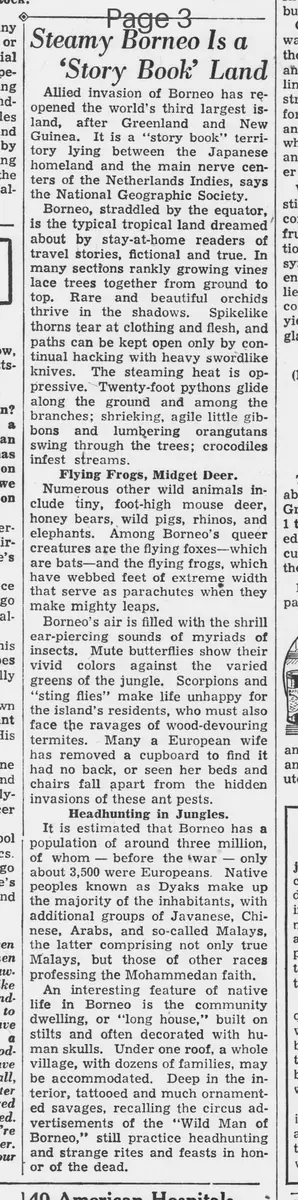
'Story Book' Land
Allied invasion of Borneo has reopened the world's third largest island, after Greenland and New Guinea. It is a "story book" territory lying between the Japanese homeland and the main nerve centers of the Netherlands Indies, says the National Geographic Society.
Borneo, straddled by the equator, is the typical tropical land dreamed about by stay-at-home readers of travel stories, fictional and true. In many sections rankly growing vines lace trees together from ground to top. Rare and beautiful orchids thrive in the shadows. Spikelike thorns tear at clothing and flesh, and paths can be kept open only by continual hacking with heavy swordlike knives.
The steaming heat is oppressive. Twenty-foot pythons glide along the ground and among the branches; shrieking, agile little gibbons and lumbering orangutans swing through the trees; crocodiles infest streams.
Flying Frogs, Midget Deer.
Numerous other wild animals include tiny, foot-high mouse deer, honey bears, wild pigs, rhinos, and elephants. Among Borneo's queer creatures are the flying foxes—which are bats—and the flying frogs, which have webbed feet of extreme width that serve as parachutes when they make mighty leaps.
Borneo's air is filled with the shrill ear-piercing sounds of myriads of insects. Mute butterflies show their vivid colors against the varied greens of the jungle. Scorpions and "sting flies" make life unhappy for the island's residents, who must also face the ravages of wood-devouring termites.
Many a European wife has removed a cupboard to find it had no back, or seen her beds and chairs fall apart from the hidden invasions of these ant pests.
Headhunting in Jungles.
It is estimated that Borneo has a population of around three million, of whom—before the war—only about 3,500 were Europeans. Native peoples known as Dyaks make up the majority of the inhabitants, with additional groups of Javanese, Chinese, Arabs, and so-called Malays, the latter comprising not only true Malays, but those of other races professing the Mohammedan faith.
An interesting feature of native life in Borneo is the community dwelling, or long house, built on stilts and often decorated with human skulls. Under one roof, a whole village, with dozens of families, may be accommodated. Deep in the interior, tattooed and much ornamented savages, recalling the circus advertisements of the "Wild Man of Borneo," still practice headhunting and strange rites and feasts in honor of the dead.
What sub-type of article is it?
What keywords are associated?
Where did it happen?
Foreign News Details
Primary Location
Borneo
Outcome
reopening of the island to the world after allied invasion
Event Details
Allied invasion reopens Borneo, a tropical island with dense vines, orchids, thorns, pythons, gibbons, orangutans, crocodiles, flying frogs, midget deer, honey bears, wild pigs, rhinos, elephants, bats, insects, scorpions, termites; population around three million including Dyaks, Javanese, Chinese, Arabs, Malays; natives live in long houses decorated with skulls and practice headhunting.