Thank you for visiting SNEWPapers!
Sign up free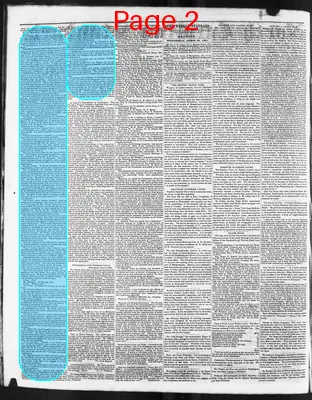
Story
April 16, 1851
North Carolina Standard
Raleigh, Wake County, North Carolina
What is this article about?
In Sacramento, California, gambler Frederick J. Roe shoots and kills blacksmith Charles H. Myers after he intervenes in a fight. An outraged crowd forms a committee, conducts a hasty trial, storms the jail, and lynches Roe that night.
Clipping
OCR Quality
98%
Excellent
Full Text
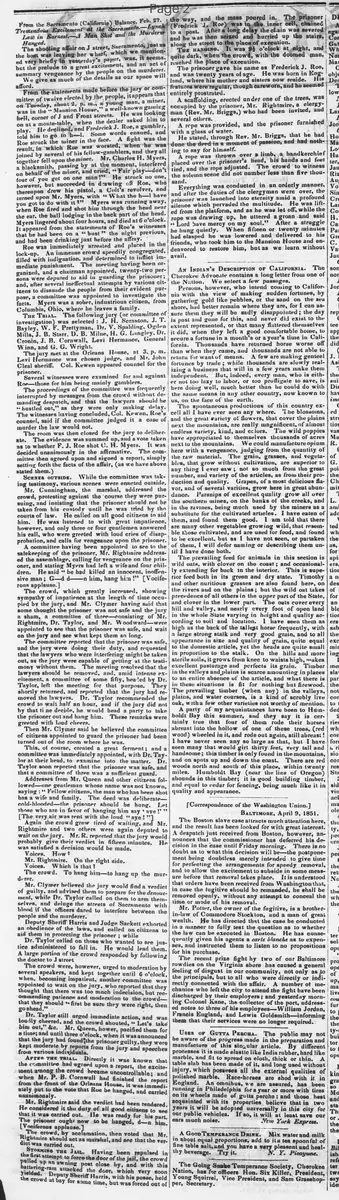
Tremendous Excitement at the Sacramento.
From the Sacramento (California) Balance, Feb. 27.
Law in Earnest. One Man Shot and the Murderer Hanged.
The shooting affair on J street, Sacramento, just as the boat was leaving her wharf, which we mentioned very briefly in yesterday's paper, was, it seems, but the prelude to a great excitement, and an act of summary vengeance by the people on the murderer.
We give as much of the details as our space will afford.
On Tuesday, about 2 p. m., a young man, a miner, was in the "Mansion House," a well-known gaming hell, corner of J and Front streets. He was looking on at a monte-table, when the dealer asked him to play. He declined, and Frederick J. Roe, a gambler, told him to go to h--l. Some words ensued, and Roe struck the miner in the face. A fight was the result, in which Roe was worsted, when he was joined by several of his fellow-gamblers, and they all together fell upon the miner. Mr. Charles H. Myers, a blacksmith, passing by at the moment, interfered on behalf of the miner, and cried, "Fair play—don't four of you get on one man!" He struck no one, however, but succeeded in drawing off Roe, who thereupon drew his pistol, a Colt's revolver, and turned upon Mr. Myers, with "What the h—l have you got to do with it?" Myers was running away, when Roe fired and shot him through the head near the ear, the ball lodging in the back part of the head. Myers lingered about four hours, and died at 6 o'clock. It appeared from the statements of Roe's witnesses that he had been on a "bust" the night previous, and had been drinking just before the affray.
Roe was immediately arrested and placed in the lock-up. An immense crowd speedily congregated, filled with indignation, and determined to inflict immediate punishment. The meeting having been organized, and a chairman appointed, twenty-two persons were deputed to aid in guarding the prisoner; and, after several ineffectual attempts by various citizens to dissuade the people from their evident purpose, a committee was appointed to investigate the facts. Myers was a sober, industrious citizen, from Columbia, Ohio, where he leaves a family.
The Trial. The following jury (or committee of investigation) was selected: J. H. Scranton, J. T. Bayley, W. F. Prettyman, Dr. V. Spalding, Ogden Mills, J. B. Starr, D. B. Milne, H. G. Langley, Dr. Cronin, J. B. Cornwall, Levi Hermance, General Winn, and G. G. Wright.
The jury met at the Orleans House, at 3 p. m. Levi Hermance was chosen judge, and Mr. John Cleal sheriff. Col. Kewen appeared counsel for the prisoner.
Several witnesses were examined for and against Roe—those for him being mainly gamblers.
The proceedings of the committee was frequently interrupted by messages from the crowd without demanding despatch, and that the lawyers should be "hustled out," as they were only making delay.
The witnesses having concluded, Col. Kewen, Roe's counsel, said if the committee judged it a case of murder the law would not.
The room was then closed for the jury to deliberate. The evidence was summed up, and a vote taken as to whether F. J. Roe shot C. H. Myers. It was decided unanimously in the affirmative. The committee then agreed upon and signed a report, simply setting forth the facts of the affair, (as we have above stated them.)
SCENES OUTSIDE.
While the committee was taking testimony, various scenes were enacted outside.
Mr. Cunningham, the marshal, addressed the crowd, protesting against the course they were pursuing, and insisting that the prisoner should not be taken from his custody until he was tried by the courts of law. He called on all good citizens to aid him. He was listened to with great impatience, however, and only three or four gentlemen answered his call, who were greeted with loud cries of disapprobation, and calls for vengeance upon the prisoner.
A committee having been appointed to see to the safekeeping of the prisoner, Mr. Rightmire addressed the assemblage, calling for vengeance on the prisoner, and stating Myers had left a wife and four children. He said "he had killed an innocent, inoffensive man; G-d d--n him, hang him!" [Vociferous applause.]
The crowd, which greatly increased, showing sympathy of impatience at the length of time occupied by the jury, and Mr. Clymer having said that some thought the prisoner was not safe and the jury a sham, a committee of three—consisting of Mr. Rightmire, Dr. Taylor, and Mr. Woodward—were appointed to see that the prisoner was safe, and wait on the jury and see what kept them so long.
The committee reported that the prisoner was safe, and the jury were doing their duty, and requested that the lawyers who were interfering might be taken out, as the jury were capable of getting at the testimony without them. The meeting resolved that the lawyers should be removed, and, amid intense excitement, a committee of some fifty, headed by Dr. Taylor, left the meeting for that purpose. They shortly returned, and reported that the jury had removed the lawyers. Dr. Taylor recommended the crowd to wait half an hour, and if the jury did not by that time decide, he would head a party to take the prisoner out and hang him. These remarks were greeted with loud cheers.
Then Mr. Clymer said he believed the committee of citizens appointed to guard the prisoner had been turned out of the room where he was.
This, of course, created a great ferment; and a committee was immediately appointed, with Dr. Taylor at their head, to examine into the matter. Dr. Taylor soon reported that the prisoner was safe, and that a committee of three was a sufficient guard.
Addresses from Mr. Queen and other citizens followed one gentleman whose name was not known, saying: "Fellow citizens, the man who has been shot has a wife and family. The deed was deliberate—cold-blooded—the prisoner should be hung. Let those who are in favor of hanging him say 'aye!' " [The very air was rent with the loud "aye!"]
Again the crowd grew tired of waiting, and Mr. Rightmire and two others were again deputed to wait on the jury. Mr. R. reported that the jury would probably give their verdict in fifteen minutes. He was satisfied a decision would be made.
Voices. How?
Mr. Rightmire. On the right side.
Voices. Which is that?
The crowd. To hang him—to hang up the murderer.
Mr. Clymer believed the jury would find a verdict of guilty, and advised them to prepare for the denouement, while Dr. Taylor called on them to arm themselves, and deluge the streets of Sacramento with blood if the officers dared to interfere between the people and the murderer.
Deputy Sheriff Harris and Judge Sackett exhorted an obedience of the laws, and called on citizens to aid them in protecting the prisoner; while Dr. Taylor called on those who wanted to see justice administered to fall in. He would lead them.
A large portion of the crowd responded by following the doctor to I street.
The crowd were, however, urged to moderation by several speakers, and kept together until 6 o'clock, when, becoming impatient, another committee was appointed to wait on the jury, who reported that they thought that there was too much indecision, but recommending patience and moderation to the crowd—that they should first be sure they were right, then go ahead."
Dr. Taylor still urged immediate action, and was loudly cheered, and the crowd shouted, "Let's take him out," &c. Mr. Queen, however, pacified them for a time; and until three o'clock, when it was announced that the jury had found the prisoner guilty, they were kept moderate by reports from the jury and speeches from various individuals.
AFTER THE TRIAL. Directly it was known that the committee had agreed upon a report, the excitement among the crowd became uncontrollable; and when Mr. P. B. Cornwall had finished the report from the front of the Orleans House, it was immediately put to the vote that Roe be hanged, and carried unanimously.
Mr. Rightmire said the verdict had been rendered. He considered it the duty of all good citizens to see that it was carried out. He was ready for his part. The prisoner ought now to be hanged, d--n him. [Vociferous applause.]
The crowd, by acclamation, then voted that Mr. Rightmire should act as marshal, and see that the verdict was carried out.
Storming The Jail.
Having been repulsed in the first attempt to force the door of the jail, the crowd pulled up an awning post close by, and with this battering-ram attacked the door, which very soon yielded. Deputy Sheriff Harris, with his posse, held the crowd at bay for some time, but was forced out of the way, and the mass poured in. The prisoner (Frederick J. Roe) was in the inner cell, chained to a post. After a long delay the chain was severed, and he was then seized and hurried up the stairs, along the street to the place of execution.
The Hanging. It was 9 o'clock at night, and quite dark, when the crowd, with the doomed man, reached the place of execution.
The prisoner gave his name as Frederick J. Roe, and was twenty years of age. He was born in England, where his mother and sisters now reside. His features were regular, though careworn, and he seemed entirely prostrated.
A scaffolding, erected under one of the trees, was occupied by the prisoner, Mr. Rightmire, a clergyman (Rev. Mr. Briggs,) who had been invited, and several others.
A rope was provided, and the prisoner furnished with a glass of water.
He stated, through Rev. Mr. Briggs, that he had done the deed in a moment of passion, and had nothing to say for himself.
A rope was thrown over a limb, a handkerchief placed over the prisoner's head, his hands and feet tied, and the rope adjusted. The crowd to witness the solemn scene did not number less than five thousand.
Everything was conducted in an orderly manner, and after the duties of the clergyman were over, the prisoner was launched into eternity amid a profound silence which pervaded the multitude. He was lifted from the platform, and as he was let off, while the rope was drawing up, he uttered a groan—and said "Lord have mercy on my soul." After a struggle he hung quietly. When fifteen or twenty minutes had elapsed he was lowered and delivered to his friends, who took him to the Mansion House and endeavored to restore him, but as we learn without avail.
From the Sacramento (California) Balance, Feb. 27.
Law in Earnest. One Man Shot and the Murderer Hanged.
The shooting affair on J street, Sacramento, just as the boat was leaving her wharf, which we mentioned very briefly in yesterday's paper, was, it seems, but the prelude to a great excitement, and an act of summary vengeance by the people on the murderer.
We give as much of the details as our space will afford.
On Tuesday, about 2 p. m., a young man, a miner, was in the "Mansion House," a well-known gaming hell, corner of J and Front streets. He was looking on at a monte-table, when the dealer asked him to play. He declined, and Frederick J. Roe, a gambler, told him to go to h--l. Some words ensued, and Roe struck the miner in the face. A fight was the result, in which Roe was worsted, when he was joined by several of his fellow-gamblers, and they all together fell upon the miner. Mr. Charles H. Myers, a blacksmith, passing by at the moment, interfered on behalf of the miner, and cried, "Fair play—don't four of you get on one man!" He struck no one, however, but succeeded in drawing off Roe, who thereupon drew his pistol, a Colt's revolver, and turned upon Mr. Myers, with "What the h—l have you got to do with it?" Myers was running away, when Roe fired and shot him through the head near the ear, the ball lodging in the back part of the head. Myers lingered about four hours, and died at 6 o'clock. It appeared from the statements of Roe's witnesses that he had been on a "bust" the night previous, and had been drinking just before the affray.
Roe was immediately arrested and placed in the lock-up. An immense crowd speedily congregated, filled with indignation, and determined to inflict immediate punishment. The meeting having been organized, and a chairman appointed, twenty-two persons were deputed to aid in guarding the prisoner; and, after several ineffectual attempts by various citizens to dissuade the people from their evident purpose, a committee was appointed to investigate the facts. Myers was a sober, industrious citizen, from Columbia, Ohio, where he leaves a family.
The Trial. The following jury (or committee of investigation) was selected: J. H. Scranton, J. T. Bayley, W. F. Prettyman, Dr. V. Spalding, Ogden Mills, J. B. Starr, D. B. Milne, H. G. Langley, Dr. Cronin, J. B. Cornwall, Levi Hermance, General Winn, and G. G. Wright.
The jury met at the Orleans House, at 3 p. m. Levi Hermance was chosen judge, and Mr. John Cleal sheriff. Col. Kewen appeared counsel for the prisoner.
Several witnesses were examined for and against Roe—those for him being mainly gamblers.
The proceedings of the committee was frequently interrupted by messages from the crowd without demanding despatch, and that the lawyers should be "hustled out," as they were only making delay.
The witnesses having concluded, Col. Kewen, Roe's counsel, said if the committee judged it a case of murder the law would not.
The room was then closed for the jury to deliberate. The evidence was summed up, and a vote taken as to whether F. J. Roe shot C. H. Myers. It was decided unanimously in the affirmative. The committee then agreed upon and signed a report, simply setting forth the facts of the affair, (as we have above stated them.)
SCENES OUTSIDE.
While the committee was taking testimony, various scenes were enacted outside.
Mr. Cunningham, the marshal, addressed the crowd, protesting against the course they were pursuing, and insisting that the prisoner should not be taken from his custody until he was tried by the courts of law. He called on all good citizens to aid him. He was listened to with great impatience, however, and only three or four gentlemen answered his call, who were greeted with loud cries of disapprobation, and calls for vengeance upon the prisoner.
A committee having been appointed to see to the safekeeping of the prisoner, Mr. Rightmire addressed the assemblage, calling for vengeance on the prisoner, and stating Myers had left a wife and four children. He said "he had killed an innocent, inoffensive man; G-d d--n him, hang him!" [Vociferous applause.]
The crowd, which greatly increased, showing sympathy of impatience at the length of time occupied by the jury, and Mr. Clymer having said that some thought the prisoner was not safe and the jury a sham, a committee of three—consisting of Mr. Rightmire, Dr. Taylor, and Mr. Woodward—were appointed to see that the prisoner was safe, and wait on the jury and see what kept them so long.
The committee reported that the prisoner was safe, and the jury were doing their duty, and requested that the lawyers who were interfering might be taken out, as the jury were capable of getting at the testimony without them. The meeting resolved that the lawyers should be removed, and, amid intense excitement, a committee of some fifty, headed by Dr. Taylor, left the meeting for that purpose. They shortly returned, and reported that the jury had removed the lawyers. Dr. Taylor recommended the crowd to wait half an hour, and if the jury did not by that time decide, he would head a party to take the prisoner out and hang him. These remarks were greeted with loud cheers.
Then Mr. Clymer said he believed the committee of citizens appointed to guard the prisoner had been turned out of the room where he was.
This, of course, created a great ferment; and a committee was immediately appointed, with Dr. Taylor at their head, to examine into the matter. Dr. Taylor soon reported that the prisoner was safe, and that a committee of three was a sufficient guard.
Addresses from Mr. Queen and other citizens followed one gentleman whose name was not known, saying: "Fellow citizens, the man who has been shot has a wife and family. The deed was deliberate—cold-blooded—the prisoner should be hung. Let those who are in favor of hanging him say 'aye!' " [The very air was rent with the loud "aye!"]
Again the crowd grew tired of waiting, and Mr. Rightmire and two others were again deputed to wait on the jury. Mr. R. reported that the jury would probably give their verdict in fifteen minutes. He was satisfied a decision would be made.
Voices. How?
Mr. Rightmire. On the right side.
Voices. Which is that?
The crowd. To hang him—to hang up the murderer.
Mr. Clymer believed the jury would find a verdict of guilty, and advised them to prepare for the denouement, while Dr. Taylor called on them to arm themselves, and deluge the streets of Sacramento with blood if the officers dared to interfere between the people and the murderer.
Deputy Sheriff Harris and Judge Sackett exhorted an obedience of the laws, and called on citizens to aid them in protecting the prisoner; while Dr. Taylor called on those who wanted to see justice administered to fall in. He would lead them.
A large portion of the crowd responded by following the doctor to I street.
The crowd were, however, urged to moderation by several speakers, and kept together until 6 o'clock, when, becoming impatient, another committee was appointed to wait on the jury, who reported that they thought that there was too much indecision, but recommending patience and moderation to the crowd—that they should first be sure they were right, then go ahead."
Dr. Taylor still urged immediate action, and was loudly cheered, and the crowd shouted, "Let's take him out," &c. Mr. Queen, however, pacified them for a time; and until three o'clock, when it was announced that the jury had found the prisoner guilty, they were kept moderate by reports from the jury and speeches from various individuals.
AFTER THE TRIAL. Directly it was known that the committee had agreed upon a report, the excitement among the crowd became uncontrollable; and when Mr. P. B. Cornwall had finished the report from the front of the Orleans House, it was immediately put to the vote that Roe be hanged, and carried unanimously.
Mr. Rightmire said the verdict had been rendered. He considered it the duty of all good citizens to see that it was carried out. He was ready for his part. The prisoner ought now to be hanged, d--n him. [Vociferous applause.]
The crowd, by acclamation, then voted that Mr. Rightmire should act as marshal, and see that the verdict was carried out.
Storming The Jail.
Having been repulsed in the first attempt to force the door of the jail, the crowd pulled up an awning post close by, and with this battering-ram attacked the door, which very soon yielded. Deputy Sheriff Harris, with his posse, held the crowd at bay for some time, but was forced out of the way, and the mass poured in. The prisoner (Frederick J. Roe) was in the inner cell, chained to a post. After a long delay the chain was severed, and he was then seized and hurried up the stairs, along the street to the place of execution.
The Hanging. It was 9 o'clock at night, and quite dark, when the crowd, with the doomed man, reached the place of execution.
The prisoner gave his name as Frederick J. Roe, and was twenty years of age. He was born in England, where his mother and sisters now reside. His features were regular, though careworn, and he seemed entirely prostrated.
A scaffolding, erected under one of the trees, was occupied by the prisoner, Mr. Rightmire, a clergyman (Rev. Mr. Briggs,) who had been invited, and several others.
A rope was provided, and the prisoner furnished with a glass of water.
He stated, through Rev. Mr. Briggs, that he had done the deed in a moment of passion, and had nothing to say for himself.
A rope was thrown over a limb, a handkerchief placed over the prisoner's head, his hands and feet tied, and the rope adjusted. The crowd to witness the solemn scene did not number less than five thousand.
Everything was conducted in an orderly manner, and after the duties of the clergyman were over, the prisoner was launched into eternity amid a profound silence which pervaded the multitude. He was lifted from the platform, and as he was let off, while the rope was drawing up, he uttered a groan—and said "Lord have mercy on my soul." After a struggle he hung quietly. When fifteen or twenty minutes had elapsed he was lowered and delivered to his friends, who took him to the Mansion House and endeavored to restore him, but as we learn without avail.
What sub-type of article is it?
Crime Story
Historical Event
Tragedy
What themes does it cover?
Crime Punishment
Justice
Tragedy
What keywords are associated?
Shooting
Lynching
Vigilante Justice
Gambling Fight
Sacramento Mob
Hasty Trial
Hanging
What entities or persons were involved?
Frederick J. Roe
Charles H. Myers
Mr. Rightmire
Dr. Taylor
Levi Hermance
Col. Kewen
Rev. Mr. Briggs
Where did it happen?
Sacramento, California
Story Details
Key Persons
Frederick J. Roe
Charles H. Myers
Mr. Rightmire
Dr. Taylor
Levi Hermance
Col. Kewen
Rev. Mr. Briggs
Location
Sacramento, California
Event Date
Tuesday, About 2 P. M., February 1850
Story Details
Gambler Frederick J. Roe shoots blacksmith Charles H. Myers during a fight in a Sacramento gaming house. An angry crowd organizes a committee trial, finds Roe guilty of murder, storms the jail, and hangs him that night despite legal protests.