Thank you for visiting SNEWPapers!
Sign up free
Fowle's New Hampshire Gazette And General Advertiser
Portsmouth, Rockingham County, New Hampshire
What is this article about?
Letter from Justice Aedanus Burke to Governor Guerard describing the December 1784 lynching of William Love in Ninety-Six, SC, for his participation in William Cunningham's 1781 massacre of American prisoners, following Love's release by the court despite public outrage.
Clipping
OCR Quality
Full Text
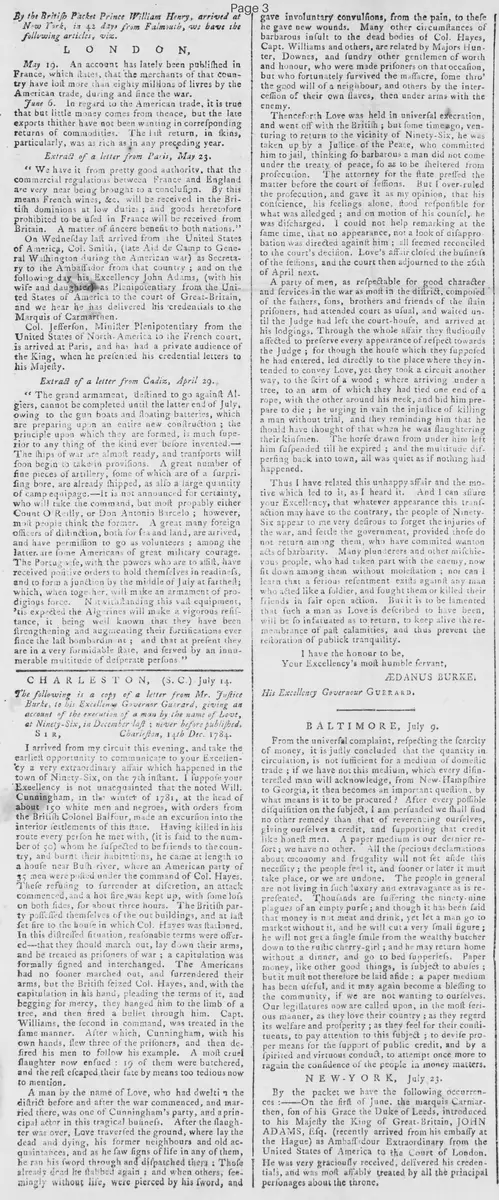
The following is a copy of a letter from Mr. Justice Burke, to his Excellency Governor Guerard, giving an account of the execution of a man by the name of Love, at Ninety-Six, in December last; never before published.
SIR,
Charleston, 14th Dec. 1784.
I arrived from my circuit this evening, and take the earliest opportunity to communicate to your Excellency a very extraordinary affair which happened in the town of Ninety-Six, on the 7th instant. I suppose your Excellency is not unacquainted that the noted William Cunningham, in the winter of 1781, at the head of about 150 white men and negroes, with orders from the British Colonel Balfour, made an excursion into the interior settlements of this state. Having killed in his route every person he met with, (it is said to the number of 20) whom he suspected to be friends to the country, and burnt their habitations, he came at length to a house near Bush river, where an American party of 35 men were posted under the command of Col. Hayes. These refusing to surrender at discretion, an attack commenced, and a hot fire was kept up, with some loss on both sides, for about three hours. The British party possessed themselves of the out buildings, and at last set fire to the house in which Col. Hayes was stationed. In this distressed situation, reasonable terms were offered--that they should march out, lay down their arms, and be treated as prisoners of war; a capitulation was formally signed and interchanged. The Americans had no sooner marched out, and surrendered their arms, but the British seized Col. Hayes, and, with the capitulation in his hand, pleading the terms of it, and begging for mercy, they hanged him to the limb of a tree, and then fired a bullet through him. Capt. Williams, the second in command, was treated in the same manner. After which, Cunningham, with his own hands, slew three of the prisoners, and then desired his men to follow his example. A most cruel slaughter now ensued: 11 of them were butchered, and the rest escaped their fate by means too tedious now to mention.
A man by the name of Love, who had dwelt in the district before and after the war commenced, and married there, was one of Cunningham's party, and a principal actor in this tragical business. After the slaughter was over, Love traversed the ground, where lay the dead and dying, his former neighbours and old acquaintances, and as he saw signs of life in any of them, he ran his sword through and dispatched them: Those already dead he stabbed again: and when others, seemingly without life, were pierced by his sword, and gave involuntary convulsions from the pain, to these he gave new wounds. Many other circumstances of barbarous insult to the dead bodies of Col. Hayes, Capt. Williams and others, are related by Majors Hunter, Downes, and sundry other gentlemen of worth and honour, who were made prisoners on that occasion, but who fortunately survived the massacre, some through the good will of a neighbor, and others by the intervention of their own slaves, then under arms with the enemy.
Thenceforth Love was held in universal execration, and went off with the British; but some time ago, venturing to return to the vicinity of Ninety-Six, he was taken up by a Justice of the Peace, who committed him to jail, thinking so barbarous a man did not come under the treaty of peace, so as to be sheltered from prosecution. The attorney for the state pressed the matter before the court of sessions. But I over-ruled the prosecution, and gave it as my opinion, that his conscience, his feelings alone, stood responsible for what was alleged; and on motion of his counsel, he was discharged. I could not help remarking at the same time, that no appearance, not a look of disapprobation was directed against him; all seemed reconciled to the court's decision. Love's affair closed the business of the sessions, and the court then adjourned to the 26th of April next.
A party of men, as respectable for good character and services in the war as most in the district, composed of the fathers, sons, brothers and friends of the slain prisoners, had attended court as usual, and waited until the Judge had left the court-house, and arrived at his lodgings. Through the whole affair they studiously affected to preserve every appearance of respect towards the Judge; for though the house which they supposed he had entered, led directly to the place where they intended to convey Love, yet they took a circuit another way, to the skirt of a wood; where arriving under a tree, to an arm of which they had tied one end of a rope, with the other around his neck, and bid him prepare to die; he urging in vain the injustice of killing a man without trial, and they reminding him that he should have thought of that when he was slaughtering their kinsmen. The horse drawn from under him left him suspended till he expired; and the multitude dispersing back into town, all was quiet as if nothing had happened.
Thus I have related this unhappy affair and the motive which led to it, as I heard it. And I can assure your Excellency, that whatever appearance this transaction may have to the contrary, the people of Ninety-Six appear to me very desirous to forget the injuries of the war, and settle the government, provided those do not return among them, who have committed wanton acts of barbarity. Many plunderers and other mischievous people, who had taken part with the enemy, now sit down among them without molestation; nor can I learn that a serious resentment exists against any man who acted like a soldier, and fought them or killed their friends in fair open action. But it is to be lamented that such a man as Love is described to have been, will be so infatuated as to return, to keep alive the remembrance of past calamities, and thus prevent the restoration of public tranquility.
I have the honour to be,
Your Excellency's most humble servant,
AEDANUS BURKE.
His Excellency Governor Guerard.
What sub-type of article is it?
What keywords are associated?
What entities or persons were involved?
Where did it happen?
Domestic News Details
Primary Location
Ninety Six
Event Date
7th Instant December 1784
Key Persons
Outcome
love hanged by vigilantes composed of relatives of 1781 massacre victims after his court discharge; in 1781 massacre, col. hayes and capt. williams hanged and shot, three slain by cunningham, 11 butchered, totaling around 15 deaths.
Event Details
Justice Burke reports the extrajudicial hanging of Love, a participant in William Cunningham's 1781 massacre of American prisoners near Bush River, after Love's release from court in Ninety-Six on grounds of the peace treaty; vigilantes, relatives of the slain, abducted and hanged him quietly without disturbance.