Thank you for visiting SNEWPapers!
Sign up free
The National Intelligencer And Washington Advertiser
Washington, District Of Columbia
What is this article about?
Continuation of an account of Spanish Louisiana's colonial administration, including the hereditary Cabildo council, roles of the Intendant and other officials, taxes and duties, government expenses and debt, key exports like sugar and cotton, import/export statistics from 1799-1802, limited manufactures, and 1802 navigation data.
Merged-components note: Merged embedded tables into the main article text for the complete 'An Account of LOUISIANA' (Continued), including shipping and trade data relevant to the foreign territory description.
Clipping
OCR Quality
Full Text
(Continued.)
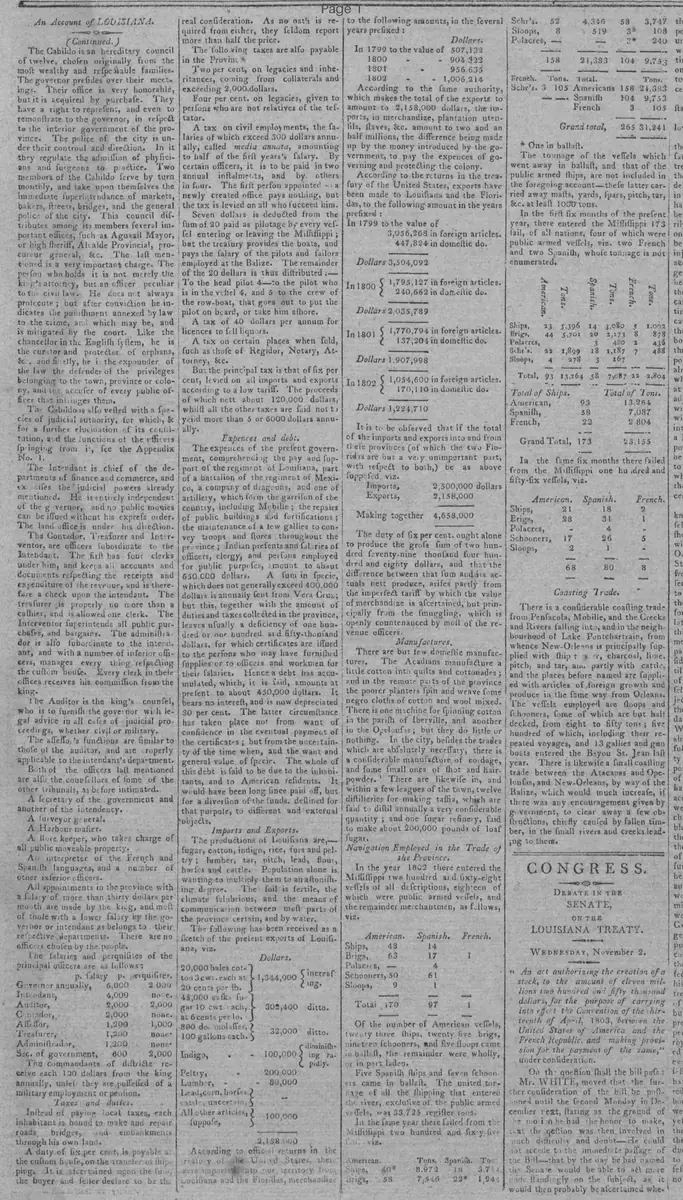
The Cabildo is an hereditary council of twelve, chosen originally from the most wealthy and respectable families. The governor presides over their meetings. Their office is very honorable, but it is acquired by purchase. They have a right to represent, and even to remonstrate to the governor, in respect to the interior government of the province. The police of the city is under their control and direction. In it they regulate the admission of physicians and surgeons to practice. Two members of the Cabildo serve by turn monthly, and take upon themselves the immediate superintendence of markets, bakers, streets, bridges, and the general police of the city. This council distributes among its members several important offices, such as Aguazil Mayor, or high sheriff, Alcalde Provincial, procurer general, &c. The last mentioned is a very important charge. The person who holds it is not merely the king's attorney, but an officer peculiar to the civil law. He does not always prosecute; but after conviction he indicates the punishment annexed by law to the crime, and which may be, and is mitigated by the court. Like the chancellor in the English system, he is the curator and protector of orphans, &c. and finally, he is the expounder of the law the defender of the privileges belonging to the town, province or colony, and the accuser of every public officer that infringes them.
The Cabildo is also vested with a species of judicial authority, for which, & for a further elucidation of its constitution, and the functions of the officers springing from it, see the Appendix No. 1.
The Intendant is chief of the departments of finance and commerce, and exercises the judicial powers already mentioned. He is entirely independent of the governor, and no public monies can be issued without his express order. The land office is under his direction. The Contador, Treasurer and Interventor, are officers subordinate to the Intendant. The first has four clerks under him, and keeps all accounts and documents respecting the receipts and expenditure of the revenue, and is therefore a check upon the intendant. The treasurer is properly no more than a cashier, and is allowed one clerk. The Interventor superintends all public purchases, and bargains. The administrador is also subordinate to the intendant, and with a number of inferior officers, manages every thing respecting the custom house. Every clerk in these offices receives his commission from the king.
The Auditor is the king's counsel, who is to furnish the governor with legal advice in all cases of judicial proceedings, whether civil or military. The asessor's functions are similar to those of the auditor, and are properly applicable to the intendant's department. Both of the officers last mentioned are also the counsellors of some of the other tribunals, as before intimated.
A secretary of the government and another of the intendency. A surveyor general. A Harbour master. A store keeper, who takes charge of all public moveable property. An interpreter of the French and Spanish languages, and a number of other inferior officers.
All appointments in the province with a salary of more than thirty dollars per month are made by the king, and most of those with a lower salary by the governor or intendant as belongs to their respective departments. There are no officers chosen by the people.
The salaries and perquisites of the principal officers are as follows;
The commandants of districts receive each 500 dollars from the king annually, unless they are possessed of a military employment or pension.
Taxes and duties.
Instead of paying local taxes, each inhabitant is bound to make and repair roads, bridges, and embankments through his own land,
A duty of six per cent, is payable at the custom house, on the transfer of shipping. It is ascertained upon the value which the buyer and seller declare to be the real consideration. As no oath is required from either, they seldom report more than half the price.
The following taxes are also payable in the Province
Two per cent, on legacies and inheritances, coming from collaterals and exceeding 2,000 dollars.
Four per cent. on legacies, given to persons who are not relatives of the testator.
A tax on civil employments, the salaries of which exceed 300 dollars annually, called media annata, amounting to half of the first year's salary. By certain officers, it is to be paid in two annual instalments, and by others in four. The first person appointed to a newly created office pays nothing, but the tax is levied on all who succeed him.
Seven dollars is deducted from the sum of 20 paid as pilotage by every vessel entering or leaving the Mississippi; but the treasury provides the boats, and pays the salary of the pilots and sailors employed at the Balize. The remainder of the 20 dollars is thus distributed :- To the head pilot 4 to the pilot who is in the vessel 4, and 5 to the crew of the row-boat, that goes out to put the pilot on board, or take him ashore.
A tax of 40 dollars per annum for licences to sell liquors.
A tax on certain places when sold, such as those of Regidor, Notary, Attorney, &c.
But the principal tax is that of six per cent, levied on all imports and exports according to a low tariff. The proceeds of which net about 120,000 dollars, whilst all the other taxes are said not to yield more than 5 or 6000 dollars annually.
Expenses and debt.
The expenses of the present government, comprehending the pay and support of the regiment of Louisiana, part of a battalion of the regiment of Mexico, a company of dragoons, and one of artillery, which form the garrison of the country, including Mobile; the repairs of public buildings and fortifications; the maintenance of a few gallies to convey troops and stores throughout the province; Indian presents and salaries of officers, clergy, and persons employed for public purposes, amount to about 650,000 dollars. A sum in specie, which does not generally exceed 400,000 dollars is annually sent from Vera Cruz; but this, together with the amount of duties and taxes collected in the province, leaves usually a deficiency of one hundred or one hundred and fifty-thousand dollars, for which certificates are issued to the persons who may have furnished supplies or to officers and workmen for their salaries. Hence a debt has accumulated, which, it is said, amounts at present to about 450,000 dollars. It bears no interest, and is now depreciated 30 per cent. The latter circumstance has taken place not from want of confidence in the eventual payment of the certificates ; but from the uncertainty of the time when, and the want and general value of specie. The whole of this debt is said to be due to the inhabitants, and to American residents. It would have been long since paid off, but for a diversion of the funds. destined for that purpose, to different and external objects.
Imports and Exports.
The productions of Louisiana are,- sugar, cotton, indigo, rice, furs and peltry; lumber, tar, pitch, lead, flour, horses and cattle. Population alone is wanting to multiply them to an astonishing degree. The soil is fertile, the climate salubrious, and the means of communication between most parts of the province certain, and by water.
The following has been received as a sketch of the present exports of Louisiana, viz.
Dollars 58,000
According to official returns in the treasury of the United States, there were imported into our territory from Louisiana and the Floridas, merchandise to the following amounts, in the several years prefixed :
According to the same authority, which makes the total of the exports to amount to 2,158,000 dollars, the imports, in merchandise, plantation utensils, slaves, &c. amount to two and a half millions, the difference being made up by the money introduced by the government, to pay the expenses of governing and protecting the colony.
According to the returns in the treasury of the United States, exports have been made to Louisiana and the Floridas, to the following amount in the years prefixed :
In 1799 to the value of 3,056,268 in foreign articles. 447,824 in domestic do. Dollars 3,504,092
In 1800 $ 1,795,127 in foreign articles. 240,662 in domestic do. Dollars 2,035,789
In 1801 $ 1,770,794 in foreign articles. 137,204 in domestic do. Dollars 1,907,998
In 1802 $ 1,054,600 in foreign articles. 170,110 in domestic do. Dollars 1,224,710
It is to be observed that if the total of the imports and exports into and from these provinces (of which the two Floridas are but a very unimportant part, with respect to both,) be as above supposed, viz.
Imports, 2,500,000 dollars
Exports, 2,158,000
Making together 4,658,000
The duty of six per cent. ought alone to produce the gross sum of two hundred seventy-nine thousand four hundred and eighty dollars, and that the difference between that sum and its actual net produce, arises partly from the imperfect tariff by which the value of merchandise is ascertained, but principally from the smuggling, which is openly countenanced by most of the revenue officers,
Manufactures.
There are but few domestic manufactures.
The Acadians manufacture a little cotton into quilts and cottonades; and in the remote parts of the province the poorer planters spin and weave some negro cloths of cotton and wool mixed.
There is one machine for ginning cotton in the parish of Iberville, and another in the Opelousas; but they do little or nothing. In the city, besides the trades which are absolutely necessary, there is a considerable manufacture of cordage, and one small one of shot and hair-powder. There are likewise in, and within a few leagues of the town, twelve distilleries for making taffia, which are said to distill annually a very considerable quantity ; and one sugar refinery, said to make about 200,000 pounds of loaf sugar.
Navigation Employed in the Trade of the Province.
In the year 1802 there entered the Mississippi two hundred and sixty-eight vessels of all descriptions, eighteen of which were public armed vessels, and the remainder merchantmen, as follows, viz.
Of the number of American vessels, twenty three ships, twenty five brigs, nineteen schooners, and five sloops came in ballast, the remainder were wholly, or in part laden.
Five Spanish ships and seven schooners came in ballast. The united tonnage of all the shipping that entered the river, exclusive of, the public armed vessels, was 33,725 register tons.
In the same year there sailed from the Mississippi two hundred and sixty-five sail. viz.
| Governor annually, | 6,000 | 2,000 |
| Intendant, | 4,000 | none. |
| Auditor, | 2,000 | 2,000 |
| Contrador, | 2,000 | none. |
| Affitor, | 1,200 | 1,000 |
| Treasurer, | 1,200 | none. |
| Administrator, | 1,200 | none. |
| Sec. of government, | 600 | 2,000 |
| 20,000 bales cot-ton 3 cwt. each at 20 cents per lb. | 1,344,000 | 5 increase ing. |
| 45,000 cakks fu gar 10 cwt. each, at 6 cents per lo. | 302,400 | ditto. |
| 800 do molaffes, 100 gallons each. | 32,000 | ditto. |
| Indigo, | 100,000 | diminish ing ra-pidly. |
| Peltry, | 200,000 | |
| Lumber, | 80,000 | |
| Lead, corn, horfe s catle, uncertain. | 100,000 | |
| All other articles, fuppole, |
| In 1799 to the value of | 507,132 |
| 1800 | - 904,322 |
| 1801 | - 956,635 |
| 1802 | - 1,006,214 |
| Schr's. | 52 | 4,346 | 58 | 3,747 |
| Sloops, | 8 | 519 | 3* | 108 |
| Polacres, | — | — | 3* | 240 |
| — | — | — | — | |
| 158 | 21,383 | 104 | 9,753 | |
| — | — | — | — | |
| Frenéh. | Tons. | Total. | — | Tons. |
| Schr's. | 3 | 105 | Americans | 158 |
| — | Spanifih | 104 | 9,753 | |
| French | 3 | 105 | ||
| — | — | — | — | |
| — | — | — | — |
| American. | Spanish. | French. |
| Ships, | 48 | 14 |
| Brigs, | 63 | 17 |
| Polacres, | — | 4 |
| Schooners, | 50 | 61 |
| Sloops, | 9 | 1 |
| Total | 170 | 97 |
| Ships, | 23 | 5,396 | 14 | 3,080 | 5 | 1,002 |
| Brigs, | 44 | 5,701 | 20 | 2,173 | 8 | 878 |
| Pelacres, | 3 | 430 | 2 | 430 | ||
| Schr's. | 22 | 1,899 | 18 | 1,187 | 7 | 488 |
| Sloops, | 4 | 278 | 3 | 167 |
| Total of Ships. | Total of Tons. |
| American, | 93 |
| Spanish, | 58 |
| French, | 22 |
| Grand Total, 173 | 23,155 |
| American. | Spanish. | French. | |
| Ships, | 21 | 18 | 2 |
| Erigs, | 28 | 31 | 1 |
| Polacres, | - | 4 | - |
| Schooners, | 17 | 26 | 5 |
| Sloops, | 2 | 1 | - |
| - | - | - | |
| 68 | 80 | 8 |
| American. | Tons. | Spanich. | Tous | |
| Ships, | 40 $ ^{*} $ | 8,972 | 18 | 3,714 |
| Brigs, | 58 | 7,546 | 22 $ ^{*} $ | 1,944 |
What sub-type of article is it?
What keywords are associated?
Where did it happen?
Foreign News Details
Primary Location
Louisiana
Event Date
As Of 1802
Event Details
Description of Spanish colonial government in Louisiana, including the hereditary Cabildo council of twelve, presided over by the governor; roles of Intendant in finance and commerce, independent of governor; subordinate officers like Contador, Treasurer, Interventor, Administrador; Auditor and Asessor for legal advice; other officials; appointment processes; salaries; taxes and duties such as six percent on imports/exports, legacies, civil employments; government expenses around 650,000 dollars annually with 450,000 dollar debt; productions like sugar, cotton, indigo; export sketch totaling about 2,158,000 dollars; US import/export statistics 1799-1802; limited manufactures; 1802 Mississippi navigation with 268 vessels entering, 265 sailing, tonnage details by nationality.