Thank you for visiting SNEWPapers!
Sign up free
Gazette Of The United States, & Philadelphia Daily Advertiser
Philadelphia, Philadelphia County, Pennsylvania
What is this article about?
Proceedings of the U.S. House of Representatives, including committee reports on consular reimbursements, stills entry alterations, stamp duty deductions, petitions from John Parker, Henry Hill, Quakers, Anna Welsh, and others; passage of 1798 appropriations bill; discussions on rules, refugee relief, land sales, franking privileges, and provisions for military widows.
Clipping
OCR Quality
Full Text
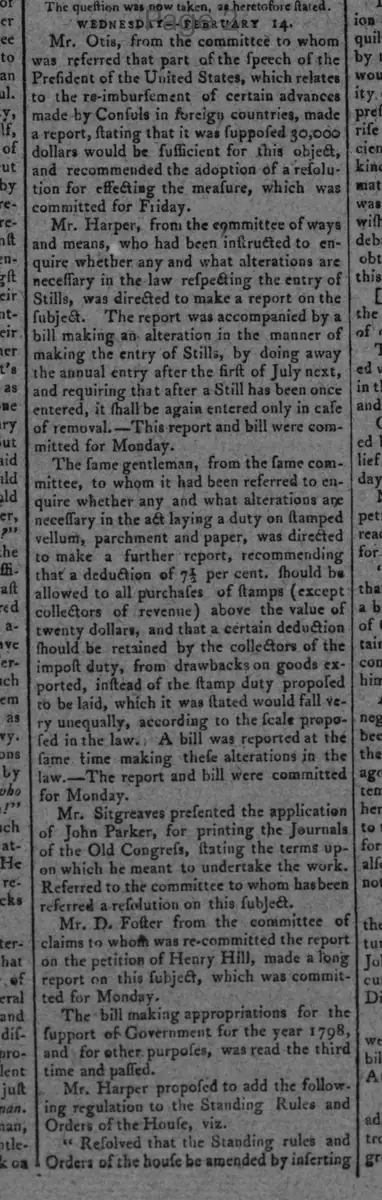
Mr. Harper, from the committee of ways and means, who had been instructed to enquire whether any and what alterations are necessary in the law respecting the entry of Stills, was directed to make a report on the subject. The report was accompanied by a bill making an alteration in the manner of making the entry of Stills, by doing away the annual entry after the first of July next, and requiring that after a Still has been once entered, it shall be again entered only in case of removal.--This report and bill were committed for Monday.
The same gentleman, from the same committee, to whom it had been referred to enquire whether any and what alterations are necessary in the act laying a duty on stamped vellum, parchment and paper, was directed to make a further report, recommending that a deduction of 7 per cent. should be allowed to all purchases of stamps (except collectors of revenue) above the value of twenty dollars, and that a certain deduction should be retained by the collectors of the impost duty, from drawbacks on goods exported, instead of the stamp duty proposed to be laid, which it was stated would fall very unequally, according to the scale proposed in the law., A bill was reported at the same time making these alterations in the law.-The report and bill were committed for Monday.
Mr. Sitgreaves presented the application of John Parker, for printing the Journals of the Old Congress, stating the terms upon which he meant to undertake the work. Referred to the committee to whom has been referred a resolution on this subject.
Mr. D. Foster from the committee of claims to whom was re-committed the report on the petition of Henry Hill, made a long report on this subject, which was committed for Monday.
The bill making appropriations for the support of Government for the year 1798, and for other purposes, was read the third time and passed.
Mr. Harper proposed to add the following regulation to the Standing Rules and Orders of the House, viz.
"Resolved that the Standing rules and Orders of the house be amended by inserting after Rules respecting motions for adjournment, provided that no motion for adjournment shall be received, except by unanimous consent, whilst any other motion is pending." Ordered to lie on the table,
The amendments of the Senate to the bill for the relief of the Refugees from Canada and Nova-Scotia, were taken up and referred to a Select Committee.
The bill from the Senate for sale of land between the Great and Little Miami in the territory north west of the Ohio, was also taken up and committed for Monday.
Mr. Nicholas wished, as in some degree connected with the subject, to present a petition from a number of persons settled near the mouth of the Kentucky river, who wished to purchase the same, which would be proper to be referred to the same committee. He wished also to move an instruction to the committee, to enquire what progress has been made in carrying the act into effect for the sale of land north west of the river Ohio, and whether any amendments are necessary in the said act, particularly as to the price of the land. Mr. N. believed there was little probability of the land selling at the price which had been fixed, and persons who might become purchasers, if the price was reasonable, were now moving off to the Spanish Territory. He thought it would be well to prevent this, and therefore moved this instruction.-It was agreed to.
Mr. Sitgreaves moved the order of the day on the report of a select committee on the memorial of the people called quakers; which motion being agreed to, the house went into a committee of the whole on the subject, Mr. Dent in the chair. The report having been read,
Mr. Thatcher could not say that he was perfectly satisfied with the report of the committee in all its parts. He wished the business disposed of, without coming to any decisive resolution upon it, so as either to approve or disapprove of it. He was not ready to say that the facts disclosed in that memorial were exclusively of judicial cognizance, and that the legislature of the Union was incompetent to do any thing in it. It might, however be true, but it was not clear to him. He would rather that the subject should not now be acted upon: he would, therefore, propose an amendment to the report, which might conclude the business, without coming to any resolution upon it, which had been the course heretofore taken with similar applications. He moved, therefore, to strike out the resolution giving the petitioners leave to withdraw their petition; and if his motion was agreed to, he should wish the committee to rise, and that the house would not act further upon it at present.
Mr. Rutledge said, he, as well as the gentleman from Massachusetts, was dissatisfied with the report of the select committee. He thought the report ought to have stated that the peace of certain states in the U. nion had been much disturbed by applications of his kind. He had prepared a resolution to this effect, which he would read in his place : It was as follows:
"Resolved, that part of the memorial of the people called Quakers, has a tendency to disturb the tranquility of some of the states of the Union; that this house is not competent to act upon, and therefore they have leave to withdraw their memorial."
There could be little difference of opinion on the assertion that the internal tranquility of several states had been disturbed by these applications; and he believed there would be no difficulty in obtaining a majority. of the house to declare it; as if the representatives of three or four states were to rise and declare the fact it must have sufficient weight to carry a declaration of this kind. He had, however, mentioned the matter to some of his friends, and found it was not very agreeable to them, as they wished to get rid of the business without debate. But if the present motion were to obtain he should afterwards bring forward this resolution.
The Chairman declared the motion of the gentleman from Massachusetts to be out of order.]
The question on the resolution as reported was put and carried, there being 74 votes in the affirmative. The committee then rose, and the house concurred in the report.
On motion of Mr. Gregg, the unfinished business of yesterday (the bill for the relief of O. Pollock) was postponed till Monday.
Mr. Coit called for the reading of the petition of Anna Welsh; which having been read, he proposed the following resolution for adoption:
"Resolved on the petition of Anna Welsh that a committee be appointed to bring in a bill for allowing the legal representatives of George Hurlburt, deceased, late a captain in the service of the United States, the commutation of half pay which was due to him."
After a few observations, this motion was negatived, 50 to 31, the question having been decided in an abstract manner, when the business was before the house some time ago, and the period of war was attempted to be fixed earlier than it had been heretofore considered to have been, in order to take in the cases of persons who died before the latter period. It was determined also that the prayer of this petition could not be granted.
Mr. Livingston called up the report of the committee of commerce and manufactures on the petitions of William Dixon, John Bagley, and others, which was concurred in, so far as it related to William Dixon and John Bagley.
On motion of Mr. Thatcher, the house went into a committee of the whole on the bill granting the right of franking to the Attorney General.
Mr. Harper moved to amend the bill by adding "and the officer commanding the troops of the United States" which was agreed to.
The committee rose, the house agreed to the amendment, and the bill was ordered to be engrossed for a third reading.
On motion of Mr. Gregg, the house went into a committee of the whole on the report of the committee of claims on the subject of making provision for the widows and orphan children of the officers of the army of the United States, who were killed in an action with the Indians, in the territory north-west of the Ohio, on the 4th of November, 1791. The report was favorable.
Mr. Davis moved to amend the report, by adding Militia Officers. He thought it was only reasonable, that an allowance should be made to the widows and orphans of militia officers, as well as to those of the officers of the army. The Kentucky militia were out on that expedition, and several officers were killed.
Mr. D. Foster proposed to make the provision general, and to go back to the 4th of March 1789.
Some objections were urged to this amendment, as it was apprehended, from its comprehensiveness, it might endanger the passage of the bill, as the Senate had rejected a former bill of this kind. The committee rose, without coming to any decision, and had leave to sit again.
Adjourned.
What sub-type of article is it?
What keywords are associated?
What entities or persons were involved?
Where did it happen?
Story Details
Key Persons
Location
House Of Representatives, United States
Event Date
1798
Story Details
Various committee reports and bills discussed and committed, including reimbursements for consuls, alterations to stills entry and stamp duties, petitions for printing journals, claims by Henry Hill, Quaker memorial leading to withdrawal permission, refugee relief amendments, land sales in Ohio territory with price concerns, franking rights extension, and provisions for 1791 battle widows with amendment debates; 1798 appropriations bill passed.