Thank you for visiting SNEWPapers!
Sign up free
Story
March 27, 1818
Kentucky Gazette
Lexington, Fayette County, Kentucky
What is this article about?
Article from the National Intelligencer reflects on the U.S. Senate's evolution from a secretive privy council under Washington to a more public, representative body, noting the 1794 opening of legislative sessions and regretting the lack of reported debates.
Clipping
OCR Quality
95%
Excellent
Full Text
FROM THE NATIONAL INTELLIGENCER.
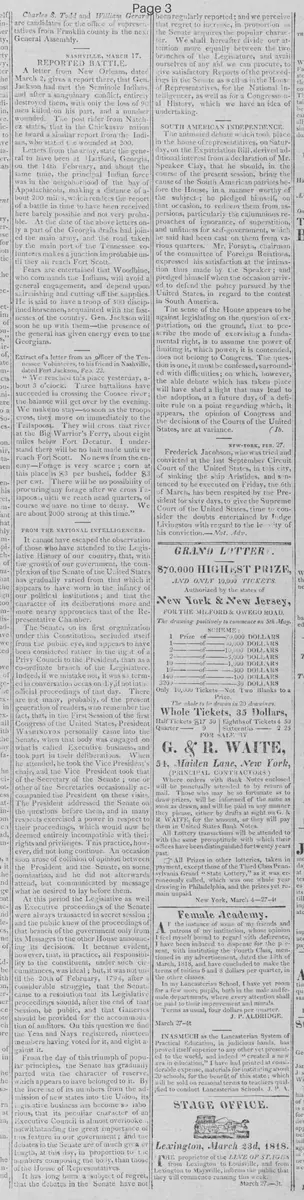
It cannot have escaped the observation of those who have attended to the Legislative History of our country, that, with the growth of our government, the complexion of the Senate of the United States has gradually varied from that which it appears to have worn in the infancy of our political institutions; and that the character of its deliberations more and more nearly approaches that of the Representative Chamber.
The Senate, on its first organization under this Constitution, secluded itself from the public eye, and appears to have been considered rather in the light of a Privy Council to the President, than as a co-ordinate branch of the Legislature. Indeed, if we mistake not, it was so termed in conversation occasionally, if not in official proceedings of that day. There are not many, probably, of the present generation of readers, who remember the fact, that, in the First Session of the first Congress of the United States, President Washington personally came into the Senate, when that body was engaged on what is called Executive business, and took part in their deliberations. When he attended, he took the Vice President's chair, and the Vice President took that of the Secretary of the Senate; one or other of the Secretaries occasionally accompanied the President on these visits.
The President addressed the Senate on the questions before them, and in many respects exercised a power in respect to their proceedings, which would now be deemed entirely incompatible with their rights and privileges. This practice, however, did not long continue. An occasion soon arose of collision of opinion between the President and the Senate, on some nomination, and he did not afterwards attend, but communicated by message what he desired to lay before them.
At this period the Legislative as well as Executive proceedings of the Senate were always transacted in secret session; and the public knew of the proceedings of that branch of the government only from its Messages to the other House announcing its decisions. It became evident however, that, in practice, all responsibility to the constituent, under such circumstances, was ideal; but, it was not until the 20th of February, 1794, after a considerable struggle, that the Senate came to a resolution that its Legislative proceedings should, after the end of that Session, be public, and that Galleries should be provided for the accommodation of auditors. On this question we find the Yeas and Nays registered, nineteen members having voted for it, and eight against it.
From the day of this triumph of popular principles, the Senate has gradually parted with the character of reserve. which appears to have belonged to it. By the increase of its numbers from the admission of new states into the Union, its legislative business has become so laborious, that its peculiar character of an Executive Council is almost overlooked, notwithstanding the great importance of this feature in our government; and the debates in the Senate are of much greater length, at this day, in proportion to the numbers composing the body, than those of the House of Representatives.
It has long been a subject of regret, that the debates in the Senate have not been regularly reported; and we perceive that regret to increase, in proportion as the Senate acquires the popular character. We shall hereafter divide our attention more equally between the two branches of the Legislature, and avail ourselves of any aid we can procure, to give satisfactory Reports of the proceedings in the Senate as well as in the House of Representatives, for the National Intelligencer, as well as for a Congressional History, which we have an idea of undertaking.
It cannot have escaped the observation of those who have attended to the Legislative History of our country, that, with the growth of our government, the complexion of the Senate of the United States has gradually varied from that which it appears to have worn in the infancy of our political institutions; and that the character of its deliberations more and more nearly approaches that of the Representative Chamber.
The Senate, on its first organization under this Constitution, secluded itself from the public eye, and appears to have been considered rather in the light of a Privy Council to the President, than as a co-ordinate branch of the Legislature. Indeed, if we mistake not, it was so termed in conversation occasionally, if not in official proceedings of that day. There are not many, probably, of the present generation of readers, who remember the fact, that, in the First Session of the first Congress of the United States, President Washington personally came into the Senate, when that body was engaged on what is called Executive business, and took part in their deliberations. When he attended, he took the Vice President's chair, and the Vice President took that of the Secretary of the Senate; one or other of the Secretaries occasionally accompanied the President on these visits.
The President addressed the Senate on the questions before them, and in many respects exercised a power in respect to their proceedings, which would now be deemed entirely incompatible with their rights and privileges. This practice, however, did not long continue. An occasion soon arose of collision of opinion between the President and the Senate, on some nomination, and he did not afterwards attend, but communicated by message what he desired to lay before them.
At this period the Legislative as well as Executive proceedings of the Senate were always transacted in secret session; and the public knew of the proceedings of that branch of the government only from its Messages to the other House announcing its decisions. It became evident however, that, in practice, all responsibility to the constituent, under such circumstances, was ideal; but, it was not until the 20th of February, 1794, after a considerable struggle, that the Senate came to a resolution that its Legislative proceedings should, after the end of that Session, be public, and that Galleries should be provided for the accommodation of auditors. On this question we find the Yeas and Nays registered, nineteen members having voted for it, and eight against it.
From the day of this triumph of popular principles, the Senate has gradually parted with the character of reserve. which appears to have belonged to it. By the increase of its numbers from the admission of new states into the Union, its legislative business has become so laborious, that its peculiar character of an Executive Council is almost overlooked, notwithstanding the great importance of this feature in our government; and the debates in the Senate are of much greater length, at this day, in proportion to the numbers composing the body, than those of the House of Representatives.
It has long been a subject of regret, that the debates in the Senate have not been regularly reported; and we perceive that regret to increase, in proportion as the Senate acquires the popular character. We shall hereafter divide our attention more equally between the two branches of the Legislature, and avail ourselves of any aid we can procure, to give satisfactory Reports of the proceedings in the Senate as well as in the House of Representatives, for the National Intelligencer, as well as for a Congressional History, which we have an idea of undertaking.
What sub-type of article is it?
Historical Event
What themes does it cover?
Triumph
Social Manners
What keywords are associated?
Senate History
Legislative Evolution
Washington Attendance
Public Sessions
National Intelligencer
What entities or persons were involved?
President Washington
U.S. Senate
Where did it happen?
United States Senate
Story Details
Key Persons
President Washington
U.S. Senate
Location
United States Senate
Event Date
First Session Of The First Congress; 20th Of February, 1794
Story Details
The U.S. Senate evolved from a secretive privy council where President Washington participated in deliberations to a public legislative body following the 1794 resolution to open sessions, amid growing numbers and debates.