Thank you for visiting SNEWPapers!
Sign up free
Story
July 23, 1833
The New Hampshire Gazette
Portsmouth, Rockingham County, New Hampshire
What is this article about?
In Providence, RI, on July 12, 1833, laborers unearthed human bones identified by Captain Turpin Smith as those of a free Black man from Curacao who, in 1758, stabbed himself during a slave auction to avoid bondage after his sloop was seized.
Clipping
OCR Quality
98%
Excellent
Full Text
Providence, R. I. July 12.
"'Twas some poor fellow's skull, said he,
Who fell in the famous victory."
SOUTHEY.
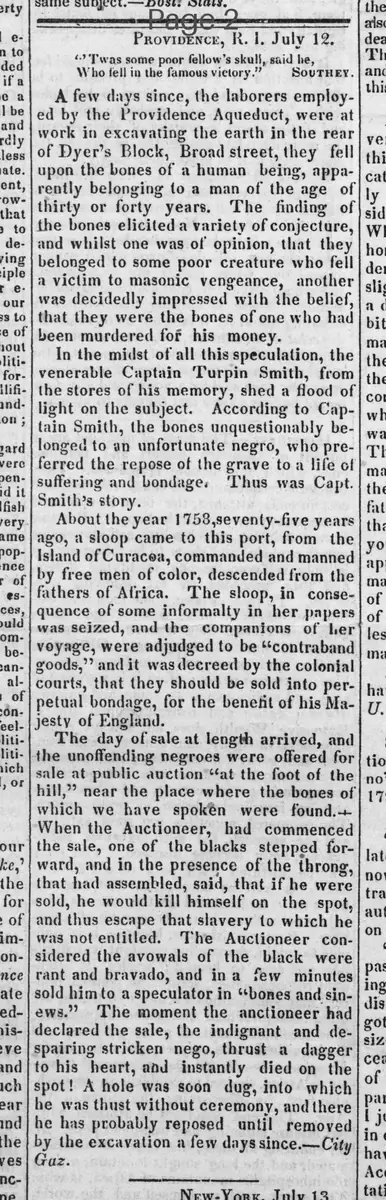
A few days since, the laborers employed by the Providence Aqueduct, were at work in excavating the earth in the rear of Dyer's Block, Broad street, they fell upon the bones of a human being, apparently belonging to a man of the age of thirty or forty years. The finding of the bones elicited a variety of conjecture, and whilst one was of opinion, that they belonged to some poor creature who fell a victim to masonic vengeance, another was decidedly impressed with the belief that they were the bones of one who had been murdered for his money.
In the midst of all this speculation, the venerable Captain Turpin Smith, from the stores of his memory, shed a flood of light on the subject. According to Captain Smith, the bones unquestionably belonged to an unfortunate negro, who preferred the repose of the grave to a life of suffering and bondage. Thus was Capt. Smith's story.
About the year 1758, seventy-five years ago, a sloop came to this port, from the Island of Curacoa, commanded and manned by free men of color, descended from the fathers of Africa. The sloop, in consequence of some informality in her papers was seized, and the companions of her voyage, were adjudged to be "contraband goods," and it was decreed by the colonial courts, that they should be sold into perpetual bondage, for the benefit of his Majesty of England.
The day of sale at length arrived, and the unoffending negroes were offered for sale at public auction "at the foot of the hill," near the place where the bones of which we have spoken were found.*
When the Auctioneer, had commenced the sale, one of the blacks stepped forward, and in the presence of the throng, that had assembled, said, that if he were sold, he would kill himself on the spot, and thus escape that slavery to which he was not entitled. The Auctioneer considered the avowals of the black were rant and bravado, and in a few minutes sold him to a speculator in "bones and sinews." The moment the auctioneer had declared the sale, the indignant and despairing stricken negro, thrust a dagger to his heart, and instantly died on the spot! A hole was soon dug, into which he was thrust without ceremony, and there he has probably reposed until removed by the excavation a few days since.—City Gaz.
"'Twas some poor fellow's skull, said he,
Who fell in the famous victory."
SOUTHEY.
A few days since, the laborers employed by the Providence Aqueduct, were at work in excavating the earth in the rear of Dyer's Block, Broad street, they fell upon the bones of a human being, apparently belonging to a man of the age of thirty or forty years. The finding of the bones elicited a variety of conjecture, and whilst one was of opinion, that they belonged to some poor creature who fell a victim to masonic vengeance, another was decidedly impressed with the belief that they were the bones of one who had been murdered for his money.
In the midst of all this speculation, the venerable Captain Turpin Smith, from the stores of his memory, shed a flood of light on the subject. According to Captain Smith, the bones unquestionably belonged to an unfortunate negro, who preferred the repose of the grave to a life of suffering and bondage. Thus was Capt. Smith's story.
About the year 1758, seventy-five years ago, a sloop came to this port, from the Island of Curacoa, commanded and manned by free men of color, descended from the fathers of Africa. The sloop, in consequence of some informality in her papers was seized, and the companions of her voyage, were adjudged to be "contraband goods," and it was decreed by the colonial courts, that they should be sold into perpetual bondage, for the benefit of his Majesty of England.
The day of sale at length arrived, and the unoffending negroes were offered for sale at public auction "at the foot of the hill," near the place where the bones of which we have spoken were found.*
When the Auctioneer, had commenced the sale, one of the blacks stepped forward, and in the presence of the throng, that had assembled, said, that if he were sold, he would kill himself on the spot, and thus escape that slavery to which he was not entitled. The Auctioneer considered the avowals of the black were rant and bravado, and in a few minutes sold him to a speculator in "bones and sinews." The moment the auctioneer had declared the sale, the indignant and despairing stricken negro, thrust a dagger to his heart, and instantly died on the spot! A hole was soon dug, into which he was thrust without ceremony, and there he has probably reposed until removed by the excavation a few days since.—City Gaz.
What sub-type of article is it?
Historical Event
Tragedy
Curiosity
What themes does it cover?
Tragedy
Misfortune
Bravery Heroism
What keywords are associated?
Bones Discovery
Slave Auction
Suicide
Providence Ri
Curacoa Sloop
1758
What entities or persons were involved?
Captain Turpin Smith
The Negro
Where did it happen?
Providence, R. I., Rear Of Dyer's Block, Broad Street; At The Foot Of The Hill
Story Details
Key Persons
Captain Turpin Smith
The Negro
Location
Providence, R. I., Rear Of Dyer's Block, Broad Street; At The Foot Of The Hill
Event Date
About The Year 1758
Story Details
A sloop from Curacoa manned by free men of color was seized in Providence due to paper issues, and the crew sold into slavery. During the 1758 auction, one negro threatened suicide if sold, then stabbed himself upon sale, was buried nearby, and his bones found in 1833.