Thank you for visiting SNEWPapers!
Sign up free
The Daily Cincinnati Republican, And Commercial Register
Cincinnati, Hamilton County, Ohio
What is this article about?
In October 1834, Cincinnati Democrats celebrated electoral wins in Pennsylvania, New Jersey, Ohio, and other states with 110-gun salute, elegant collation, music, speeches by Rep. Robert T. Lytle defending his resignation over bank policy, and 24 regular plus volunteer toasts praising Jackson, democracy, and anti-aristocracy. 300-400 attended orderly event.
Clipping
OCR Quality
Full Text
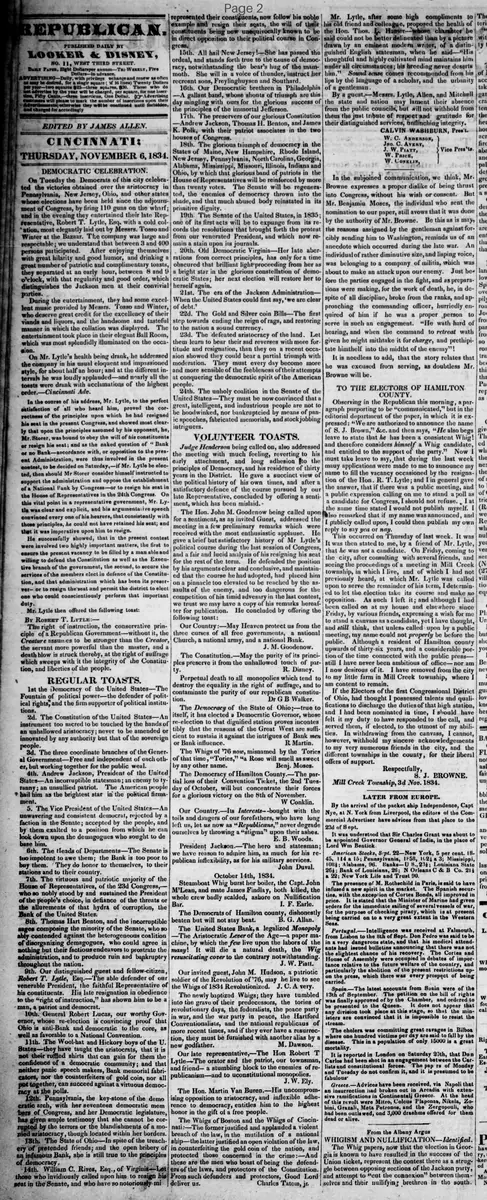
On Tuesday the Democrats of this city celebrated the victories obtained over the aristocracy in Pennsylvania, New Jersey, Ohio, and other states whose elections have been held since the adjournment of Congress, by firing 110 guns on the wharf; and in the evening they entertained their late Representative, Robert T. Lytle, Esq. with a cold collation, most elegantly laid out by Messrs. Tosso and Winter at the Bazaar. The company was large and respectable; we understand that between 3 and 400 persons participated. After enjoying themselves with great hilarity and good humor, and drinking a great number of patriotic and complimentary toasts, they separated at an early hour, between 8 and 9 o'clock, with that regularity and good order, which distinguishes the Jackson men at their convivial parties.
During the entertainment, they had some excellent music provided by Messrs. Tosso and Winter, who deserve great credit for the excellency of their viands and liquors, and the handsome and tasteful manner in which the collation was displayed. The entertainment took place in their elegant Ball Room, which was most splendidly illuminated on the occasion.
On Mr. Lytle's health being drank, he addressed the company in his usual eloquent and impassioned style, for about half an hour; and at the different intervals he was loudly applauded—and nearly all the toasts were drank with acclamations of the highest order.—Cincinnati Adv.
In the course of his address, Mr. Lytle, to the perfect satisfaction of all who heard him, proved the correctness of the principles upon which he had resigned his seat in the present Congress, and showed most clearly that upon the principles assumed by his opponent, he, Mr. Storer, was bound to obey the will of his constituents or resign his seat; and as the naked question of "Bank or no Bank—accordance with, or opposition to the present Administration, were thus involved in the present contest, to be decided on Saturday,—if Mr. Lytle be elected, then should Mr Storer consider himself instructed to support the administration and oppose the establishment of a National Bank by Congress—or to resign his seat in the House of Representatives in the 24th Congress. On this vital point in a representative government, Mr. Lytle was clear and explicit, and his argumentative speech convinced every one of his hearers, that consistently with those principles, he could not have retained his seat; and that it was imperative upon him to resign.
He successfully showed, that in the present contest were involved two highly important matters, the first to ensure the present vacancy to be filled by a man able and willing to defend the Constitution as well as the Executive branch of the government, the second, to secure the services of the members elect in defence of the Constitution, and that administration which has been its preserver- or to resign the seat and permit the district to elect one who could conscientiously perform that important duty.
Mr. Lytle then offered the following toast:
By ROBERT T. LYTLE:-
The right of instruction, the conservative principle of a Republican Government—without it, the Creature assumes to be stronger than the Creator, the servant more powerful than the master, and a death blow is struck thereby, at the right of suffrage which sweeps with it the integrity of the Constitution, and liberties of the people.
REGULAR TOASTS.
1st the Democracy of the United States—The Fountain of political power—the defender of political rights, and the firm supporter of political institutions.
2d. The Constitution of the United States—An instrument too sacred to be touched by the hands of an unhallowed aristocracy; never to be amended or innovated by any authority but that of the sovereign people.
3d. The three coordinate branches of the General Government—Free and independent of each other, but working together for the public weal.
4th. Andrew Jackson, President of the United States—An incorruptible statesman; an enemy to tyranny; an unsullied patriot. The American people hail him as the brightest star in the political firmament.
5. The Vice President of the United States—An unwavering and consistent democrat, rejected by a faction in the Senate; accepted by the people, and by them exalted to a position from which he can look down upon the demagogues who sought to debase him.
6th. The Heads of Departments—The Senate is too impotent to awe them; the Bank is too poor to buy them. They do honor to themselves, to their stations and to their country.
7th. The virtuous and patriotic majority of the House of Representatives, of the 23d Congress, who so nobly stood by and sustained the President of the people's choice, in defiance of the threats or the allurements of that hydra of corruption, the Bank of the United States.
8th. Thomas Hart Benton, and the incorruptible sages composing the minority of the Senate, who so ably contended against the heterogeneous coalition of disorganizing demagogues, who could agree in nothing but their factious endeavors to prostrate the administration, and to produce ruin and bankruptcy throughout the nation.
9th. Our distinguished guest and fellow-citizen Robert T. Lytle, Esq.—The able defender of our venerable President, the faithful Representative of his constituents. His late resignation in obedience to the "right of instruction," has shown him to be a man, a patriot and democrat.
10th. General Robert Lucas, our worthy Governor, whose re-election is convincing proof that Ohio is anti-Bank and democratic to the core, as well as favorable to a National Convention.
11th. The Wool-hat and Hickory boys of the U. States—they have taught the aristocrats, that it is not their ruffled shirts that can gain for them the confidence of a democratic community; and that neither panic speech makers, Bank memorial fabricators, nor the counterfeiters of gold coin, nor all put together, can succeed against a virtuous democracy at the polls.
12th. Pennsylvania, the key-stone of the democratic arch, with her seventeen democratic members of Congress, and her Democratic legislature, has given ample testimony that she cannot be corrupted by the terrors or the blandishments of a monied aristocracy, though located within her borders.
13th. The State of Ohio—In spite of the treachery of pretended friends; and the open bribery of an infamous Bank, she is still true to the principles of democracy
14th. William C. Rives, Esq., of Virginia—Let those who invidiously called upon him to resign his seat in the Senate, and who have so notoriously misrepresented their constituents, now follow his noble example and resign their seats, the will of their constituents being now unequivocally known to be in direct opposition to their political course in Congress.
15th. All hail New Jersey! She has passed the ordeal, and stands forth true to the cause of democracy, notwithstanding the bear's hug of the mammoth. She will in a voice of thunder, instruct her recrcant sons, Freylinghuysen and Southard.
16th. Our Democratic brethren in Philadelphia -A gallant band, whose shouts of triumph are this day mingling with ours for the glorious success of the principles of the immortal Jefferson.
17th. The preservers of our glorious Constitution -Andrew Jackson, Thomas H. Benton, and James K. Polk, with their patriot associates in the two houses of Congress.
18th. The glorious triumph of democracy in the States of Maine, New Hampshire, Rhode Island, New Jersey, Pennsylvania, North Carolina, Georgia, Alabama, Mississippi, Missouri, Illinois, Indiana and Ohio, by which that glorious band of patriots in the House of Representatives will be reinforced by more than twenty votes. The Senate will be regenerated, the enemies of democracy thrown into the shade, and that much abused body reinstated in its primitive dignity.
19th. The Senate of the United States, in 1835: one of its first acts will be to expunge from its records the resolutions that brought forth the protest from our venerated President, and which now remain a stain upon its journals.
20th. Old Democratic Virginia—Her late aberrations from correct principles, has only for a time obscured that brilliant light proceeding from her as a bright star in the glorious constellation of democratic States; her next election will restore her to herself again.
21st. The era of the Jackson Administration When the United States could first say, 'we are clear of debt.'
22d. The Gold and Silver coin Bills—The first step towards ending the reign of rags, and restoring to the nation a sound currency.
23d. The defeated aristocracy of the land. Let them learn to bear their sad reverses with more fortitude and resignation, than they on a recent occasion showed they could bear a partial triumph with moderation, They must every day become more and more sensible of the feebleness of their attempts at conquering the democratic spirit of the American people.
24th. The unholy coalition in the Senate of the United States—They must be now convinced that a great, intelligent, and industrious people are not to be hoodwinked, nor bankrupted by means of panic speeches, fabricated memorials, and stockjobbing intriguers.
VOLUNTEER TOASTS.
Judge Henderson being called on, also addressed the meeting with much feeling, reverting to his early attachment, and long adhesion to the principles of Democracy, and his residence of thirty years in the District. He gave a succinct view of the political history of his own times, and after a satisfactory defence of the course pursued by our late Representative, concluded by offering a sentiment, which has been mislaid.
The Hon. John M. Goodenow being called upon for a sentiment, as an invited Guest, addressed the meeting in a few preliminary remarks which were received with the most enthusiastic applause. He gave a brief but satisfactory history of Mr Lytle's political course during the last session of Congress, and a fair and lucid analysis of his resigning his seat for the rest of the term. He defended the position by his arguments clear and conclusive, and maintained that the course he had adopted, had placed him on a pinnacle too elevated to be reached by the assaults of the enemy, and too dangerous for the competition of his timid adversary in the last contest, we trust we may have a copy of his remarks hereafter for publication. He concluded by offering the following toast:
Our Country:—May Heaven protect us from the three curses of all free governments, a national Church, a national army, and a national Bank.
J. M. Goodenow.
The Constitution.—May the purity of its principles preserve it from the unhallowed touch of party.
R. Disney.
Perpetual death to all monopolies which tend to destroy the equality in the right of suffrage, and to contaminate the purity of our republican constitution.
Dr G B Walker.
The Democracy of the State of Ohio;—true to itself, it has elected a Democratic Governor, whose re-election to that dignified station proves incontestibly that the reasons of the Great West are sufficient to sustain it against the intrigues of Bank men or Bank influence.
R Martin.
The Whigs of '76 now, misnamed by the Tories of that time, "Tories," "a Rose will smell as sweet by any other name."
Benj. Moses.
The Democracy of Hamilton County.—The partial loss of their Convention Ticket, the 2nd Tuesday of October, will but concentrate their forces for a glorious victory on the 8th of November.
W Conklin.
Our Country.—Its Interests—bought with the toils and dangers of our forefathers, who have long left us, let us now as "Republicans," never degrade ourselves by throwing a "stigma" upon their ashes.
E. B. Woods.
President Jackson.—The hero and statesman; we have reason to admire him, as much for his republican inflexibility, as for his military services.
John Duval.
October 14th, 1834.
Steamboat Whig burst her boiler, the Capt. John M'Lean, and mate James Findlay, both killed, the whole crew badly scalded, ashore on Nullification Bar.
I. F. Earle.
The Democrats of Hamilton county, dishonestly beaten but will not stay beat.
B. G. Allan.
The United States Bank, a legalized Monopoly -The Aristocratic Leper of the Age—a paper machine, by which the few live upon the labors of the many! It will die a natural death, the Whig resuscitating cover to the contrary notwithstanding.
J. W. Piatt.
Our invited guest. John M. Hudson, a patriotic soldier of the Revolution of '76, may he live to see the Whigs of 1834 Revolutionized. J. C. Avery.
The newly baptized Whigs; they have tumbled into the grave of their predecessors, the tories of revolutionary days, the federalists, the peace party in war, and the war party in peace, the Hartford Conventionalists, and the national republicans of more recent times, and if they ever have a resurrection, they must be furnished with another alias by a new godfather.
M. Dawson.
Our late representative,—The Hon Robert T Lytle—The orator and the patriot, our townsman, and friend— a stumbling block to the enemies of republicanism—and to unconstitutional monopolies.
J. W. Ely.
The Hon. Martin Van Buren.—His uncompromising opposition to aristocracy, and inflexible adherence to democracy, entitles him to the highest honor in the gift of a free people.
The Whigs of Boston and the Whigs of Cincinnati: The former justified and applauded a violent breach of the law, in the mutilation of a national ship—the latter justified an open violation of the law. in counterfeiting the gold coin of the nation, and protected those concerned in the crime:—And these are the men who boast of being the defenders of the laws, and protectors of the Constitution. From such defenders and protectors, Good Lord deliver us.
Charles Tatem, jr.
Mr. Lytle, after some high compliments to his old friend and colleague. proposed the health of the Hon. Thos. L. Hamer—whose character he said could not be better delineated than by a picture drawn by an eminent modern writer. of a distinguished English statesman, when he said "His thoughtful and highly cultivated mind maintains him under all circumstances; his breeding never deserts him." Sound sense comes recommended from his lips by the language of a scholar, and the urbanity of a gentleman.
By a guest.—Messrs. Lytle, Allen, and Mitchell the state and nation may lament their absence from the public councils, but will not withhold from them the just tribute of respect and gratitude for their distinguished services, unflinching integrity.
CALVIN WASHBURN. Pres't.
W. C. Anderson,
Jno. C. Avery,
J. W. PIATT
Vice Pres'ts.
W. PRICE,
W. CONKLIN
What sub-type of article is it?
What themes does it cover?
What keywords are associated?
What entities or persons were involved?
Where did it happen?
Story Details
Key Persons
Location
Cincinnati
Event Date
Tuesday, October 1834
Story Details
Democrats in Cincinnati celebrate election victories in several states with cannon fire, a cold collation, music, speeches, and numerous patriotic toasts honoring President Jackson, the anti-bank stance, and Representative Robert T. Lytle, who resigned his congressional seat to obey constituents' instructions against supporting a national bank.