Thank you for visiting SNEWPapers!
Sign up free
Editorial
August 14, 1909
The Labor World
Duluth, Saint Louis County, Minnesota
What is this article about?
Editorial criticizes the 1909 tariff revision under President Taft as a 'confidence game' benefiting special interests, not the public. Praises dissenting Republican senators and condemns Taft, Cannon, and Aldrich for betraying campaign pledges. Published in The Star, San Francisco.
Clipping
OCR Quality
98%
Excellent
Full Text
BUNCOED ONCE MORE.
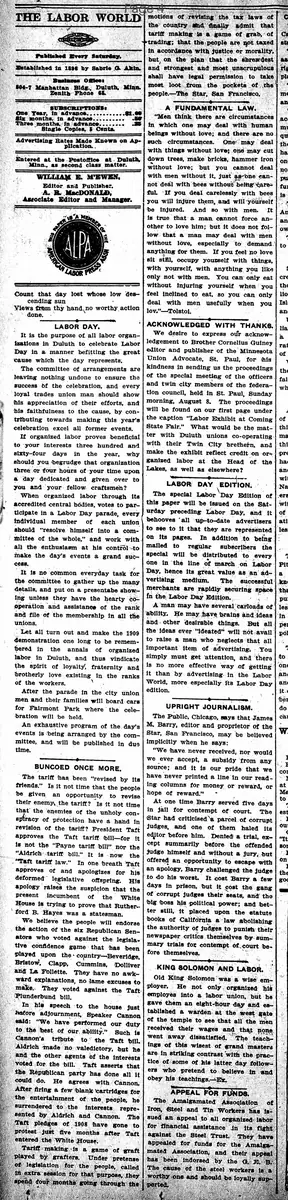
The tariff has been "revised by its friends." Is it not time that the people be given an opportunity to revise their enemy, the tariff? Is it not time that the enemies of the unholy conspiracy of protection have a hand in revision of the tariff? President Taft approves the Taft tariff bill--for it is not the "Payne tariff bill" nor the "Aldrich tariff bill." It is now the "Taft tariff law." In one breath Taft approves of and apologizes for his deformed legislative offspring. His apology raises the suspicion that the present incumbent of the white House is trying to prove that Rutherford B. Hayes was a statesman.
We believe the people will endorse the action of the six Republican Senators who voted against the legislative confidence game that has been played upon the country--Beveridge, Bristow, Clapp, Cummins, Dolliver and La Follette. They have no awkward explanations, no lame excuses to make. They voted against the Taft Plunderbund bill.
In his speech to the house just before adjournment, Speaker Cannon said: "We have performed our duty to the best of our ability." Such is Cannon's tribute to the Taft bill. Aldrich made no valedictory, but he and the other agents of the interests voted for the bill. Taft asserts that the Republican party has done all it could do. He agrees with Cannon.
After firing a few blank cartridges for the entertainment of the people, he surrendered to the interests represented by Aldrich and Cannon. The Taft pledges of 1908 have gone to protest just five months after Taft entered the White House.
Tariff making is a game of graft played by grafters. Under pretense of legislation for the people, called in extra session for that purpose, they spend four months going through the motions of revising the tax laws of the country and finally admit that tariff making is a game of grab, of trading; that the people are not taxed in accordance with justice or morality, but, on the plan that the shrewdest and strongest and most unscrupulous shall have legal permission to take most loot from the pockets of the people.--The Star, San Francisco.
The tariff has been "revised by its friends." Is it not time that the people be given an opportunity to revise their enemy, the tariff? Is it not time that the enemies of the unholy conspiracy of protection have a hand in revision of the tariff? President Taft approves the Taft tariff bill--for it is not the "Payne tariff bill" nor the "Aldrich tariff bill." It is now the "Taft tariff law." In one breath Taft approves of and apologizes for his deformed legislative offspring. His apology raises the suspicion that the present incumbent of the white House is trying to prove that Rutherford B. Hayes was a statesman.
We believe the people will endorse the action of the six Republican Senators who voted against the legislative confidence game that has been played upon the country--Beveridge, Bristow, Clapp, Cummins, Dolliver and La Follette. They have no awkward explanations, no lame excuses to make. They voted against the Taft Plunderbund bill.
In his speech to the house just before adjournment, Speaker Cannon said: "We have performed our duty to the best of our ability." Such is Cannon's tribute to the Taft bill. Aldrich made no valedictory, but he and the other agents of the interests voted for the bill. Taft asserts that the Republican party has done all it could do. He agrees with Cannon.
After firing a few blank cartridges for the entertainment of the people, he surrendered to the interests represented by Aldrich and Cannon. The Taft pledges of 1908 have gone to protest just five months after Taft entered the White House.
Tariff making is a game of graft played by grafters. Under pretense of legislation for the people, called in extra session for that purpose, they spend four months going through the motions of revising the tax laws of the country and finally admit that tariff making is a game of grab, of trading; that the people are not taxed in accordance with justice or morality, but, on the plan that the shrewdest and strongest and most unscrupulous shall have legal permission to take most loot from the pockets of the people.--The Star, San Francisco.
What sub-type of article is it?
Economic Policy
Partisan Politics
Taxation
What keywords are associated?
Tariff Revision
Taft Bill
Protectionism
Republican Betrayal
Special Interests
Graft
Tax Laws
What entities or persons were involved?
President Taft
Beveridge
Bristow
Clapp
Cummins
Dolliver
La Follette
Speaker Cannon
Aldrich
Republican Party
The Star, San Francisco
Editorial Details
Primary Topic
Criticism Of The Taft Tariff Bill
Stance / Tone
Strongly Anti Protectionist And Critical Of Republican Leadership
Key Figures
President Taft
Beveridge
Bristow
Clapp
Cummins
Dolliver
La Follette
Speaker Cannon
Aldrich
Republican Party
The Star, San Francisco
Key Arguments
Tariff Revised By Its Friends To Benefit Special Interests
Taft Approves And Apologizes For The Flawed Bill
Dissenting Senators Voted Against The 'Confidence Game'
Cannon And Aldrich Supported The Bill Despite Public Pretense
Taft's 1908 Pledges Betrayed Shortly After Inauguration
Tariff Making Is A Graft Game Favoring The Unscrupulous